
Table of Contents
- The myth: "maintenance-free" means you never touch them
- Humidipak replacement: how long a set really lasts
- The squeeze test: soft means working, dried out means doing nothing
- What a humidity sensor tells you that your hand can't
- Your guitar will tell you too: fret ends, a sinking top, a lifting bridge
- How to swap a Humidipak replacement set
- "My old guitar never had a humidifier"
- Mandolins, Dobros and gig bags
- Who should change their packs today
Austin, our general manager, toured for years with a 2005 Alvarez and a sponge humidifier in the soundhole. He set a weekly reminder to refill it and figures he missed it about 75% of the time, and that guitar now carries the cracks, a lifting bridge and a loose brace to prove it. Two-way packs like the D'Addario Humidipak exist so nobody has to remember a weekly refill. But they still run out, and nothing on the case tells you when. This is our take on Humidipak replacement: how long a set really lasts, the ten-second test that tells you it's spent, and what the guitar itself shows you when you've waited too long.
The myth: "maintenance-free" means you never touch them
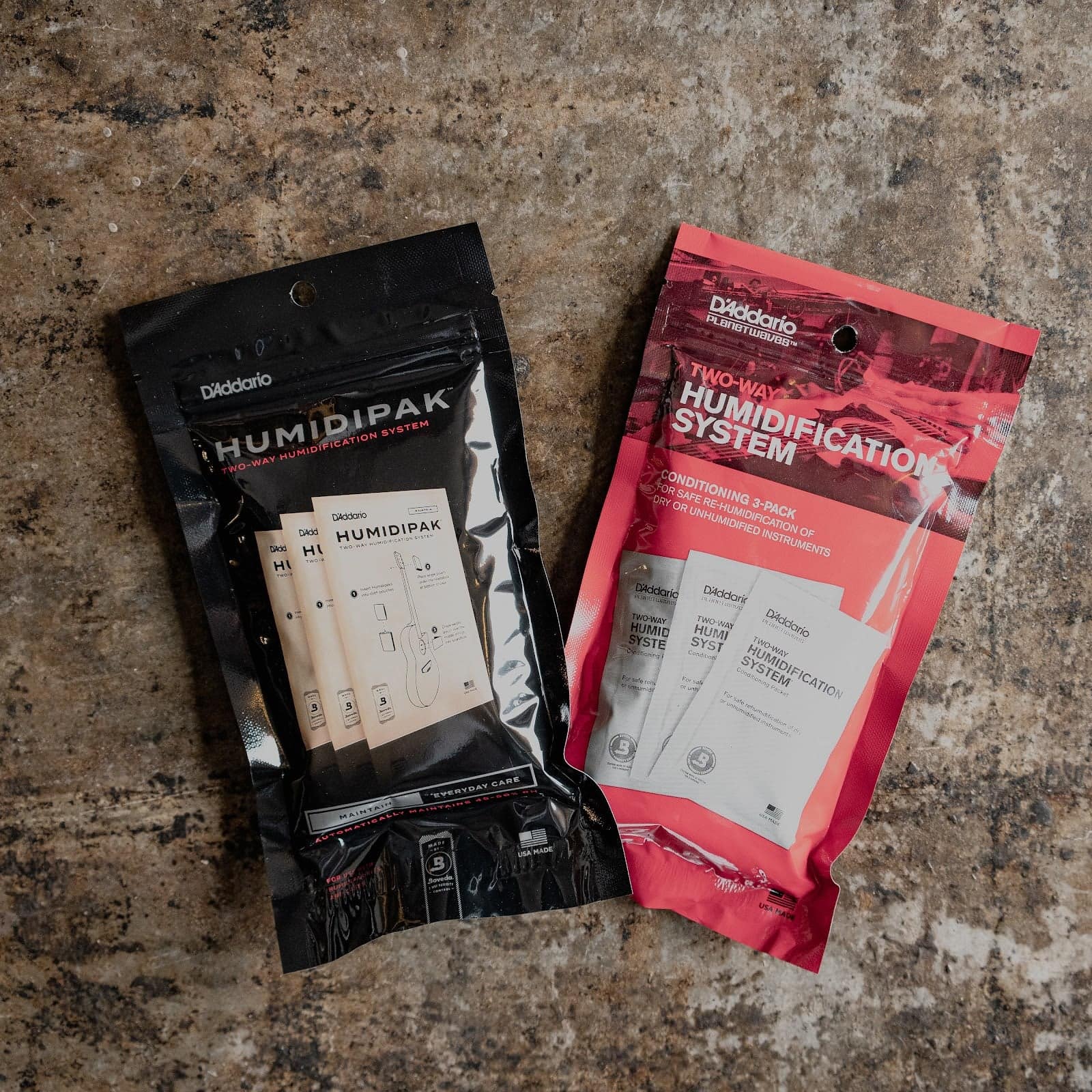
The packets earned that label honestly. There's no sponge to soak, no distilled water and no drip on your top. You put them in the case, close the lid, and they give off moisture when the air is dry and take it back when it's damp, holding the case at 45 to 50% relative humidity. That's the range we keep the shop at, and it's the range we'd want your guitar living in all year.
What "maintenance-free" doesn't mean is permanent. Each packet holds a set amount of water, and it spends that water doing its job. Once it's gone, the packet is still sitting in your soundhole looking official while it does nothing at all. Every winter we open cases for customers who keep a humidifier in there, and the guitar inside is dry anyway, because nobody checked it.
For the record, we'd still pick the packs over a sponge for almost everybody. John's line on it is simple: "I don't care what kind of humidifier you're using, just get one." But if you're going to rely on two-way packs, you need a Humidipak replacement habit to go with them.
Humidipak replacement: how long a set really lasts
John's rule of thumb has been the same since our 2018 Shoppe Talk on humidity: a set usually holds enough for two to three months, so plan on replacing it about every three months.
"Treat it like an oil change in your car, and just plan on every three months replacing these." (John)The real number depends on how hard the packs have to work, and we've seen a wide spread across the shop:
| Where the guitar lives | Humidipak replacement interval we've seen |
|---|---|
| Hard case, average house | About 3 to 4 months, sometimes less |
| Tight flight case (Calton) | Close to a full year |
| Gig bag | Noticeably sooner; the bag can't hold the moisture in |
| Dobro or other no-soundhole instrument | Works, but expect to replace far more often |
| Boveda 4-pack set (49%) | 3 to 4 months, maybe 5, since it carries more water |
That last row is worth a word. Humidipak is D'Addario's name for a two-way pack that Boveda builds, so the chemistry is the same. A guitar set of Boveda 49% packs uses four packets with a little more water in each, while the Humidipak set uses three. Both hold the same humidity; the Boveda set simply has more water to spend, so it tends to go longer between swaps.
Two things shorten the clock. A dry house in furnace season pulls harder on the packs, and so does starting them on a guitar that's already dry. D'Addario says Maintain packets on a dry instrument will burn out much faster, and that's why the Humidipak Restore Kit exists: it brings a dried-out guitar and case back up first, then the Maintain packets take over.
The squeeze test: soft means working, dried out means doing nothing
You don't need a gauge to know whether a pack is still alive. Pull it out and squeeze it. A fresh one is soft and squishy, like a gel pack. A spent one has dried out, and you'll feel the difference the second you hold the two side by side. That feel is the whole Humidipak replacement signal.
"You don't want these to get this dry, because it's doing absolutely nothing for your guitar."Once the packs hit that point, the case is drifting toward whatever the room is, and in a heated house in January that's a long way below 45%. That's where you get into what we call dangerous territory:
- a top that bellies up behind the bridge or sinks near the soundhole
- a neck that moves and needs a truss rod adjustment to play right
- crazing in a nitro finish, the fine cracks that show up after a quick temperature change
- cracks in the top, sides or fretboard, and binding that starts to separate
The fix is the same for everybody: fresh packs in the soundhole pouch, back in the case before the next cold snap turns the heat up full blast. We trust the feel test because we've checked it. While the packs are still soft, they hold the case within a point or two of their range.
What a humidity sensor tells you that your hand can't
If you use two-way packs and squeeze them on schedule, you don't strictly need a sensor. We've said that even though it costs us a sale or two. But a lot of players want proof, and John checks his own guitar on his phone all the time.
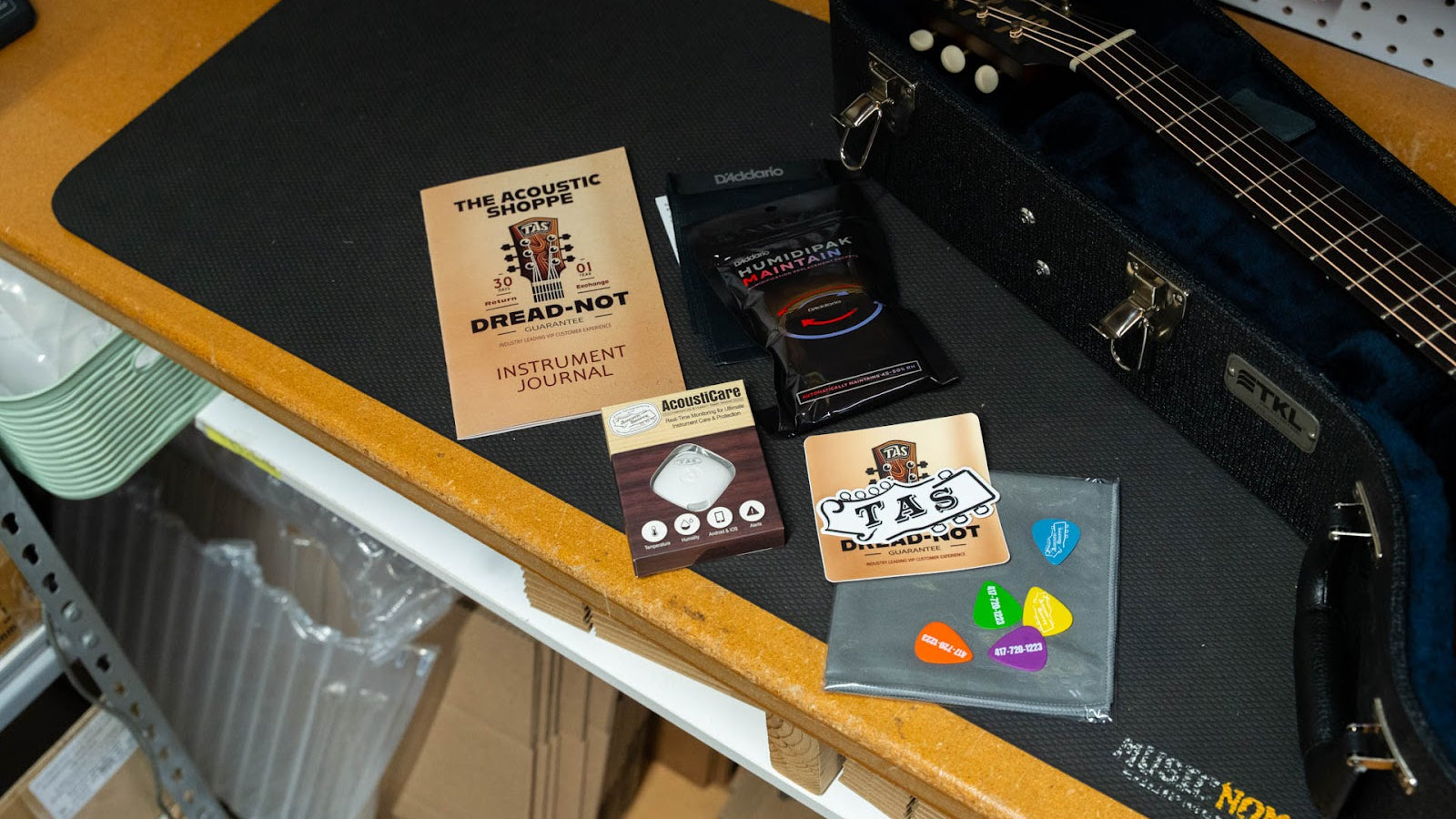
The AcoustiCare Bluetooth Humidity and Temperature Tracker sits in the case and reports humidity and temperature to the SensorPro app in real time, with a history graph and alerts you set yourself. That turns Humidipak replacement from a calendar guess into a reading. Because healthy packs hold the case so close to 45 to 50%, a reading that slides below the mid-40s and stays there is the sign the packs are losing the fight, well before the guitar is in trouble. Set your low alert there. Below 35% is where we start seeing real damage.
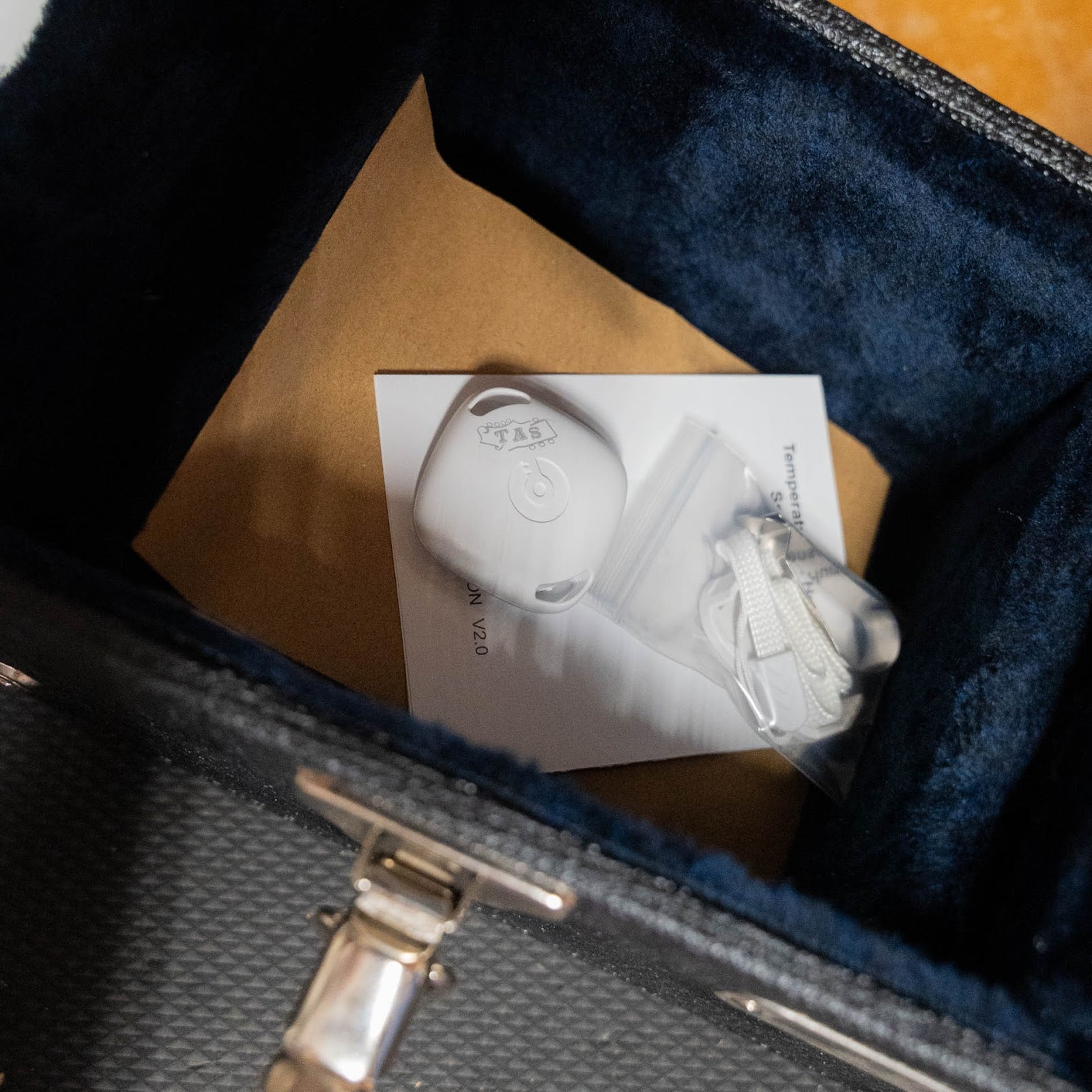
If your guitar came with a sensor in the box, the setup steps and app links are on our Dread-Not welcome page.
Your guitar will tell you too: fret ends, a sinking top, a lifting bridge
Run your hand along the edge of the fretboard. If the fret ends feel sharp where they used to be smooth, the wood has shrunk and the metal frets haven't. When frets are dressed, they sit just inside the edge of the board. As the fretboard dries and pulls in from both sides, the ends start to stick out. It's one of the best early checks there is, and if you're only just starting to feel them, humidifying the guitar back up can bring the board back to where it belongs.
The other signs are a top sinking around the soundhole, the back edge of the bridge starting to lift, and action that suddenly plays worse. Those are the same spots our techs check before a guitar ships, as part of the 23-Point Professional Inspection: bridge flush to the top, neck flush, fret ends smooth, finish clean. If you find one of them on yours, the Humidipak replacement is overdue, and it's worth a call to us before you change anything else.
How to swap a Humidipak replacement set
- Squeeze the packets you have. Soft means leave them. Dried out means replace them.
- If the guitar has been sitting dry, start with the Restore Kit before going back to Maintain packets.
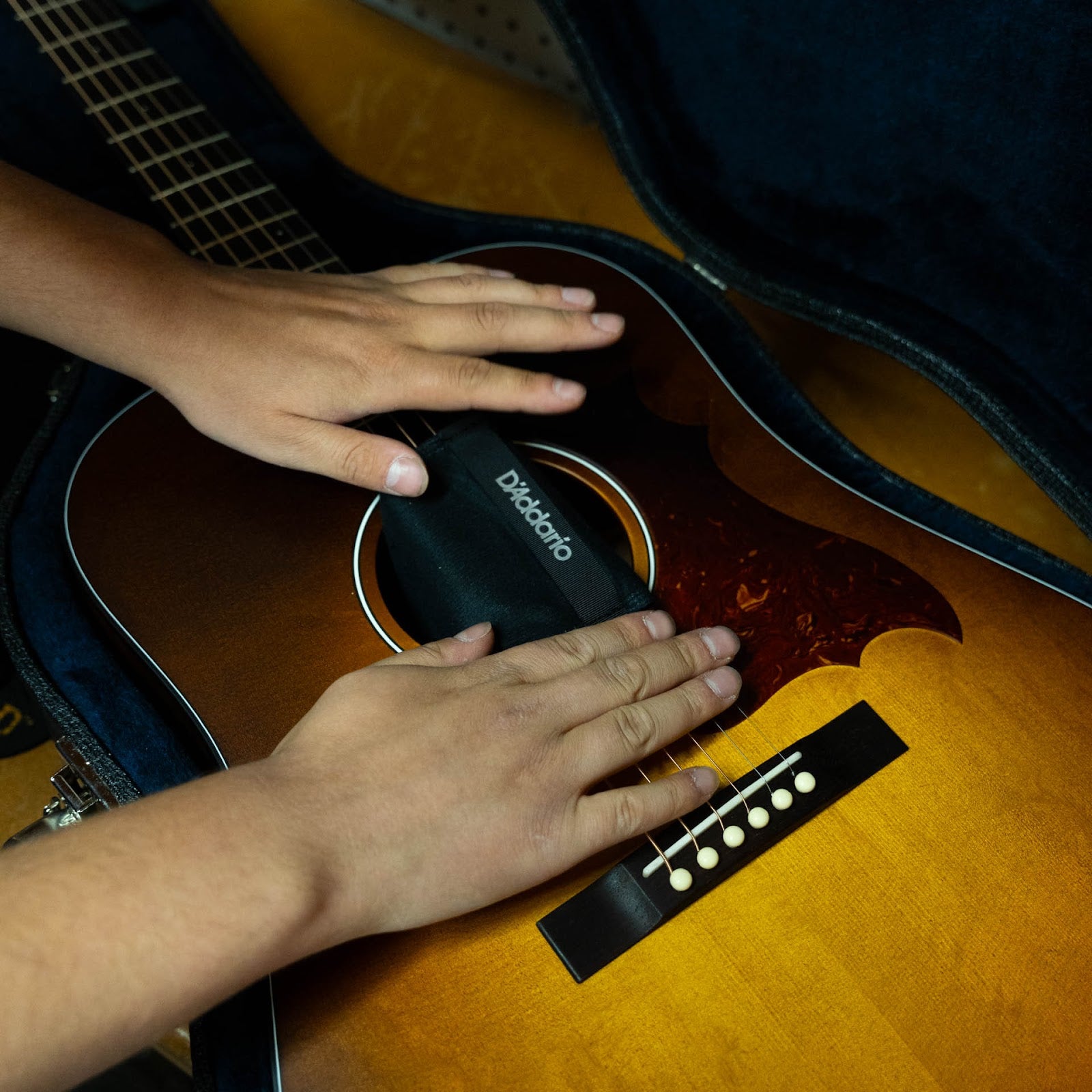
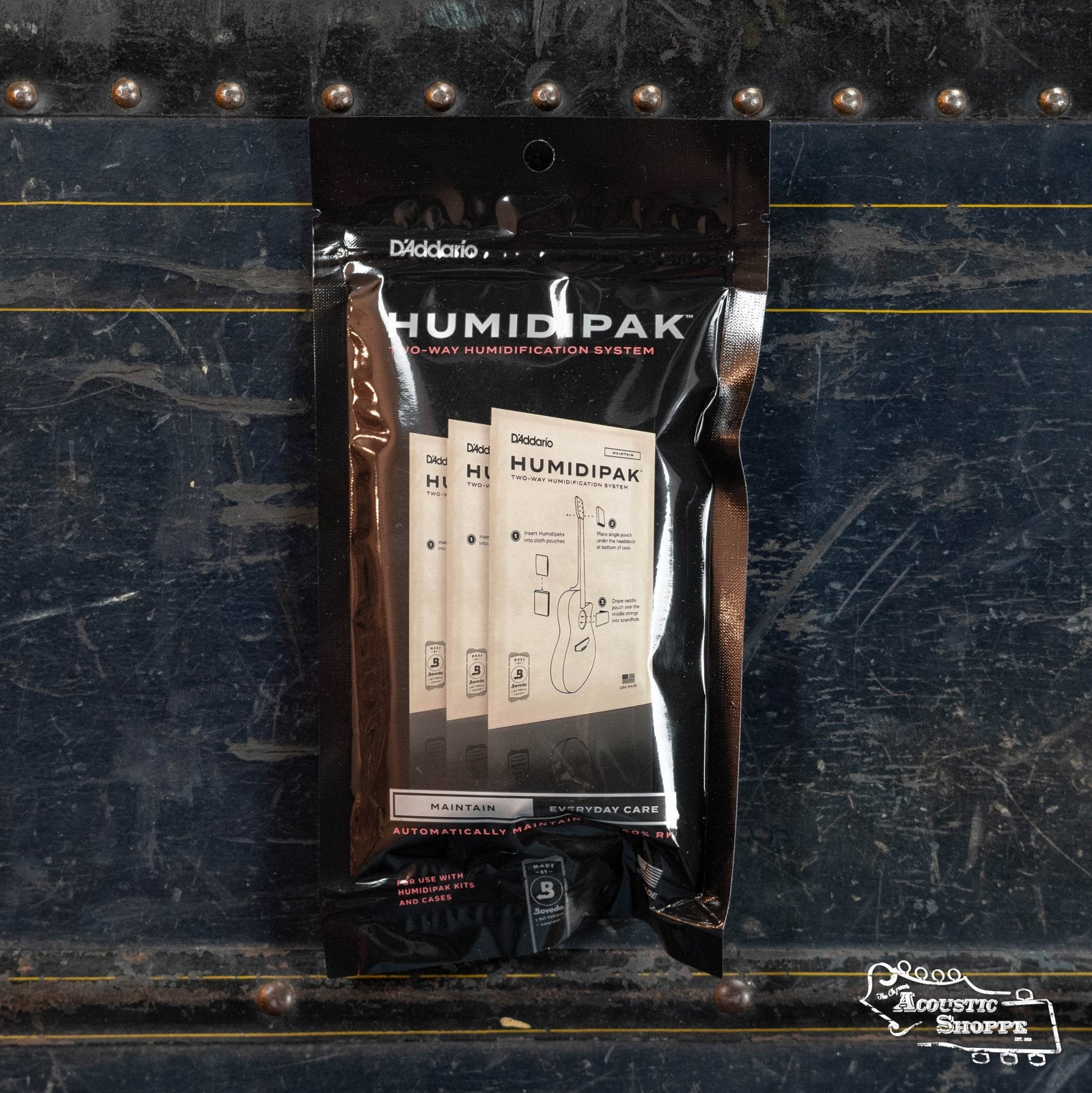
- Put two packets in the saddle-bag pouch that hangs over the strings at the soundhole, and one in the pouch up by the headstock.
- Close the case whenever the guitar is out of it, so the packs aren't trying to humidify the whole room.
- Put the next check on your calendar, or set the low alert on your sensor.
Refills come as D'Addario Humidipak 3-Pack Replacement Packets, one set per guitar. If you're starting from scratch, the Humidipak Starter Kit includes the pouches. If your case runs damp instead of dry, the Humidipak Absorb Kit is the one built to pull it back down.
"My old guitar never had a humidifier"
We hear it every winter, usually about a grandfather's Martin from the 1950s. The honest answer is that some old guitars made it and plenty didn't. Builders made them a lot heavier back then, and the survivors are the ones you see. We had an 1896 Martin come through the shop with three repaired top cracks and a bridge that was missing entirely when it came in, which is what an unhumidified century looks like.
It also matters for your warranty. Martin, Taylor, Eastman, Gibson and Yamaha all ask whether a guitar has been properly humidified when a repair comes in, and fret ends sticking way out plus a top full of cracks is hard to argue with. A Humidipak replacement every few months is a lot cheaper than shipping a guitar back to the factory.
Mandolins, Dobros and gig bags
On a mandolin, a packet up by the headstock works fine, and Boveda's directional humidity control straps over the strings to put more moisture near the body. A Dobro with no soundhole can run on two packs in the case, but you'll replace them more often. In a gig bag the packs still work; they just run out sooner because the bag can't seal the moisture in. If the bag is thin, a room humidifier is the better tool.
For the full picture on target humidity and why wood moves, start with our Humidity 101 guide to instrument humidification.
Related reading
- Winter guitar care: protecting a guitar from cold, dry air
- Hard case or gig bag: which one your instrument needs
- Our acoustic guitar care guide: cleaning, strings and storage
Who should change their packs today
If your packs have been in the case since the leaves turned, squeeze them tonight. If you can't remember when you put them in, replace them. If you play out of a gig bag, check twice as often as you think you need to. And if you'd rather see a number than trust your hand, put a sensor in the case and let your phone tell you when the Humidipak replacement is due.
Every instrument of $1,000 or more from us ships with a Humidipak set and an AcoustiCare sensor already in the case as part of the Dread-Not Guarantee, which also gives you a 1-year trade-in credit of up to 90% of the pre-tax price, less round-trip shipping, toward anything else in the shop. If you're shopping for your next one, start with the acoustic guitars on our wall. To keep the one you've got healthy, everything we use and recommend is in our humidifiers and care products collection.
Acoustic Shoppe FAQ
How long does a D'Addario Humidipak last?
John's rule of thumb is two to three months, so plan on a fresh set about every three months, like an oil change. In a hard case in an average house we usually see three to four months, sometimes less. A tight flight case can stretch a set close to a year, and a gig bag runs through them noticeably faster.
How can I tell if my Humidipak packets are dried out?
Squeeze them. A working packet is soft and squishy. A spent one has dried out and is doing nothing for your guitar, and you'll feel the difference right away if you hold a fresh one next to it. If you use an AcoustiCare sensor, a case reading that slides below the mid-40s and stays there is your other signal.
Do Boveda packs last longer than Humidipaks?
Usually, yes. Humidipak is D'Addario's name for a two-way pack Boveda builds, and both hold the case at the same humidity. A guitar set of Boveda 49% packs uses four packets with more water in each, so we see three to four months and sometimes five, where a three-packet Humidipak set runs two to three, maybe four.
Do Humidipaks work in a gig bag?
They do, but they run out sooner, because a gig bag can't hold the moisture in the way a hard case does. Check them more often. If the bag is thin and the guitar lives in it full time, a room humidifier is the better tool.
Do I need a humidity sensor if I use Humidipaks?
Not strictly. Healthy packs hold a case within a point or two of 45 to 50%, so the squeeze test on a schedule works. A sensor gives you the proof: it reports humidity and temperature to your phone and alerts you when the case drops. Every instrument of $1,000 or more from us ships with both as part of the Dread-Not Guarantee, along with a 1-year trade-in credit of up to 90%.