

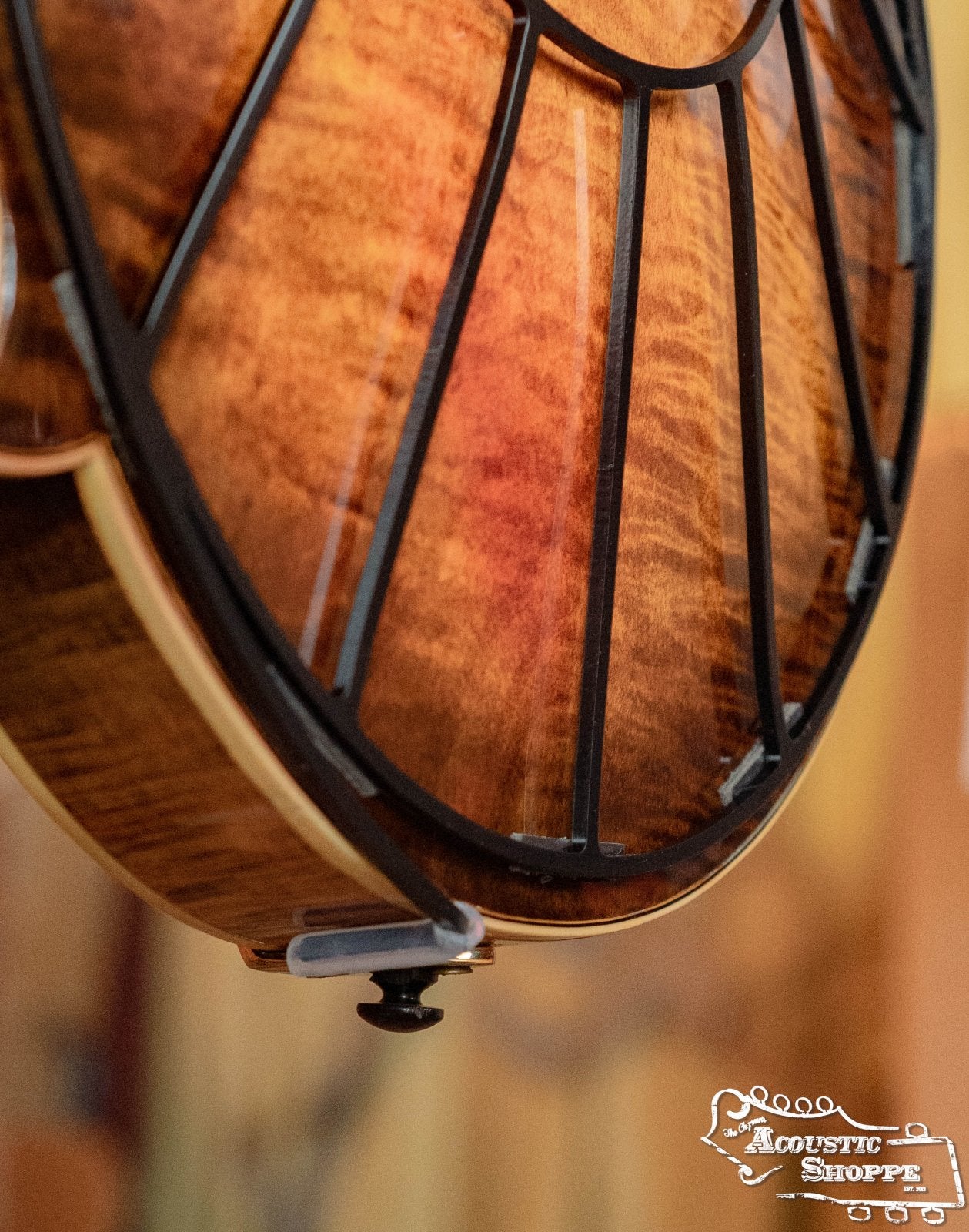
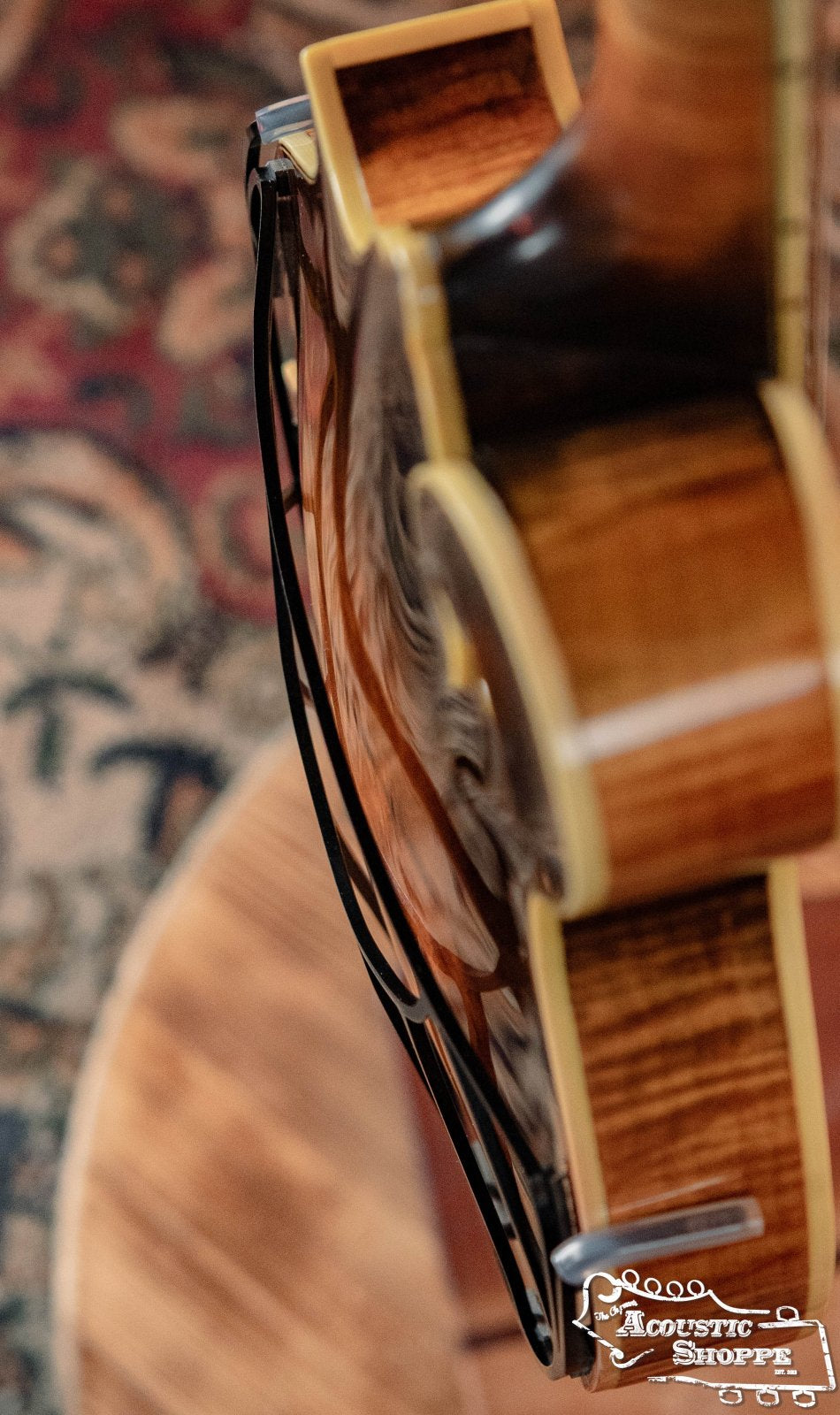
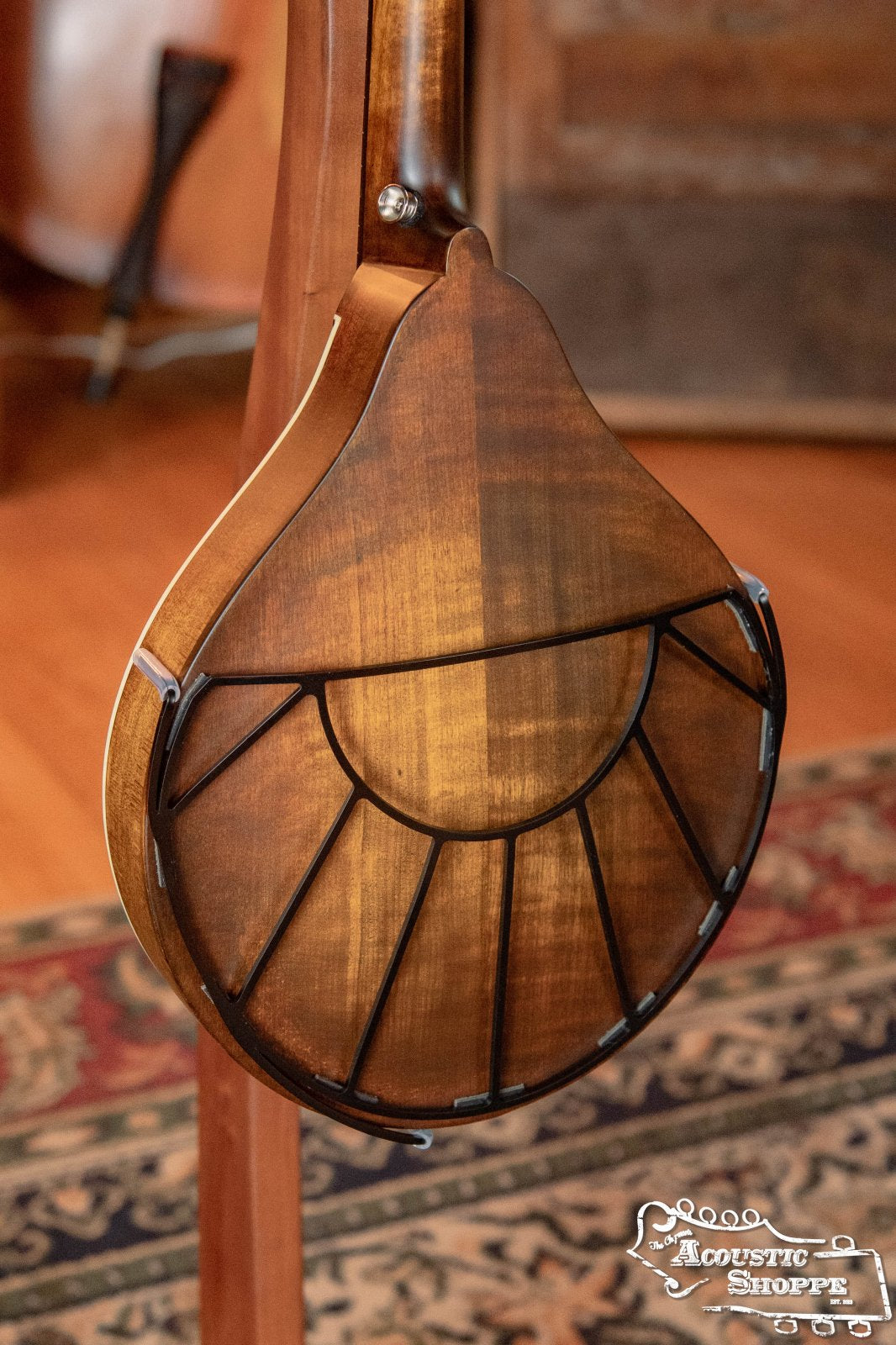
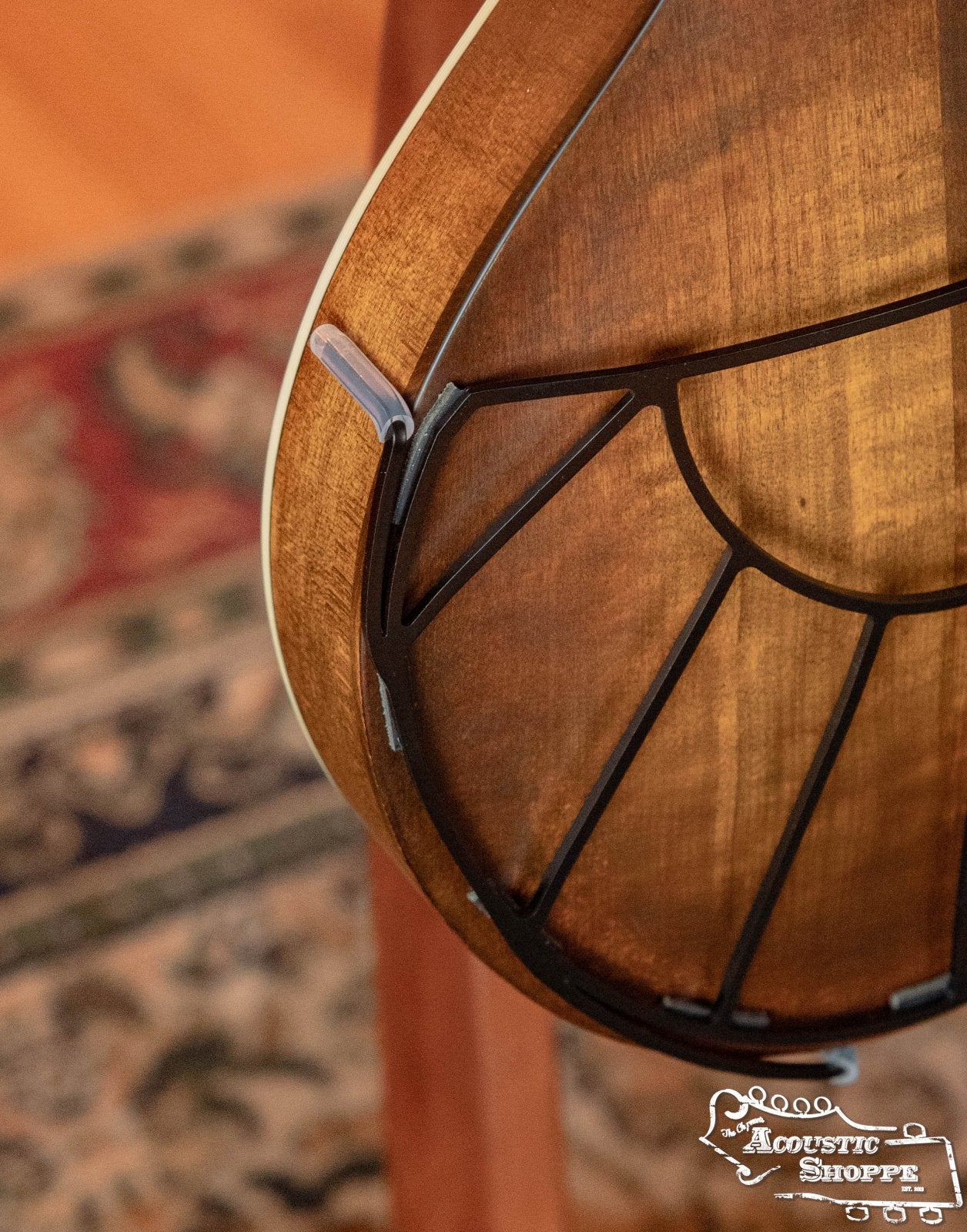
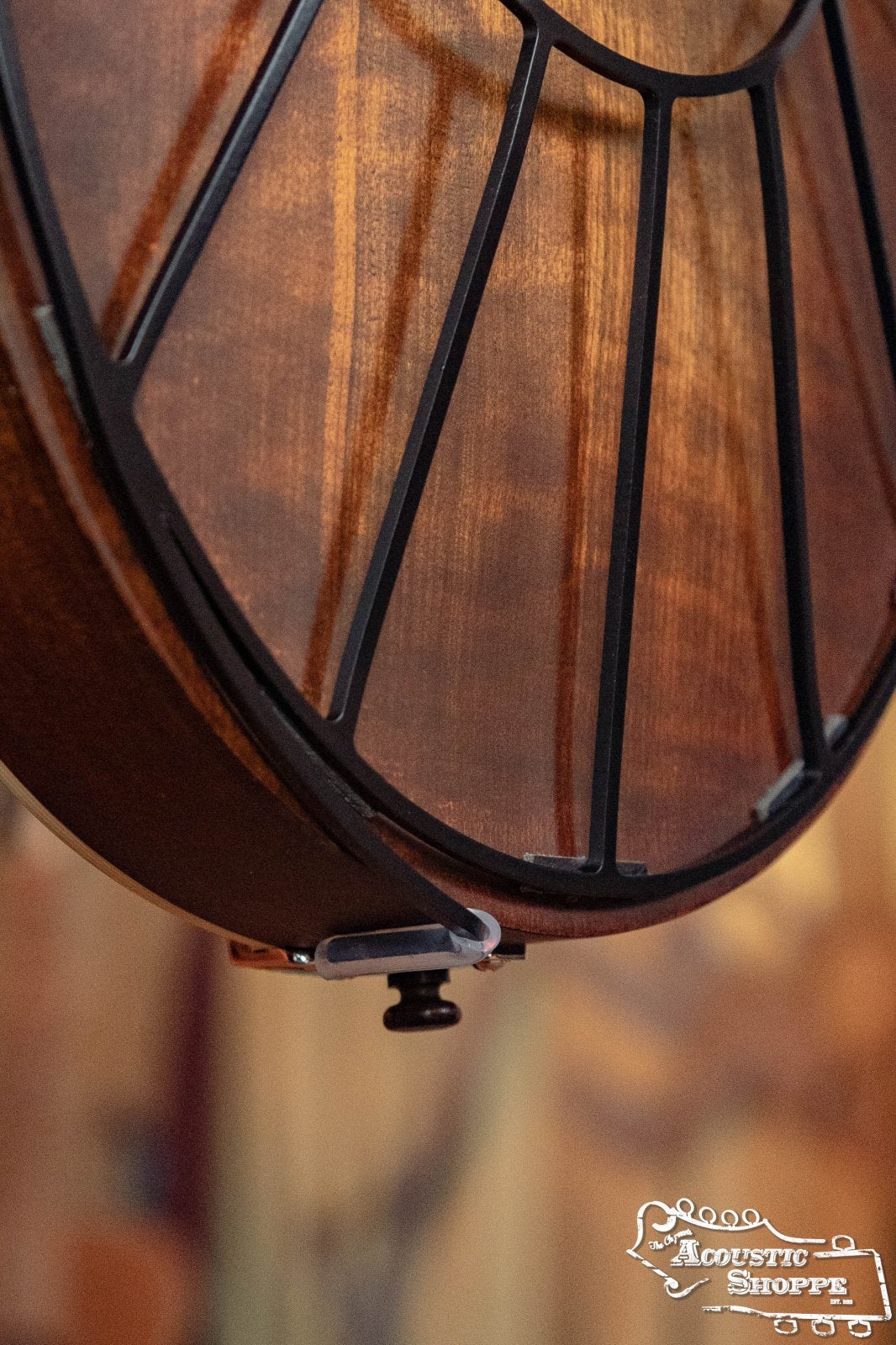
Tone-Gard Mandolin - Sunrise
%20from%20the%20player's%20body,%20producing%20more%20volume%20and%20enhancing%20the%20tone.%0AWhich%20Tone-Gard%20fits%20my%20mandolin?%0AFit%20...
)
FAST SHIPPING!
Most items usually ship within 24 hours. Exceptions will be noted below.
Questions about this instrument?
Every one of us plays. Virtual demos available on request.
Description
Which Tone-Gard fits my mandolin?
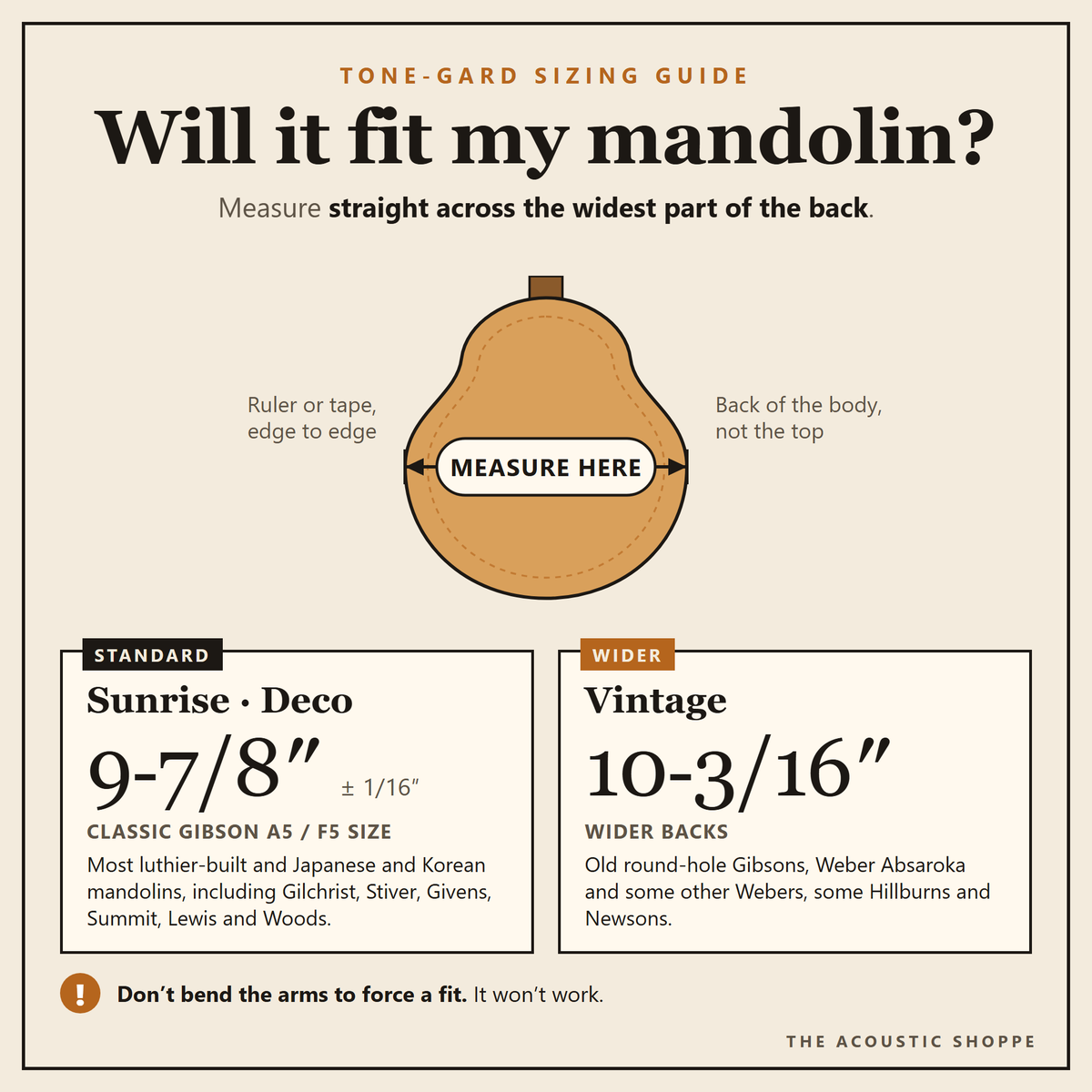
Fit comes down to one number: how wide your mandolin is straight across the back, measured at the widest point. Lay a ruler or tape from edge to edge across the back in a straight line, without following the curve, and match the number to the sizes below. This page is the Sunrise.
- About 9-7/8" across the back (plus or minus 1/16"): choose the Sunrise or the Deco. These fit mandolins built on the classic Gibson carved-back A5 and F5 body, which includes most luthier designs such as Gilchrist, Stiver, Givens, Summit, Lewis and Woods, and the Japanese and Korean mandolins. They also fit the standard Eastman MD305, MD314 and MD315.
- About 10-3/16" across the back: choose the Vintage. These fit old round-hole Gibsons, Weber Absarokas and some other Webers (including some F models), and some Hillburns and Newsons.
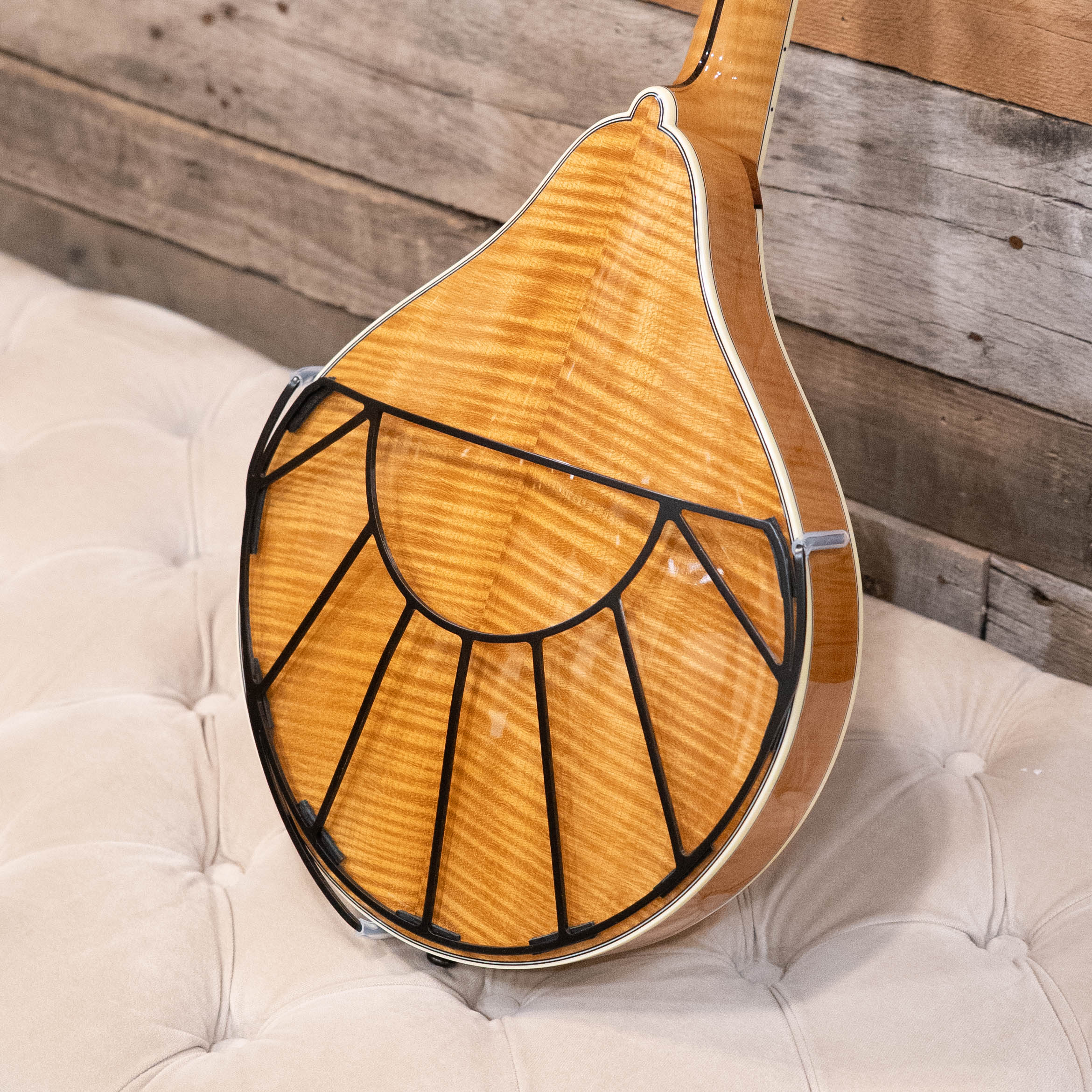
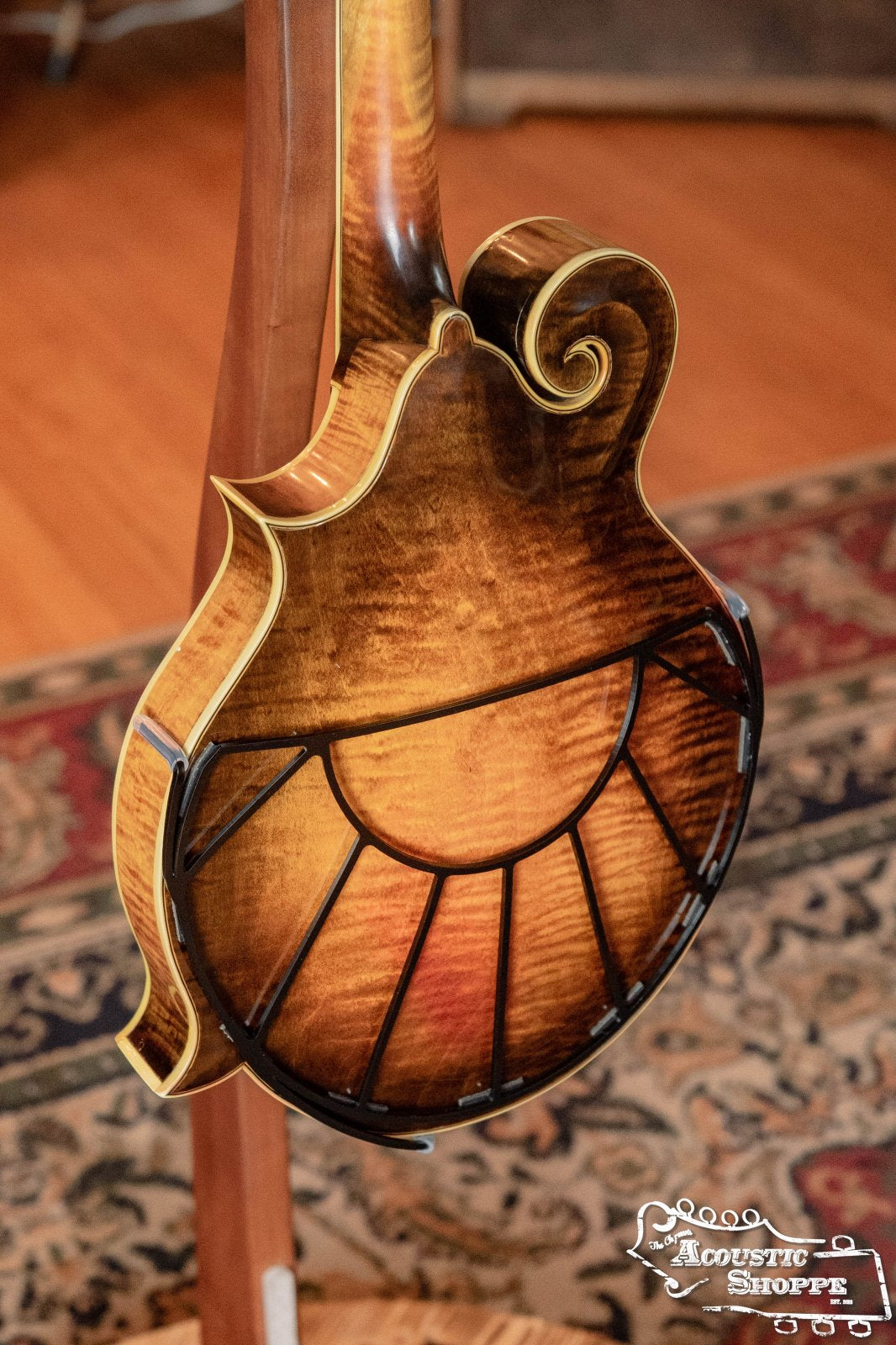
The Sunrise (7-ray pattern) and the Deco are the same size, so choose the one you like the look of, while the Vintage (6-ray pattern) is for the wider backs. If your mandolin is a Vintage size, please order the Vintage, because the arms of a Sunrise or Deco will not bend out far enough to force a fit.
If your measurement lands between the two sizes, measure again at the widest point of the back before you order.
You can test the concept right now without a Gard. Play your instrument normally, while facing a wall about a foot or two away, allowing the sound to bounce back directly so you can hear how your instrument projects. After you are used to the sound, hold the mandolin by the neck so that the back of the instrument is a couple of inches away from your body. Now try playing some chop chords. Go back and forth, against and away from your body, and you will notice a difference. You will hear a difference just hitting one chop and letting it ring while holding against you, then away. (If you don't hear the difference, it's time to visit an audiologist — no kidding.)
An extra benefit is protecting the back of your instrument from wear, dings, and scratches. You can and should leave the Gard on the instrument all the time, not take it on and off. It fits in almost all cases.
Preëminent mandolinists — such as David Grisman, Mike Marshall, Chris Thile, Ricky Skaggs, Andy Statman, John Reischman, Chris Hillman, Roland White, and many others — use and recommend the Tone-Gard™ to get the best possible sound. A Gard improves anything from starter instruments to Loars.
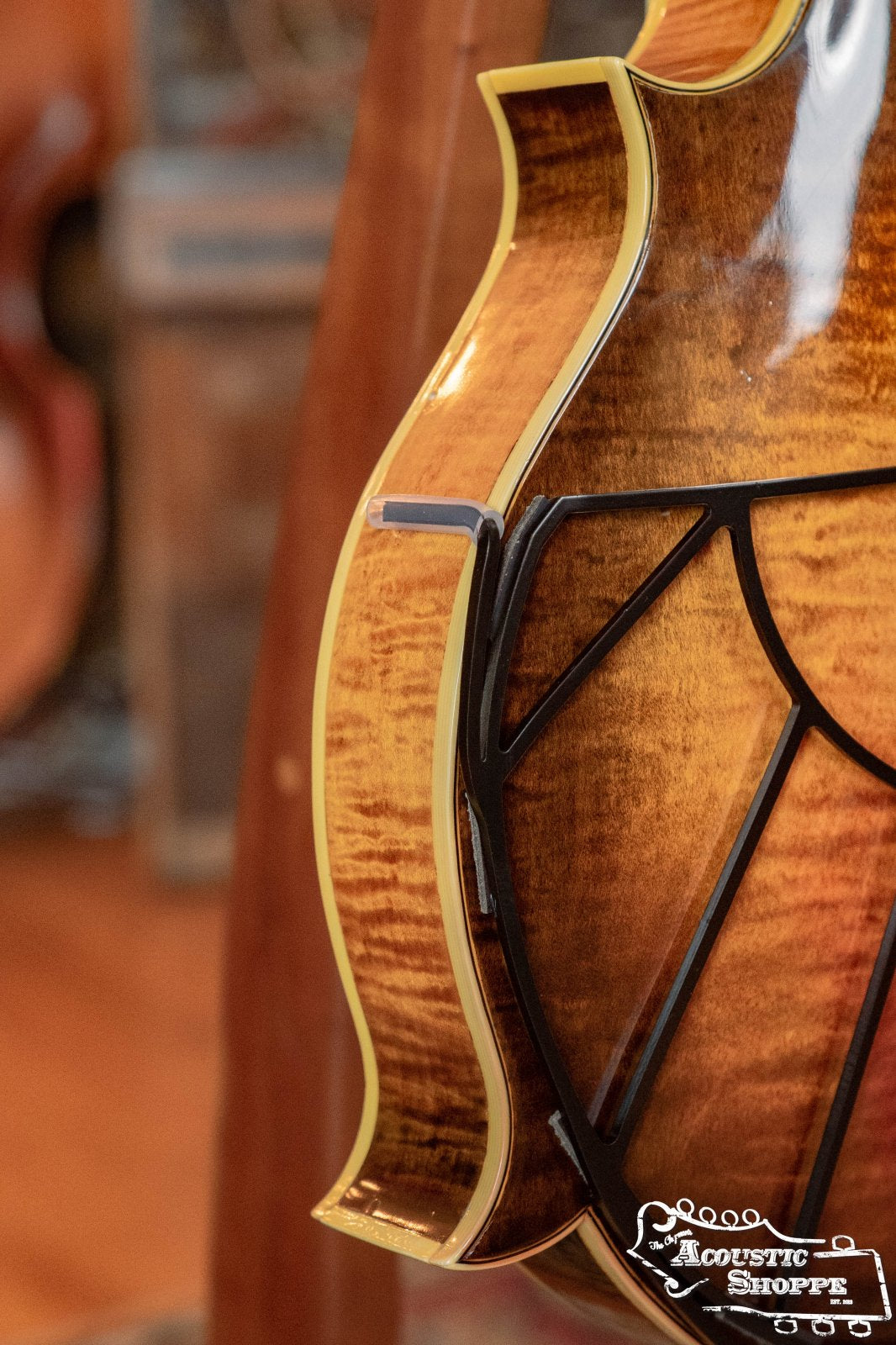
Standard Gards are now made of laser-cut steel with a ceramic powder-coat. They have more pads, which are directly glued on to prevent loss. Vintage, Rigel, and custom Gards are hand-made from mild steel, sprayed with a durable high-gloss paint, and have older-style pads. All surfaces that come in contact with the instrument have rubber and leather pads where needed to protect the instrument’s finish. The only maintenance is occasionally to apply a little instrument wax or Pledge™ or similar product on the rubber-pads to protect from deterioration. The rubber pads can also be easily replaced if necessary.
VintageGards (6-ray design) are for mandolins that are 10-3/16" across the back, such as old round-hole Gibsons, Weber Absarokas, some of the other Webers (including some F models) some Hillburns, Newsons, etc. If you have one of these instruments, please get the Vintage, and don’t try to bend out the arms of a Sunrise or Deco to force a fit. It won't work.
Tone-Gard questions we get all the time
What is a Tone-Gard?
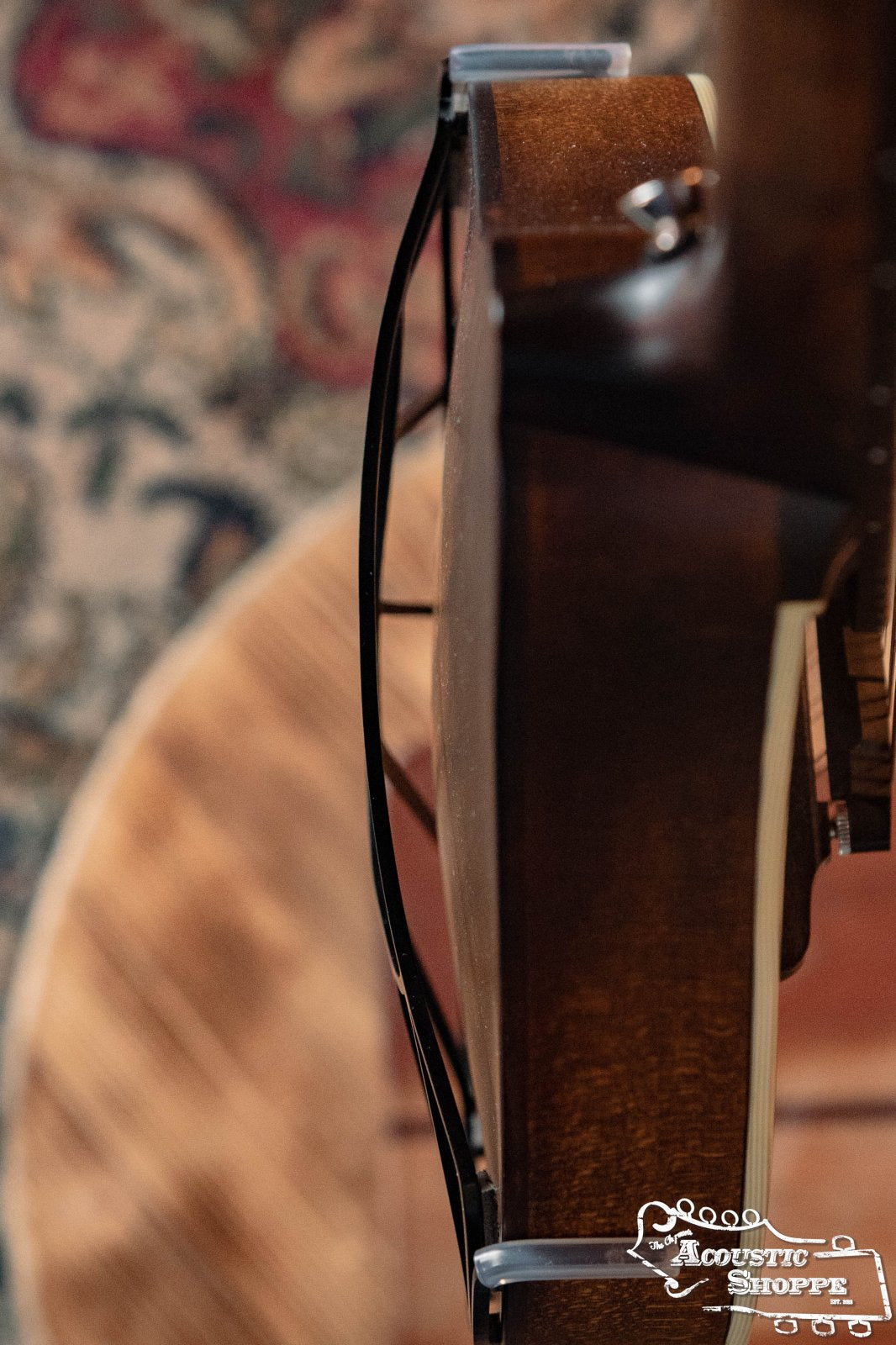
The Tone-Gard (some players search for it as a "tone guard") is a steel frame that sits on the back of a mandolin and holds the back about 3/8" to 1/2" away from your body. That lets the back vibrate freely because your stomach and clothing are no longer damping it, and it keeps belt buckles, buttons and snaps off the finish.
How do I measure my mandolin to pick a size?
Set the mandolin face down on a soft towel and hold a ruler or tape straight across the back at its widest point, edge to edge. Match that number to the sizes at the top of this page: about 9-7/8" takes a Sunrise or Deco, and about 10-3/16" takes the Vintage.
What is the difference between the Sunrise, Deco and Vintage?
The Sunrise (7-ray) and Deco are the standard size and use laser-cut steel with a ceramic powder-coat and glued-on pads. The Vintage (6-ray) is made for wider backs and is hand-made from mild steel with a high-gloss paint and older-style pads.
Will a Tone-Gard scratch or mark my finish?
Every surface that touches the instrument has a rubber or leather pad. The designer says he has used a Gard since 1987 and that a protected back looks much like it did when new, with perhaps some light scuffing under the upper pads that rubs out. Soft finishes are the exception: on French polish the pads can leave marks, although the maker's view is that it still does less harm than the buckle and button wear you would get without one. If your mandolin has a varnish or French-polish finish, check the finish under the pads during the first few weeks.
Can I leave the Tone-Gard on when I put the mandolin in its case?
Yes, and the maker recommends leaving it on all the time, including in Calton cases. It adds about 3/8" to 1/2" to the depth of the instrument.
How do I put it on?
Lay the mandolin face down on a soft surface, set the Gard on the back, and bend the arms at the waist and the tail a little at a time until it sits snug and centered. That small adjustment is all the arms are meant for. If it needs more than a nudge, the size is wrong.
Does a Tone-Gard really make a difference?
We think it does, and you can test the idea before you buy one. Face a wall a foot or two away, play some chop chords with the mandolin against your body, then hold it a couple of inches away from you and play the same chords. The difference you hear is what the Gard gives you when you are playing standing up with a strap. But don't take our word for it: our Tone-Gards are rated 4.9 stars from 27 customer reviews.
What if my mandolin is not a standard size?
Some smaller-bodied A models, such as Celtic-style mandolins, run narrower than the Sunrise range, so measure before you order. We also carry the OM-Gard for A-style octave mandolins, the D-Gard for Martin-style dreadnought guitars, and open-back banjo Gards in 11" and 12".
Specifications