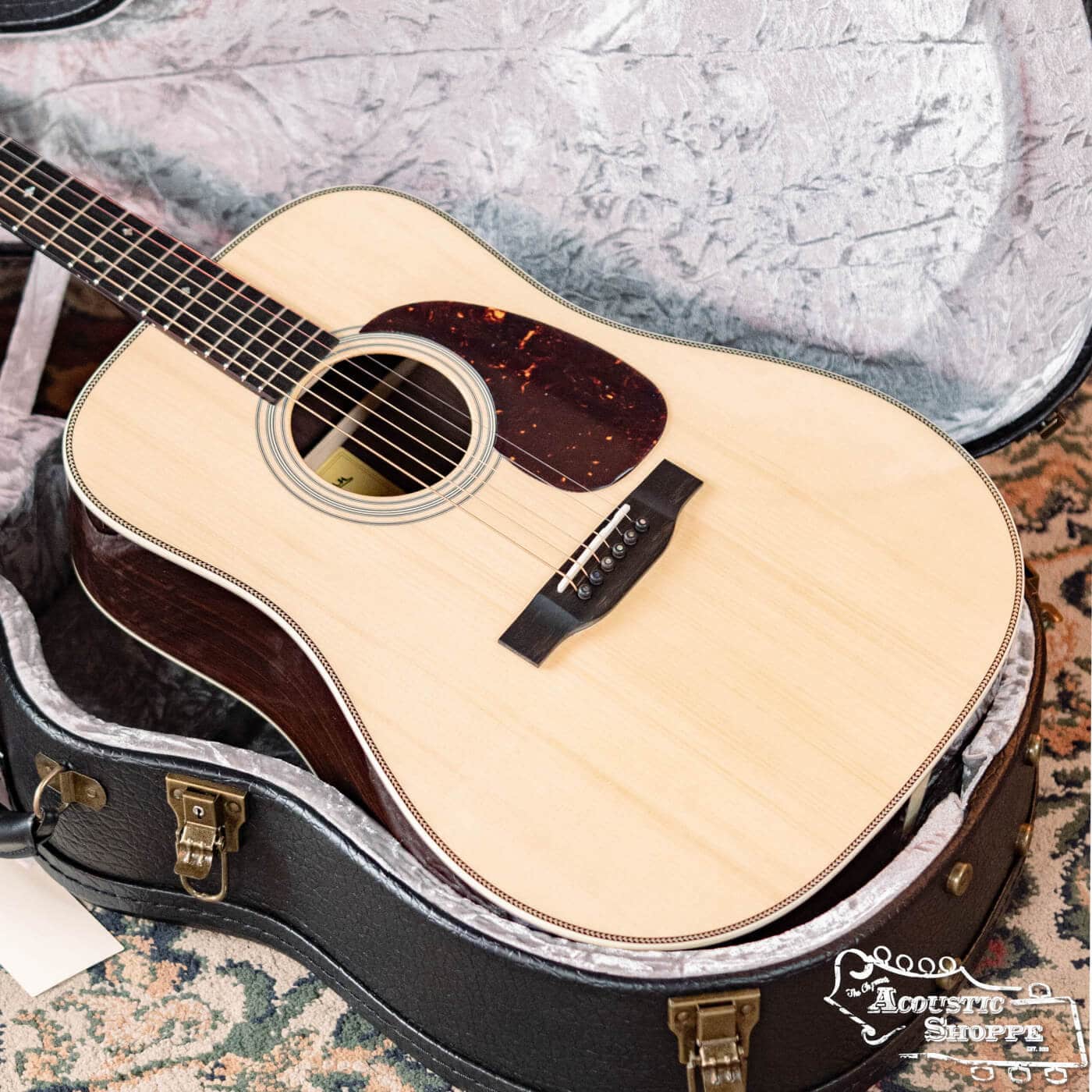

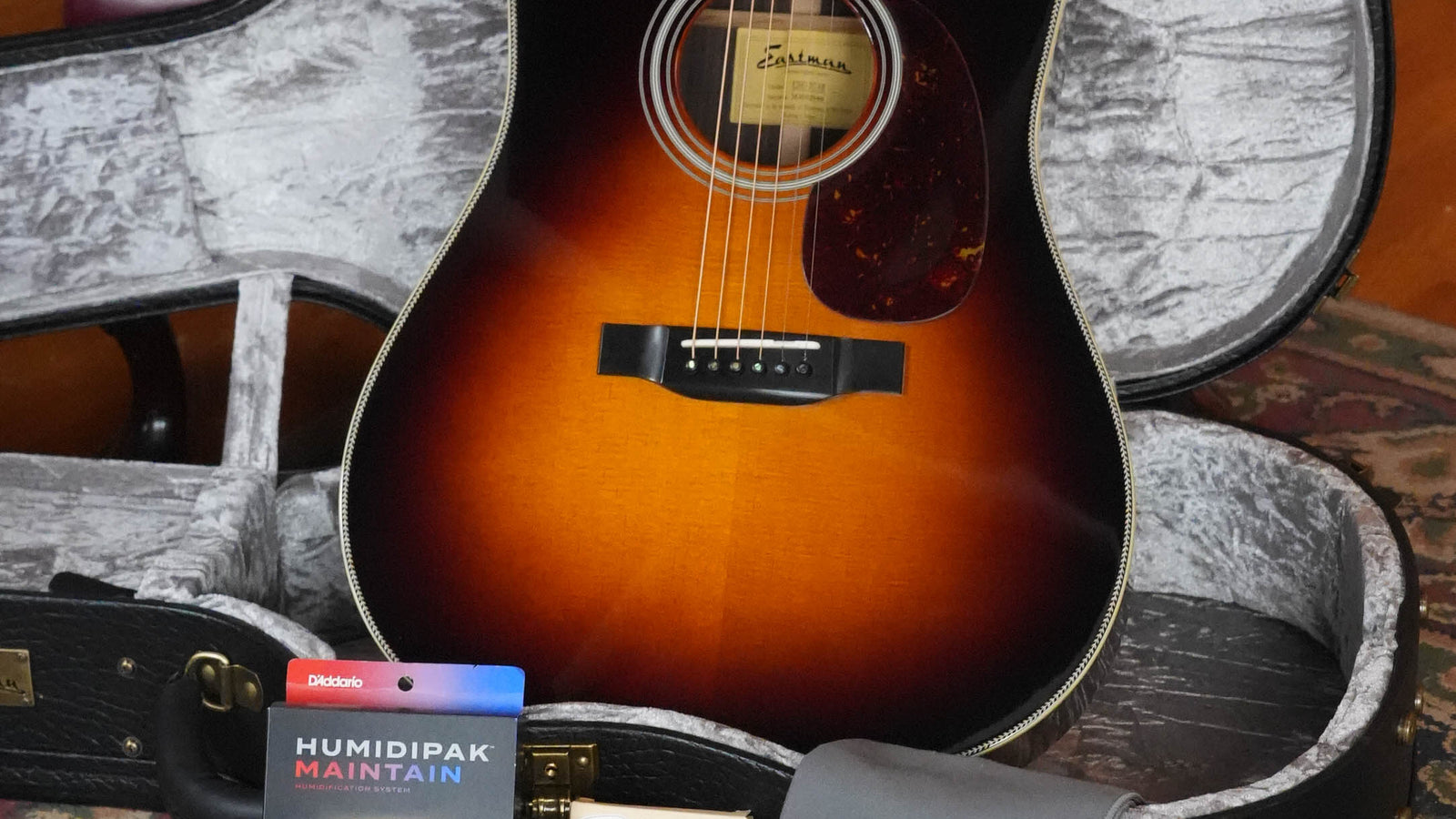
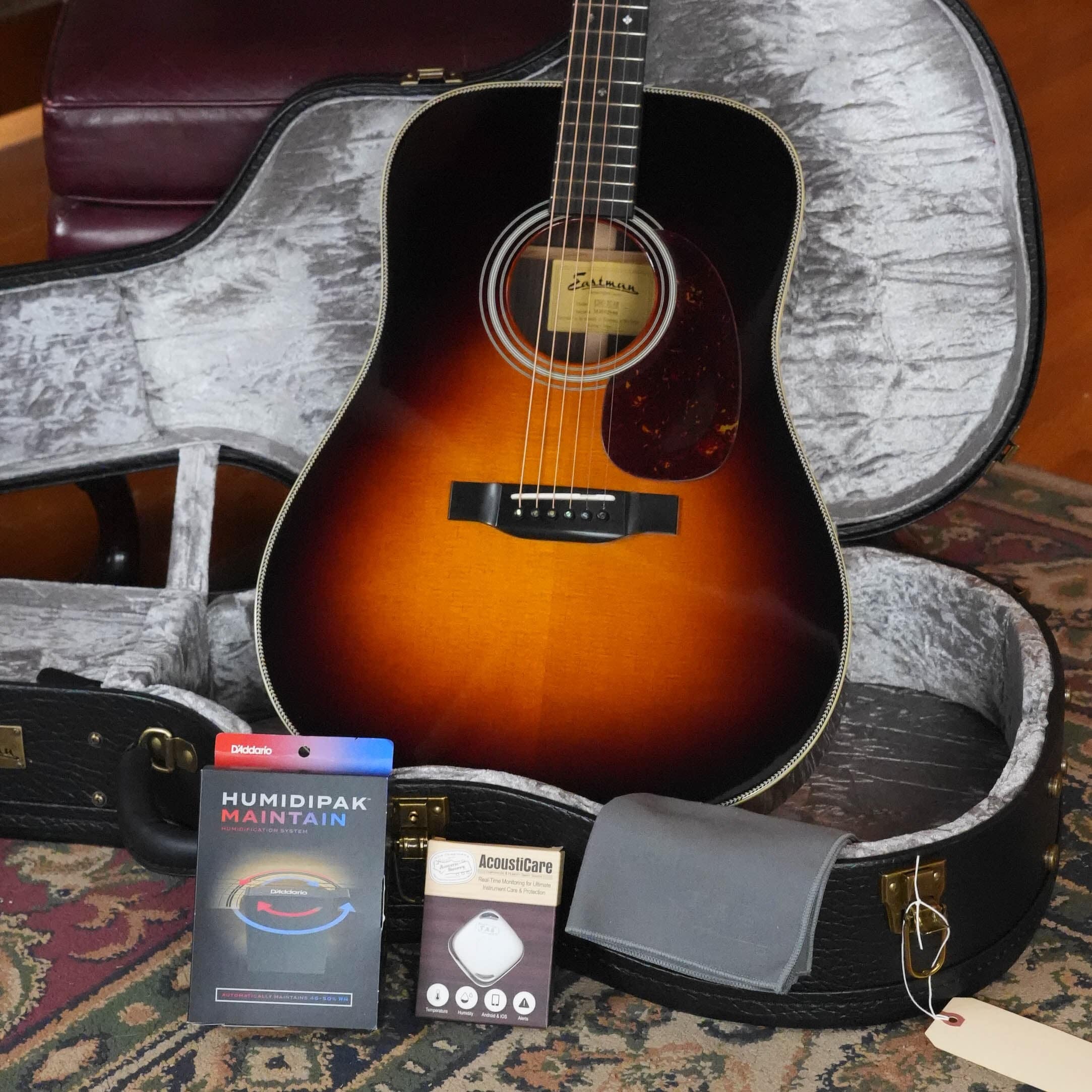
"Why would I want a Touchstone when it's basically an E20D?" We hear some version of that question every week, along with its cousin: "Should I wait for the Madagascar one?" On paper the three guitars look like siblings. All three are rosewood dreadnoughts, Eastman builds the bodies of all three, and the two we have in stock today are about $650 apart. So the E20D vs Touchstone question, with the E20D-MR-TC in the middle, comes down to one thing the spec sheet can't show you: who voiced the top, and what they were going for.
The short answer is that they aren't the same guitar, and they aren't meant to be. Bourgeois guitars sound like Bourgeois guitars, Eastman guitars sound like Eastman guitars, and each company builds them to do exactly that. We played all three blind, and none of them lost. Which one you should buy depends on how you play.
E20D vs Touchstone: what's different?
Start with who does what. The E20D is Eastman's design from top to bottom: hand-scalloped X bracing, voiced the way Eastman has voiced its traditional dreadnoughts for years, with a dovetail neck joint. It's one of the first guitars we carried when we opened the shop, along with the E10, E6 and E8, so we know it well.
The Touchstone works differently. Dana Bourgeois' team in Lewiston, Maine builds, braces and voices the tops, then sends them to Eastman, where the top goes onto the body. The neck joint is Dana's own system rather than a dovetail, and the neck profile is close to the Lewiston-built guitars. That split is how Bourgeois got its sound under $3,000. The Lewiston guitars average around $8,000, and the shop builds about 450 a year, so the only way to bring the price down was to let Eastman do the hours that don't decide the tone.
Voicing is the part of the E20D vs Touchstone question that matters most. We'd say Dana's team voices each top to be as detailed and responsive as that piece of wood can be, with even tone across the range rather than big bass and a missing midrange. Eastman, like most builders, leans its voicing toward a particular sound, and for the E20D that sound sits close to a Martin HD-28.
Hear the E20D vs Touchstone blind test
Jump to:
- The E20D at 3:02
- The Touchstone at 7:26
- The Madagascar E20D-MR-TC at 9:42
- The blind shootout at 15:08
- Our E20D vs Touchstone verdict at 16:22
The three guitars side by side
The prices we quoted back in 2022 have moved since, so these are today's, from our own listings.
| Spec | Eastman E20D-TC | Eastman E20D-MR-TC | Bourgeois D Vintage/TS Touchstone |
|---|---|---|---|
| Top | Thermo-cured Adirondack spruce | Thermo-cured Adirondack spruce | Alaskan Sitka spruce, Adirondack bracing |
| Back and sides | Rosewood | Madagascar rosewood | Indian rosewood |
| Top voiced by | Eastman | Eastman | Bourgeois, Lewiston, Maine |
| Nut width | 1 3/4" bone | 1 3/4" bone | 1 23/32" bone |
| Scale | 25.4" | 25.4" | 25.5" |
| Tuners | Gotoh | Gotoh | Schaller GrandTune |
| Price today | $2,119 | Ask us | $2,767 |
Eastman E20D: an HD-28-style dreadnought with a little extra
The E20D is the most traditional of the three. It's built in the HD-28 mold, with herringbone trim and an Adirondack top, and the 1 3/4" bone nut gives your fretting hand a bit more room between strings than a lot of modern necks. Newer E20Ds have come through with a slightly slimmer take on the C shape than the early ones. If you want the long version, our full Eastman E20D review goes deeper on this one guitar.
The sound falls in that Martin-style dreadnought range, with a little more boutique character than the Martin, and it plays straight down the road with a few extra frills. In our blind test the standard E20D had more sparkle than either of the other two, and both Eastmans had a warmth and richness in the strum that one of us prefers to the Bourgeois. If you want to know how it sits against the guitar it's modeled on, our D-28 vs HD-28 comparison covers the Martin side.
One honest note on hardware. Eastman's stock tuners have switched suppliers over the years, and some players replace them right away. One of us has four guitars with these tuners and has never had one fail, so we wouldn't rush to swap them.
Bourgeois Touchstone: a Bourgeois first, an Eastman build second
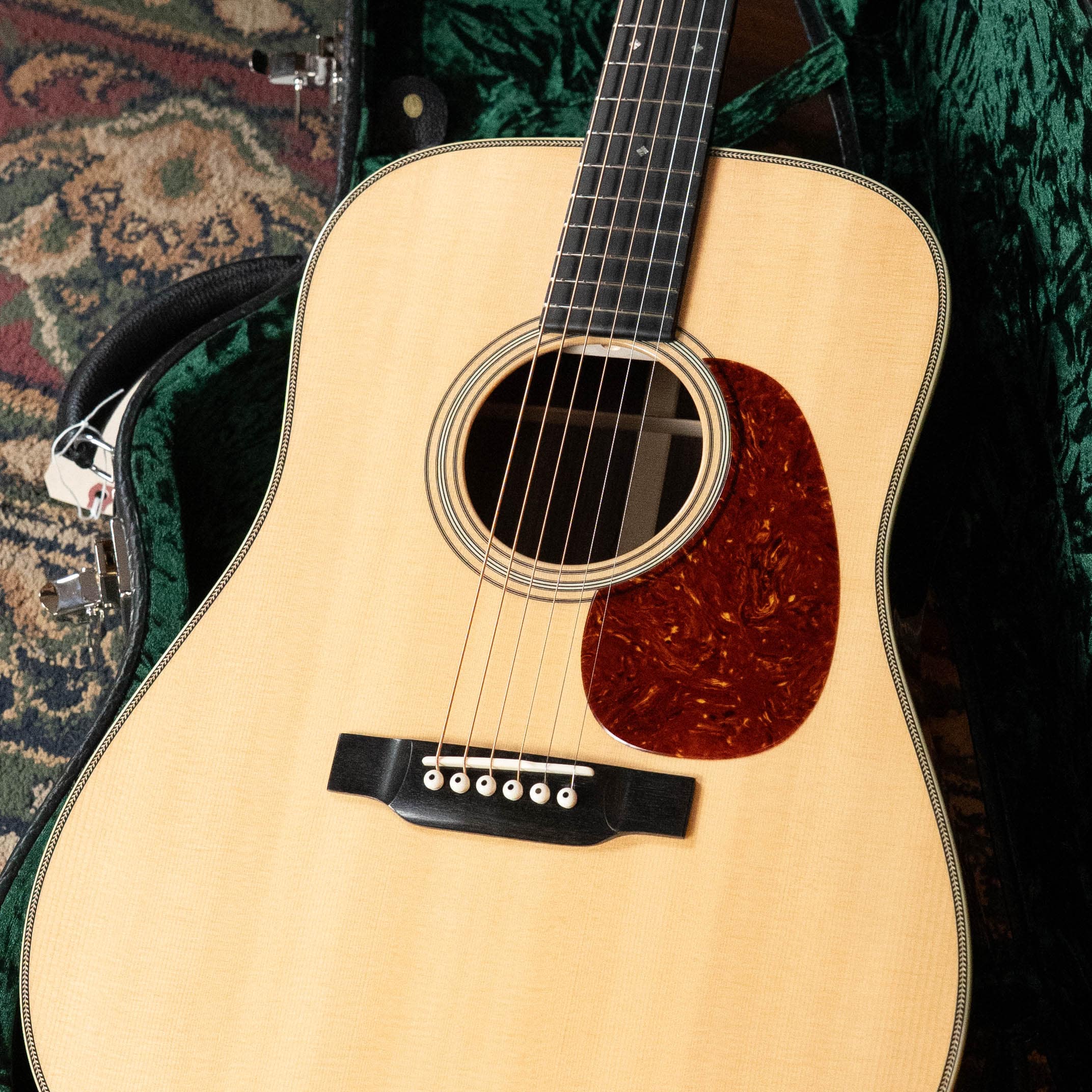
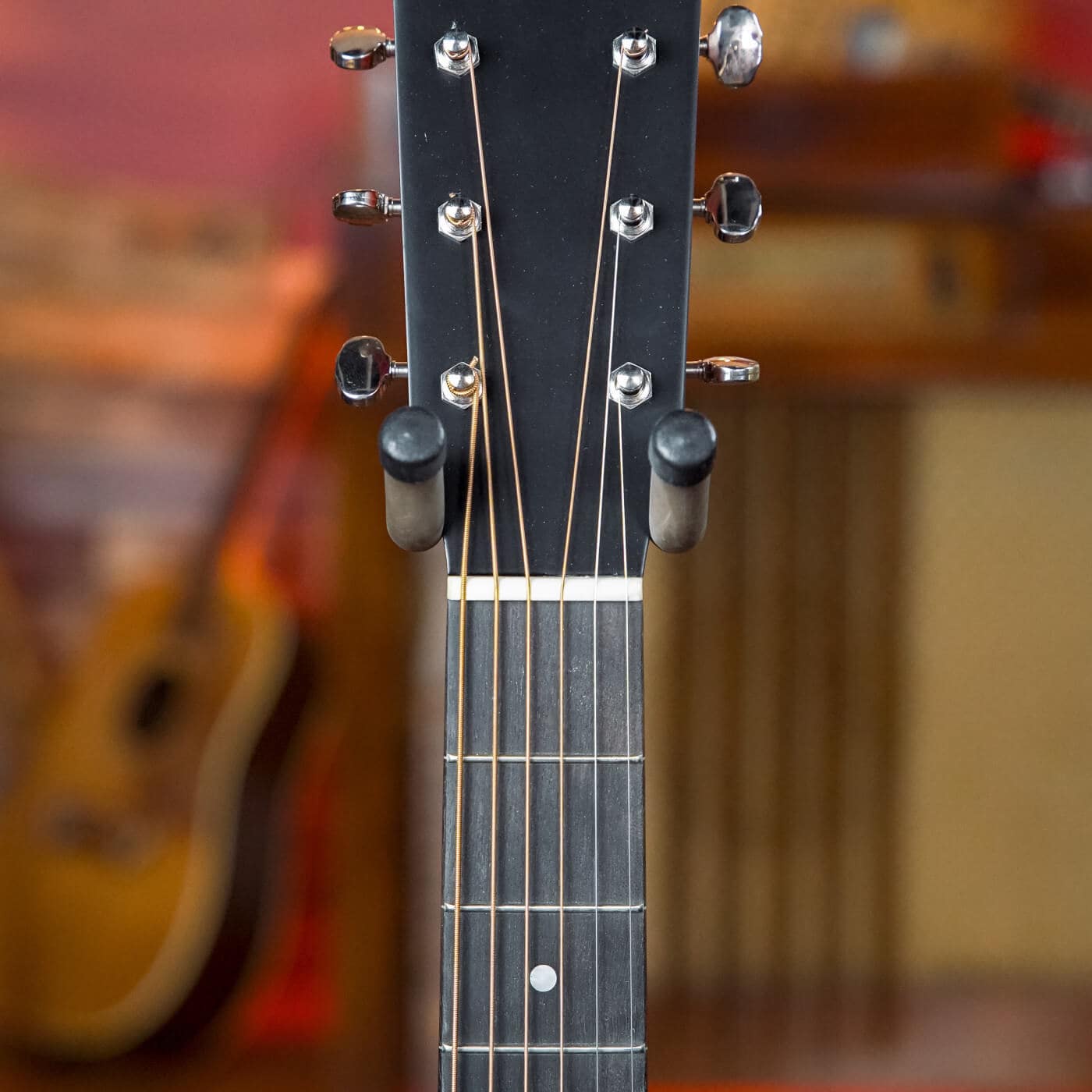
Everyone, Dana included, will tell you the Touchstone is a Bourgeois guitar. It's built to sound and feel like a Lewiston Bourgeois, and the D Vintage/TS pairs an Alaskan Sitka top, Adirondack bracing and Indian rosewood back and sides. You also get a few extras over the Eastmans: Schaller tuners, a nicer hardshell case, and the slightly narrower 1 23/32" nut that Bourgeois uses.
What you hear is responsiveness. The Touchstone isn't laid back at all, and a note just jumps out of it, which is a lot to ask of a Sitka top. In our hands it was much more lively than the Eastmans, with clearer note separation. One of us thinks that clarity gives the flatpickers at the Winfield contest an edge; the other isn't sold on it. Our Bourgeois buyer's guide covers how the Touchstone line fits with the Lewiston models.
"It's not laid back at all. It's just responsive. It just kind of jumps out, especially for a Sitka spruce guitar."
So the E20D vs Touchstone choice comes down to the voice you want: a traditional dreadnought sound with a full bottom end, or one built to give you every note in the chord.
The E20D-MR-TC: where Madagascar rosewood comes in
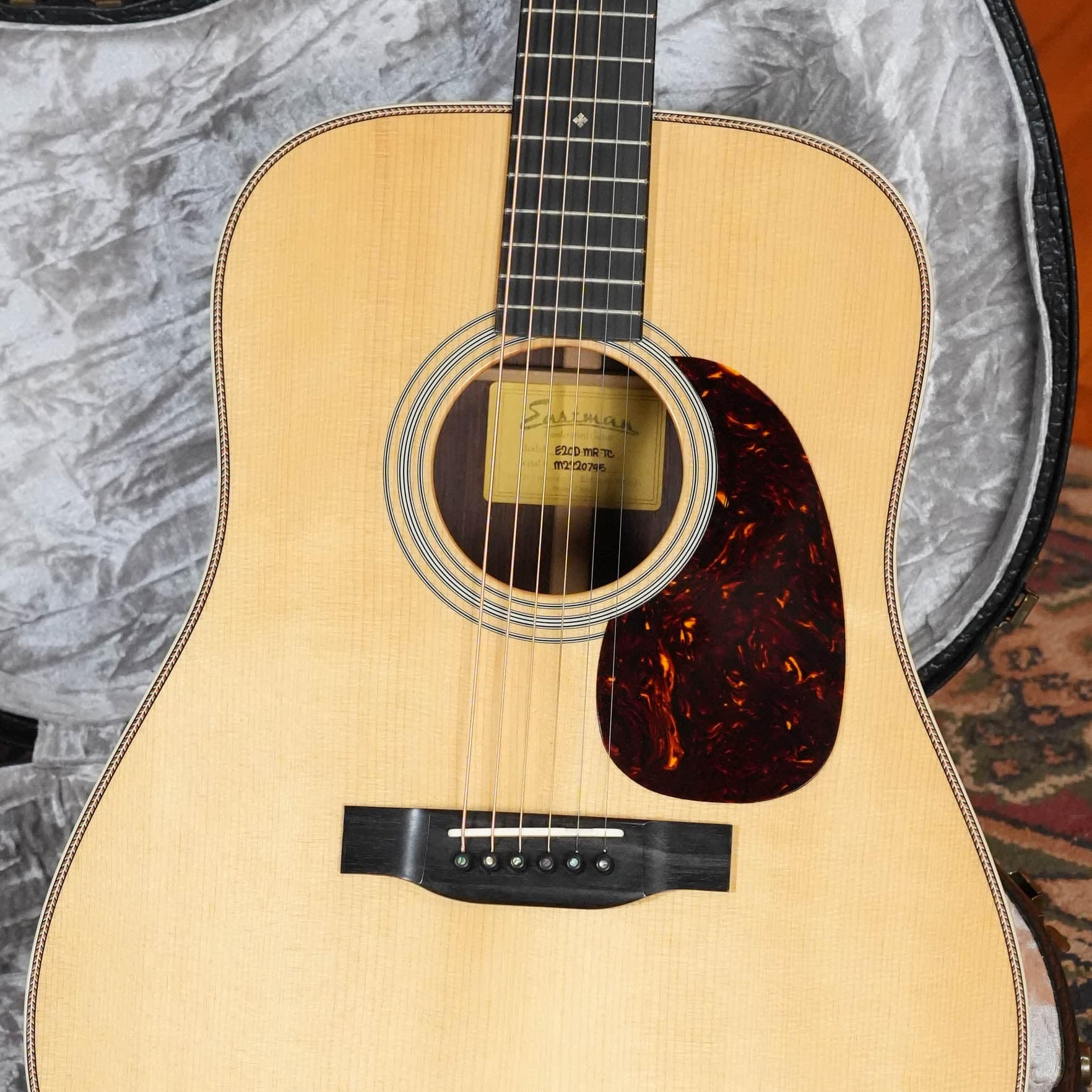
The MR-TC exists because of the Bourgeois partnership. Dana has built with Madagascar rosewood for years, but it's hard to get in volume. Combining Eastman's numbers with Bourgeois' made a large purchase possible, and the E20D-MR-TC uses the same wood Dana uses in Lewiston, selected together. Add a thermo-cured Adirondack top and you have an E20D with the same neck and Eastman voicing, plus a different back and sides.
So what does the Madagascar do? Indian rosewood has a slightly mushier low end. Madagascar, and Brazilian even more so, puts a kind of shimmer on the bass, a high-end sparkle riding on top of the low notes. In our view Madagascar gets you much closer to a Brazilian tone for a lot less money, and it looks the part, with darker streaks and a more chocolatey color than Indian rosewood. It also gets ebony bridge pins.
"I think the player will feel it more than you will hear it."
That's the catch, and it's worth taking seriously. Between the two Eastmans, the difference is smaller than between either one and the Touchstone. So if you're weighing E20D vs Touchstone, decide that first and the Madagascar question second. The MR-TC is warmer, which we put down partly to the thermo-cured top, and it has a slightly different attack, but that's something you'll feel under the pick more than a listener will hear across the room. The other catch is the wood's history. Madagascar rosewood has a shady trading history, so buying it comes down to trusting the paperwork. We've been given assurances by Dana and his team that this wood was sourced properly, and we trust them, but you should know the issue exists. For more on what the rosewood itself changes, our mahogany vs rosewood guide is a good next read.
We don't have a new E20D-MR-TC listed right now. If you want one, ask us about ordering one.
E20D vs Touchstone: which should you buy?
None of these is a bad guitar, and they're different enough that, if you can, you should own one of each (one of us does). If you only get one, here's how we'd split it:
- Buy the E20D if you strum and sing, play in jams, or mostly play alone. You get a fuller, rounded bottom end with more sustain, and the most traditional sound of the three for the least money.
- Buy the E20D-MR-TC if you want the E20D's feel with a warmer voice and a taste of the Brazilian low end, and the difference you feel under your hands is worth it to you.
- Buy the Touchstone if you play intricate lines or flatpick in an ensemble, where note separation counts more than a big wash of bass. It's also the one to pick if you want the Bourgeois sound without the Lewiston price.
If you'd rather have a smaller body, the same Touchstone voicing comes in the Bourgeois OM Vintage/TS (see what's in stock in our Bourgeois collection), and our Touchstone Country Boy post covers the mahogany option in the series.
How we get them ready
Both Eastmans get their setup at Eastman's facility in Pomona before they reach us, and you can see how that works in our look inside Eastman Pomona. Then every guitar, Eastman or Bourgeois, goes through our 23-Point Professional Inspection before it ships.
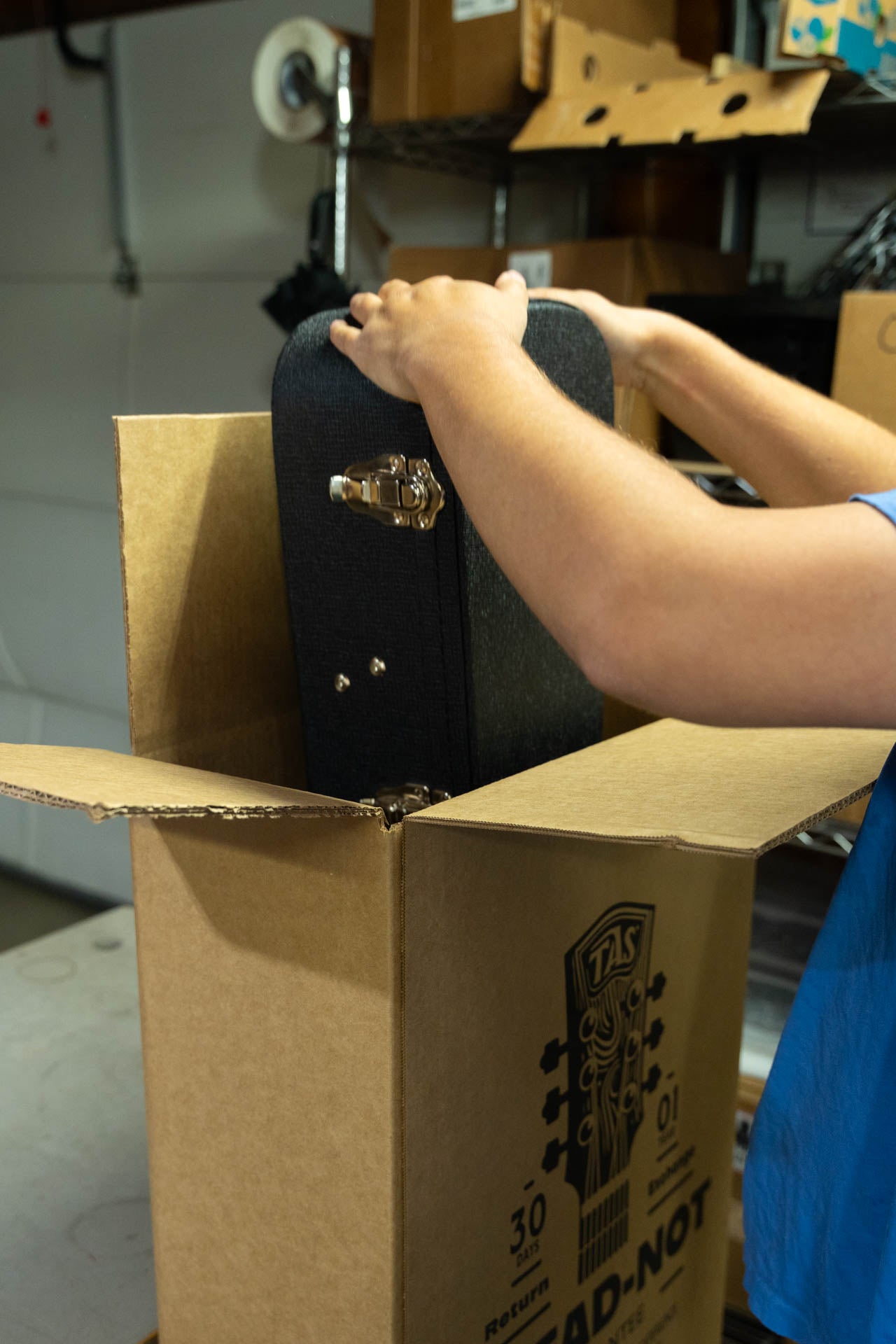
All three are over $1,000, so all three are covered by the Dread-Not Guarantee: a full year to trade it in for up to 90% of the pre-tax purchase price in credit, less round-trip shipping, plus a 30-day in-home trial. That matters here, because the E20D vs Touchstone call is one you really make by playing the guitar in your own room.
Related reading
- Martin D-41 vs Eastman E40D, for the fancier end of Eastman's rosewood dreadnoughts
- Why we're the #1 Worldwide Dealer for Eastman
Find your E20D or Touchstone
The Eastman E20D-TC-SB is in stock at $2,119, and the Bourgeois D Vintage/TS Touchstone is in stock at $2,767. For everything else, browse our Eastman guitars and Bourgeois guitars, or our full range of dreadnought guitars and acoustic guitars. If you're stuck between the two, call or stop by and tell us how you play. We'll help you narrow it down, but the guitar in your hands settles it faster than anything we can write.