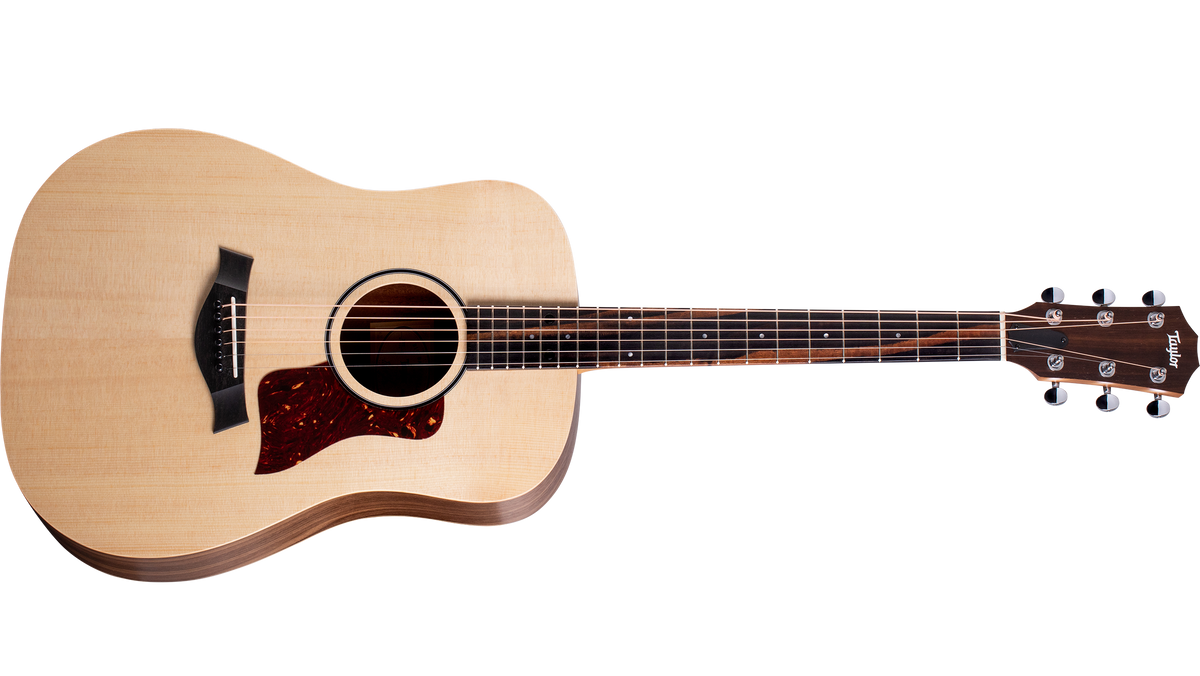
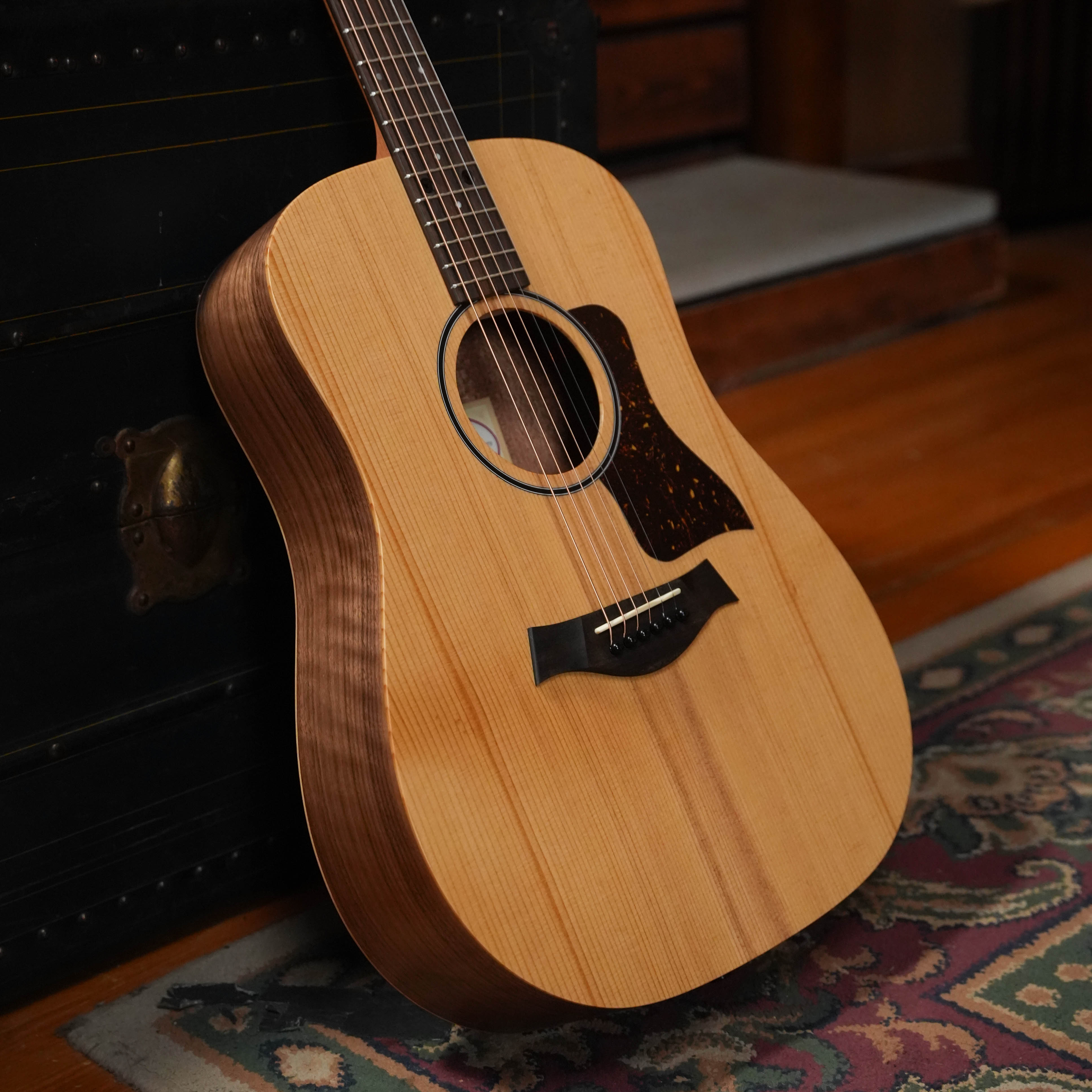
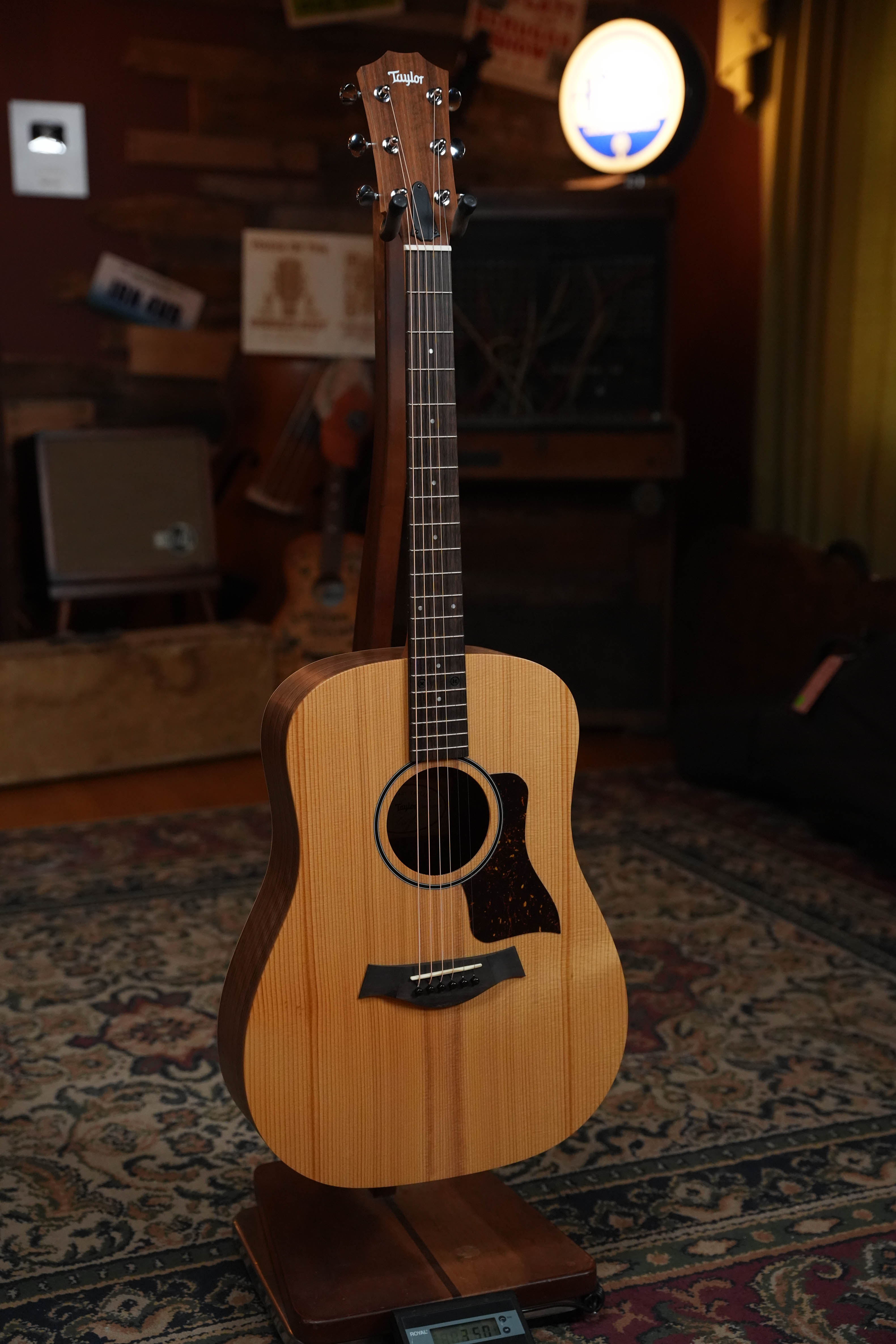
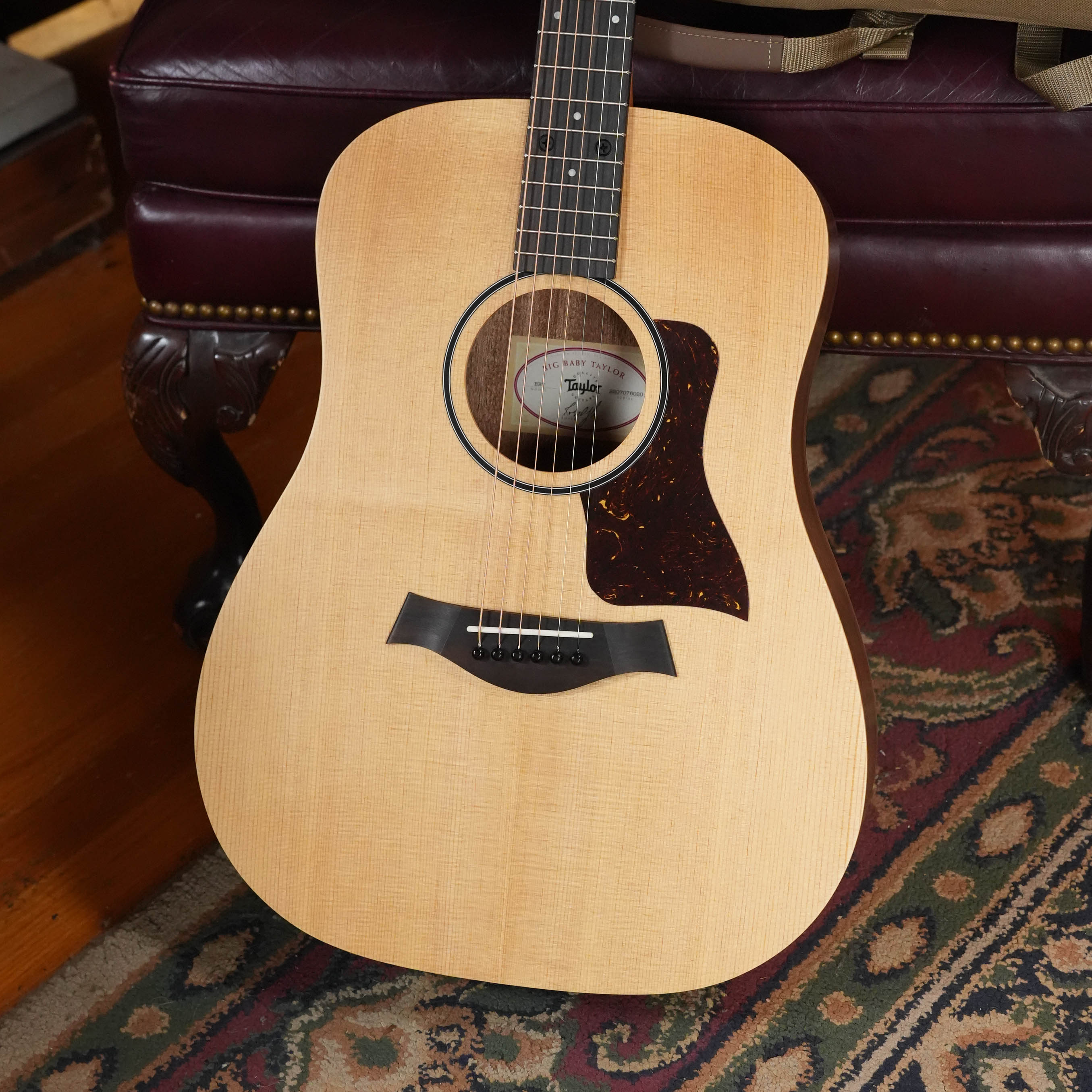
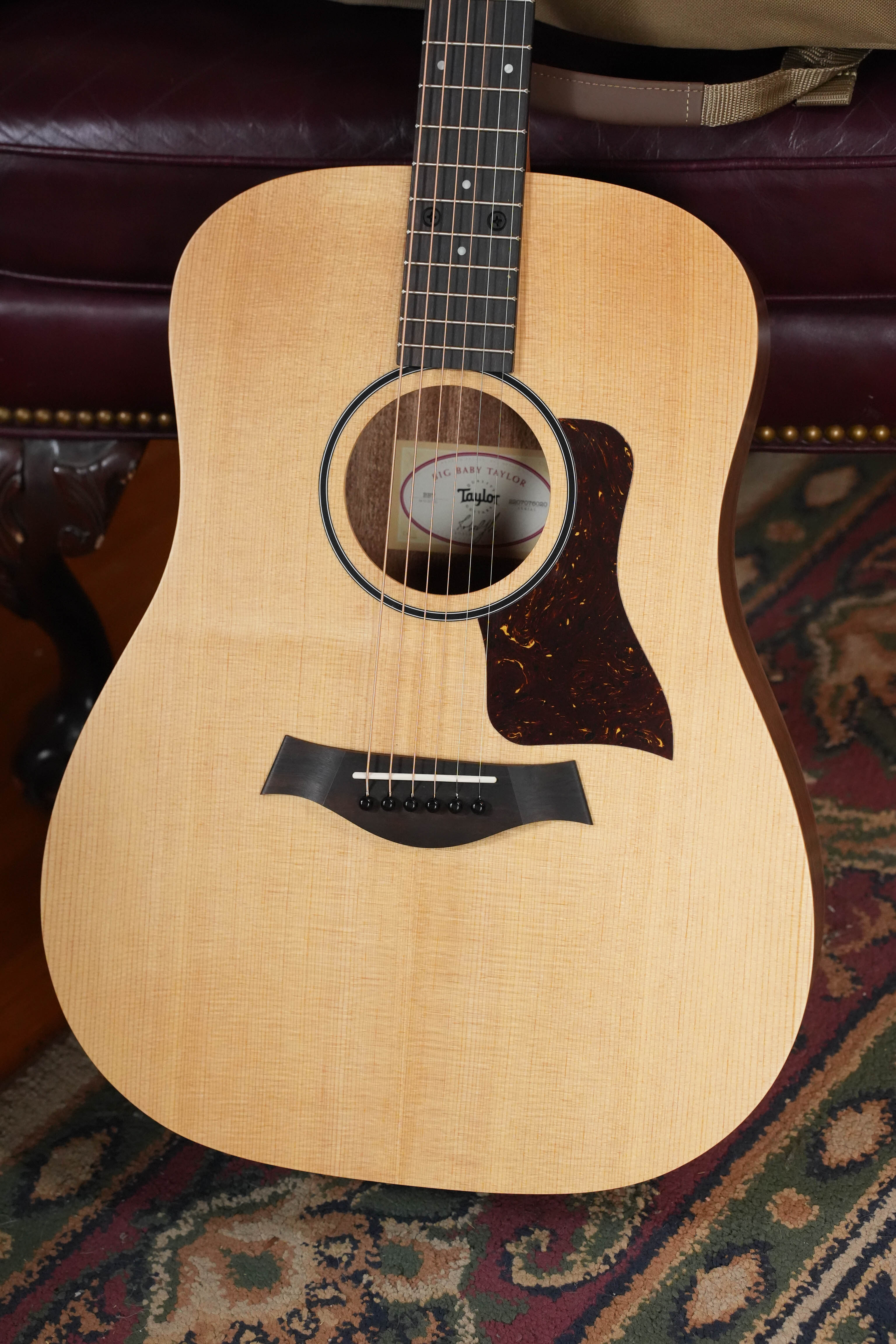
Walnut is a relative newcomer to Taylor's back-and-sides lineup, and it reads differently than the mahogany, sapele, and rosewood options that dominate the rest of the catalog. Paired with X-bracing instead of the V-Class pattern found on nearly every other current Taylor, walnut favors a brighter attack and a quicker note decay than the warmer, longer-sustaining tone V-Class and rosewood produce together elsewhere in the line. That combination puts the BBT's voice closer to a traditional flat-top's punchy midrange than to the deep, complex low end Taylor chases on its higher-tier instruments — a difference worth knowing going in, since this guitar is voiced for strumming and everyday practice rather than studio-level tonal complexity.
The Big Baby body itself is Taylor's way of shrinking a dreadnought without shrinking the player's relationship to it. It's narrower through the waist and shallower front-to-back than a full-size dreadnought, which trims both weight and bulk, but the 25-1/2 inch scale length carries over unchanged from Taylor's full-size guitars. That matters more than it sounds like it should: a player who practices on a BBT and picks up a full-size Taylor later isn't relearning fret spacing, because the distance between frets hasn't moved. The smaller body does cost something in return — less internal air volume means less low-end output and projection than a full dreadnought delivers, especially unplugged in a room with other instruments — but for practice, travel, or a first guitar, that's a fair trade for the reduced size and weight.
The BBT's closest relative in Taylor's catalog is the Baby Taylor (BT1), and the two share almost everything except scale and body size. Both use the same solid Sitka spruce top over layered walnut back and sides, the same X-bracing, and neither carries onboard electronics. Where they split is scale length: the BBT holds Taylor's full 25-1/2 inch scale, while the BT1 drops to 22-3/4 inches, the shortest scale in Taylor's current catalog, inside a smaller 3/4-size Baby body. That makes the BBT the better fit for a teenager or adult who wants a genuinely portable guitar without relearning fretting-hand distances, and the BT1 the better fit for a younger player, a smaller-handed adult, or anyone chasing the smallest possible footprint for travel.
In practice, the BBT works best as exactly what Taylor built it to be: a durable everyday practice guitar, a travel companion that survives a gig bag better than a full-size case, or a first Taylor for a player not ready to commit to a full-size instrument's price or bulk. At $499, it's also one of the most accessible ways into the Taylor catalog without stepping down to a laminate-top guitar from another brand.
Every BBT that ships from The Acoustic Shoppe completes the same 23-point professional inspection every instrument in the shop goes through, regardless of price point, before it leaves our hands. See the full Baby Taylor series collection for the BBT alongside the BT1, or browse the complete Taylor Guitars collection for the rest of the lineup.
The Acoustic Shoppe is an Authorized Taylor Premier Dealer and Gold Label Advantage Dealer.