

Table of Contents
- What is the best acoustic guitar pickup for playing live?
- Why does a microphone still sound best?
- Bridge plate transducers: the natural-sounding acoustic guitar pickup
- Under-saddle piezo pickups: when the stage is loud
- Can a blend system give you the best of both?
- What acoustic guitar pickup do our staff play live?
- Do you need an outboard preamp or DI?
- What does installing a pickup involve?
- Which acoustic guitar pickup should you buy?
- Acoustic Shoppe FAQ
You've finally got the gig, the open mic or the Sunday morning slot, and the guitar that sounds so good on your couch has to come through a PA. Pick the wrong acoustic guitar pickup and that guitar turns thin, quacky or ready to howl the second the band gets loud. The choice is harder than it should be, because every system promises to sound like your guitar, only louder, and the spec sheets all read the same.
Here's the verdict first: for most players who want their guitar to sound like itself, a bridge plate transducer is the best acoustic guitar pickup to start with, and a transducer blended with an internal mic is the upgrade. An under-saddle piezo still earns its place on loud stages, where it hears the strings and ignores the room. The rest of this post explains why, what our own staff run on stage, and what's in stock today.
What is the best acoustic guitar pickup for playing live?
It depends less on the guitar than on the job. Corey, our sales manager and a working bluegrass guitarist, puts it this way when someone asks whether to swap pickups: the real conversation is about what you need the pickup to do. Before you pick a brand, answer these:
- How loud is the stage? A quiet listening room and a five-piece band with drums need different tools.
- Is it a big stage or an intimate one? The bigger the room, the more feedback resistance matters.
- Do you fingerpick or strum? Fingerstyle detail lives in the top of the guitar, and some pickups hear it better than others.
- Do you want to tweak, or plug in and go? A passive pickup into an outboard DI is simple. An onboard blend gives you more knobs and more to set.
His last piece of advice is the one most people need to hear before they spend money:
"If something is servicing you well and you're getting the desired tone for your setting and for your playing style, then stick with it." (Corey)
Why does a microphone still sound best?
A good condenser mic in front of a good guitar is still the sound every acoustic guitar pickup is chasing, because it hears the air moving off the whole top. The problem is the stage: you have to stand still at the mic, and it hears the rest of the band too. So the job of an acoustic guitar pickup is to get you as close to that miked sound as it can while letting you move and be heard.
Jump to: the HiFi Duet and how the blend works (24:43) · swapping an Anthem for a HiFi Duet (27:21) · how to choose a pickup for your playing (30:09).
Bridge plate transducers: the natural-sounding acoustic guitar pickup
Bridge plate transducers like the K&K Pure Mini and the L.R. Baggs HiFi stick to the underside of the bridge plate inside the guitar. An under-saddle pickup mostly hears string pressure, while a transducer listens to the wood, so you get a warmer, woodier sound that keeps the percussive detail of your right hand. That's why we point singer-songwriters and solo players to a transducer first.
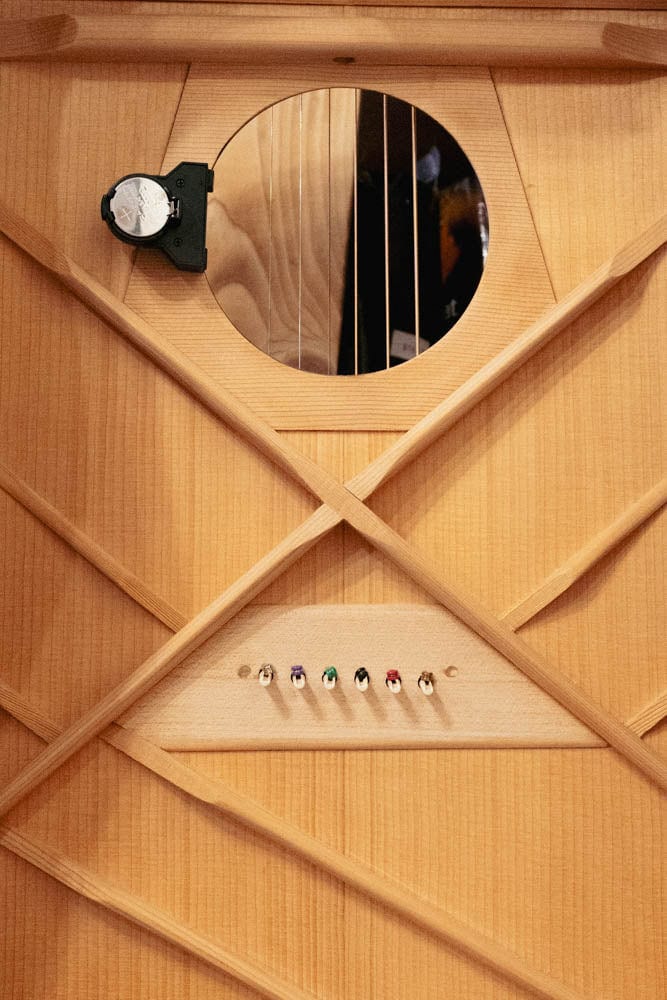
Corey has run K&K pickups for years because they're minimally invasive and passive: there's not a lot going on inside the guitar, and he runs his straight out to an external DI and then to the PA. The catch with any transducer is feedback. Because it hears the top move, it's more prone to howl than a piezo when the stage gets loud.
In stock today, the L.R. Baggs HiFi bridge plate pickup ($199) is the easy way into this sound. The K&K Pure Mini with volume control ($162) is sold out on the site right now, so ask us if that's the one you want.
Under-saddle piezo pickups: when the stage is loud
If you're playing big rooms with drums, electric guitars or a banjo that never lets up, you need a pickup that only hears the strings. That's the under-saddle piezo. It sits in the saddle slot, so it ignores most of the stage volume and resists feedback better than anything else here. The downside is the famous piezo quack, a sharp, synthetic attack that feels disconnected from the wood, and a good preamp downstream takes a lot of that edge off.
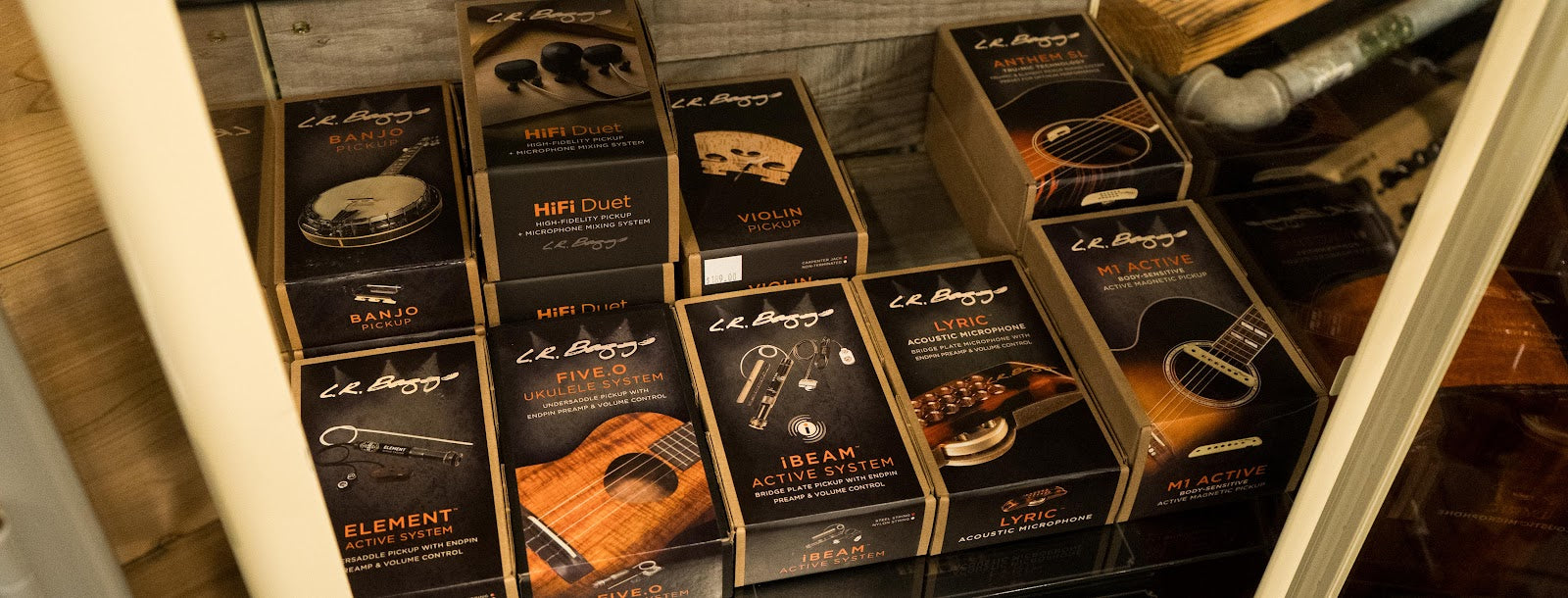
For an under-saddle system, the L.R. Baggs Element VTC ($179) and the L.R. Baggs Session VTC ($229) are both in stock today, and either one pairs well with the preamps further down.
Can a blend system give you the best of both?
A blend system pairs an acoustic guitar pickup with an internal microphone: the pickup gives you the foundation and the volume, and you dial in just enough mic to add air. The L.R. Baggs Anthem blends an under-saddle pickup with its mic. The newer HiFi Duet keeps the two HiFi transducers on the bridge plate, always on, and adds a small mic between them, so you're blending mic into an already natural pickup. Corey puts the Duet right up there with the Anthem, for the player who wants more control than a piezo gives:
"If you have the chance to blend it then with a microphone… and you can actually manually adjust it for each room you're in, it's really nice." (Corey)
We also played the HiFi Duet in L.R. Baggs' own AEG-1 guitar, and the takeaway was the same: natural tone, and a guitar that sits in a band mix with very little hassle. Our verdict on the sound was plain:
"The HiFi really does a great job of getting that natural tone without being too quacky, as some piezo pickups can be."
A blend adds a live microphone to your signal, so it rewards a little care. Here's how we'd set one up:
- Start with the pickup alone, volume and tone up, and get a level at the board.
- Bring the mic in slowly. In our AEG-1 test, 75 to 80 percent mic was the sweet spot; all the way to 100 percent was too much.
- Check it at stage volume. If one string rings out with the band, notch that frequency a little. On a loud stage it was the D string for us, and every acoustic does some version of this.
- Reset the blend for each room. That's the whole point of having the knob.
The HiFi Duet ($449), the Anthem ($349) and the K&K Trinity Pro Mini ($392) are all sold out on the site today. Check the acoustic guitar pickup collection for what's back in, or ask us to order one.
What acoustic guitar pickup do our staff play live?
The best way to choose a system is to see what working players use. Here's what our crew runs on stage, from the shop's own notes:
| Who | Pickup | Preamp or DI | Why |
|---|---|---|---|
| Corey, sales manager | K&K Pure Mini | L.R. Baggs Venue DI | Low maintenance, raw and natural, little to adjust |
| John Chapman, co-owner | K&K Trinity | ToneDexter | The Trinity adds an internal mic; the ToneDexter brings back the studio-mic feel |
| Jonas, sales floor manager | L.R. Baggs HiFi Duet | L.R. Baggs Venue DI | Transducers plus a mic in one system |
| Austin, general manager | L.R. Baggs HiFi Duet | Fishman Aura Spectrum DI | Aura images on top of the HiFi sensors sound real |
| Sean, sales | K&K Pure Mini | Fishman Aura Spectrum DI | The woody K&K signal with mic imaging on top |
| Thomas, lead tech | K&K with volume, or HiFi Duet | L.R. Baggs Align Equalizer | A clean signal and precise EQ control |
Notice the pattern: nobody runs a bare piezo, and almost everybody runs something between the guitar and the PA.
Do you need an outboard preamp or DI?
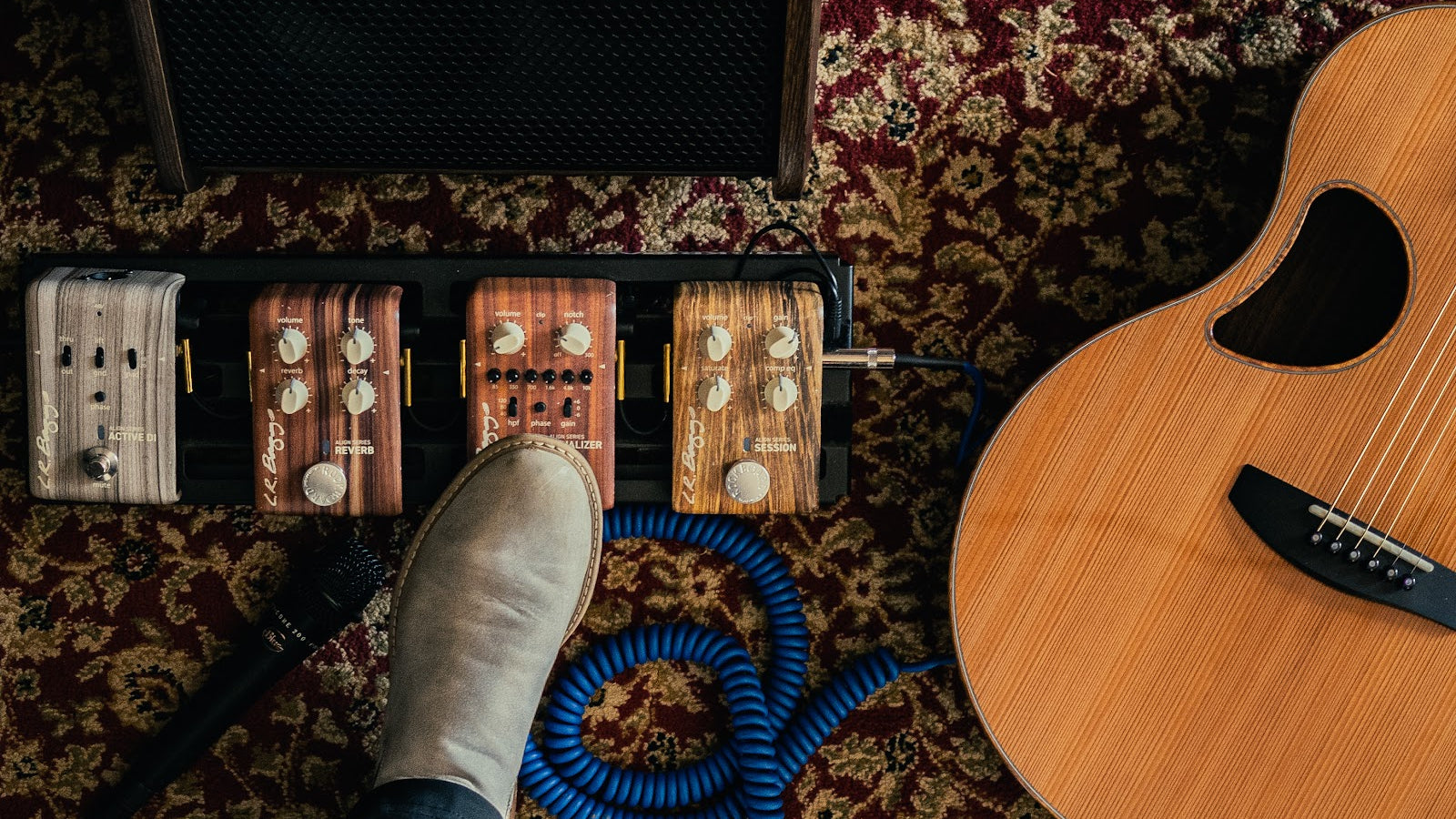
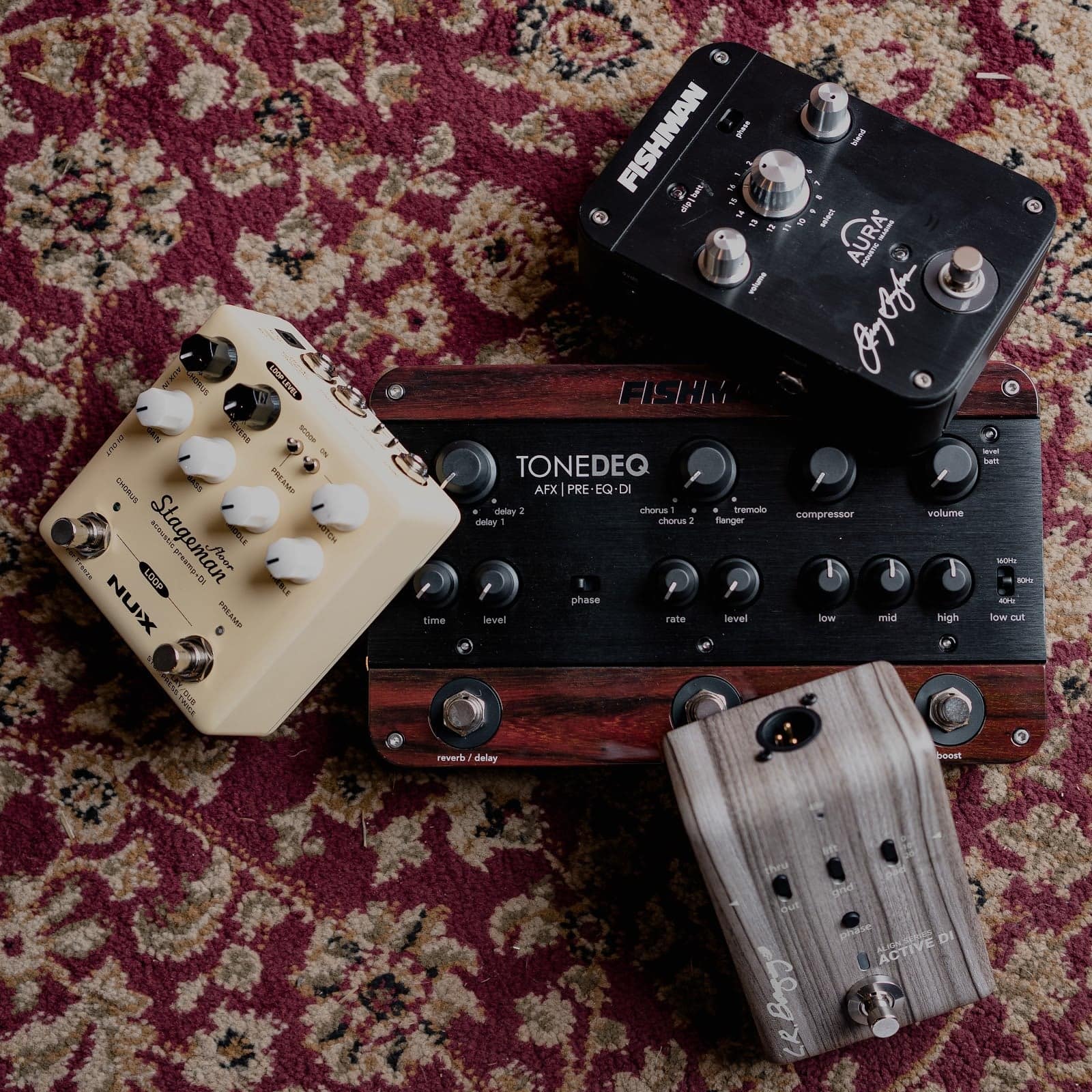
The acoustic guitar pickup is only half the sound. An outboard preamp or DI buffers the signal, hands the sound engineer a clean line, and puts EQ and often a tuner and boost at your feet. A thin plugged-in sound is often a passive pickup with nothing buffering it, and a good DI brings back the body and low end. Imaging pedals like the Fishman Aura and the L.R. Baggs VoicePrint go further, laying the sound of a studio mic over your pickup to tame piezo quack.
In stock today:
- L.R. Baggs Para Acoustic DI ($249), the straightforward choice for a passive K&K
- L.R. Baggs Align Equalizer ($199), Thomas' pick for EQ control
- L.R. Baggs VoicePrint DI ($429), an impulse-response pedal for mic-like tone
- Fishman Aura Spectrum DI ($469.95), Austin's and Sean's choice
The Venue DI ($329) and ToneDexter II ($649) are sold out right now. Browse the rest of the acoustic pedals and DIs.
What does installing a pickup involve?
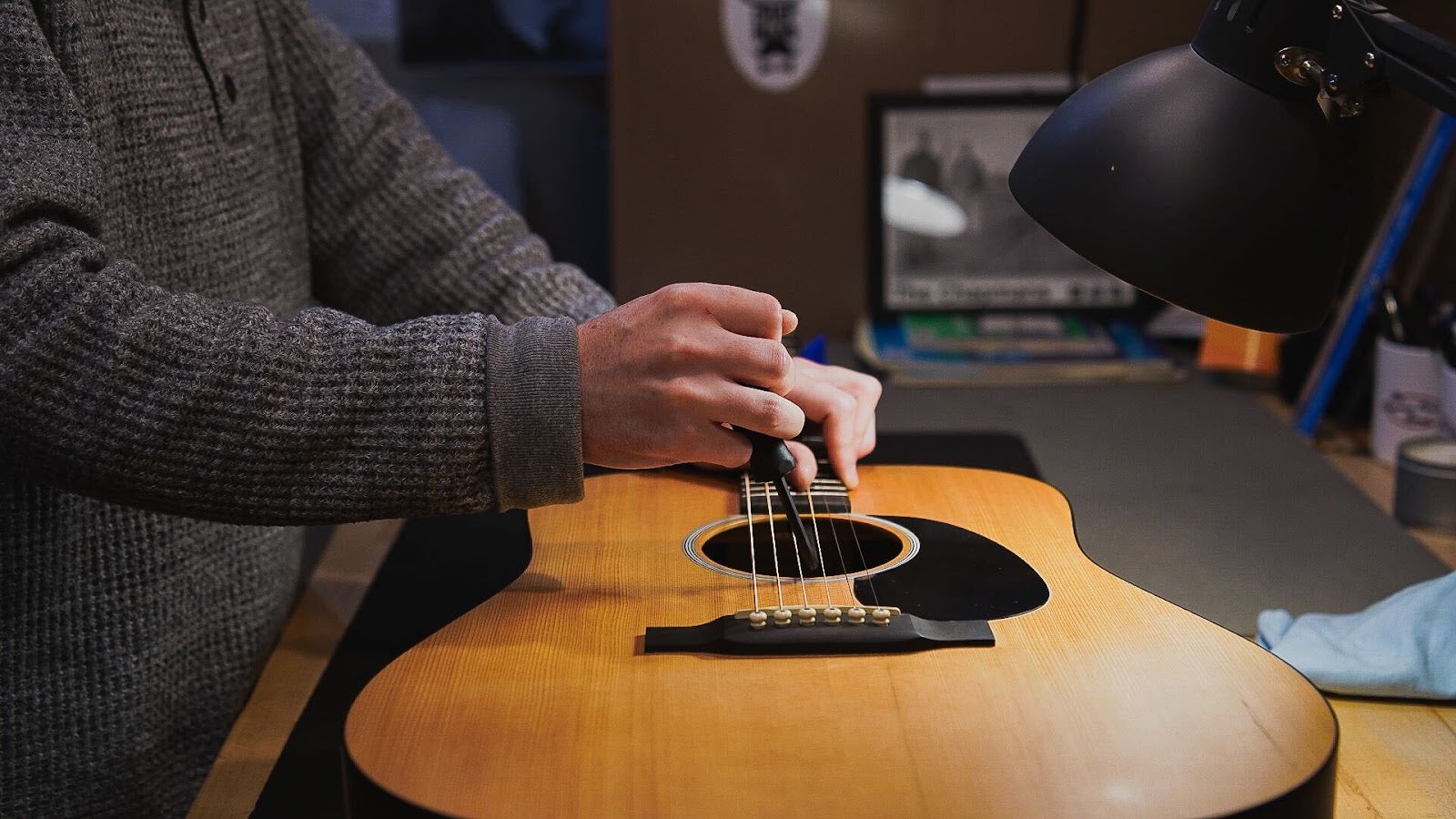
Most systems need the endpin hole reamed out for the output jack. Companies use slightly different jack threads and hole sizes, but L.R. Baggs is consistent across its line, so swapping an Anthem for a HiFi Duet uses the same hole. If you want no modification at all, a soundhole pickup is the way to go, or a guitar that comes with a system already fitted, like the ones in our acoustic-electric guitars. Every guitar we sell, plugged in or not, goes through our 23-Point Professional Inspection before it ships.
Some guitars come with a factory acoustic guitar pickup worth keeping. Our Yamaha Atmosfeel pickup post covers the system in the FG9, and the FG9 vs D-18 blind tests show how that guitar holds up unplugged.
Related reading
- Do I Really Need an Acoustic Amp?
- Yamaha TAG3 C Review: the TransAcoustic Looper Guitar
- Acoustic Guitar Strings: A Comprehensive Guide
Which acoustic guitar pickup should you buy?
If you play solo or with a quiet band and want your guitar to sound like itself, buy a bridge plate transducer and put a good DI after it. If you want that plus air and a knob to fit every room, a blend system like the HiFi Duet or the Anthem is worth the money. If your stage is loud and feedback is the enemy, an under-saddle piezo with an imaging pedal is the safe, proven rig. And if the pickup you have already sounds right for where you play, keep it and spend the money on the DI. Start with our pickups, or call or stop in and we'll help you match a system to your guitar and your stage. Need a plugged-in guitar to go with it? Browse every acoustic guitar we have on the wall.