
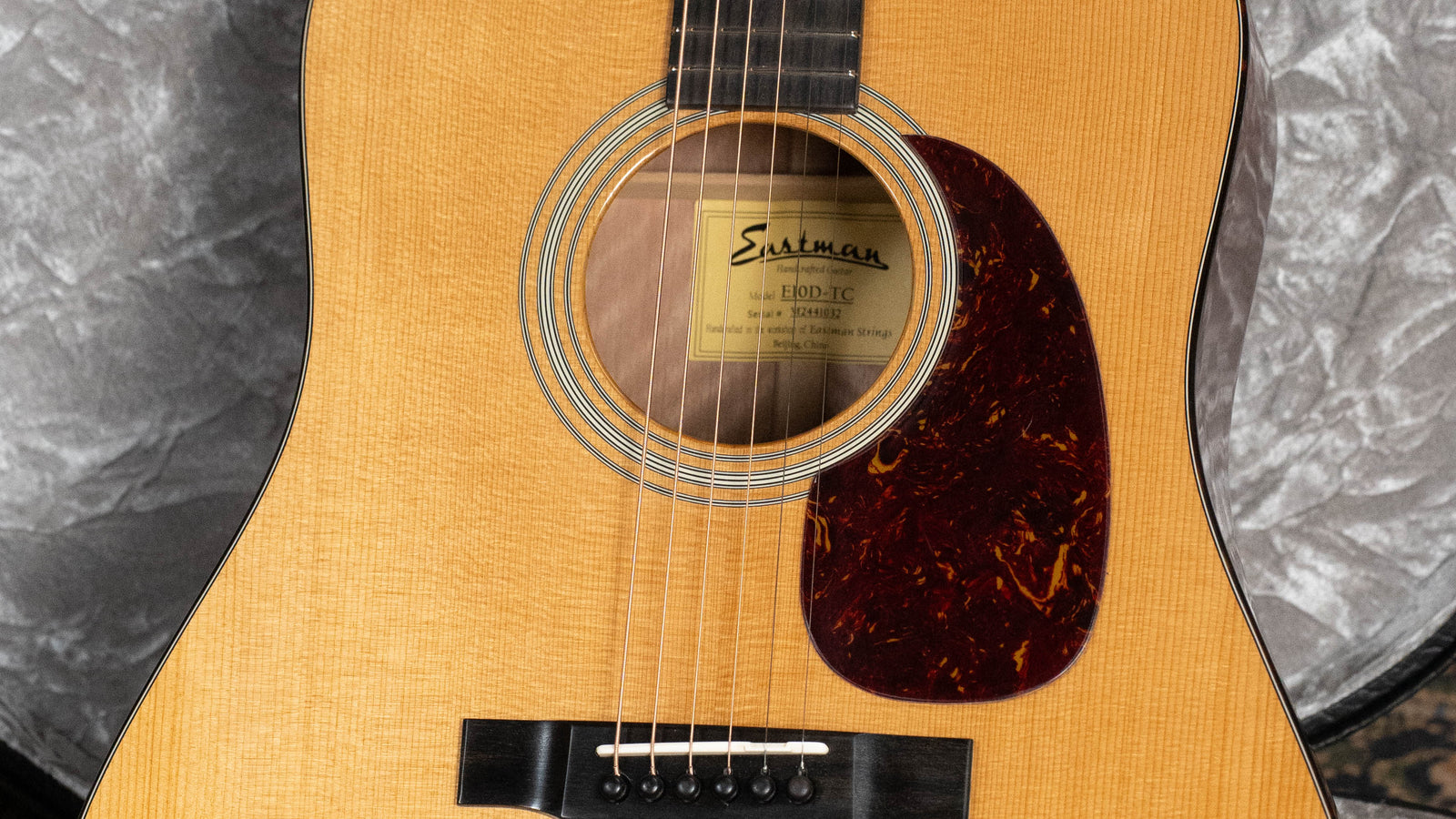
John would rather play his Eastman E10D than Jeremy's Martin D-18 Golden Era, and that's a Golden Era John rates among the best he's played. If you're shopping for a mahogany dreadnought with a red spruce top, that's the question sitting under every listing you open. Is the Eastman E10D really in that company, or is it just the sensible buy at around $1,800?
The short answer from us is that it holds its own, and for a flatpicker it may be the better tool. The longer answer depends on how you play, what you want from mahogany, and what you're willing to give up compared with a $4,000 to $6,000 boutique dreadnought.
What is the Eastman E10D?
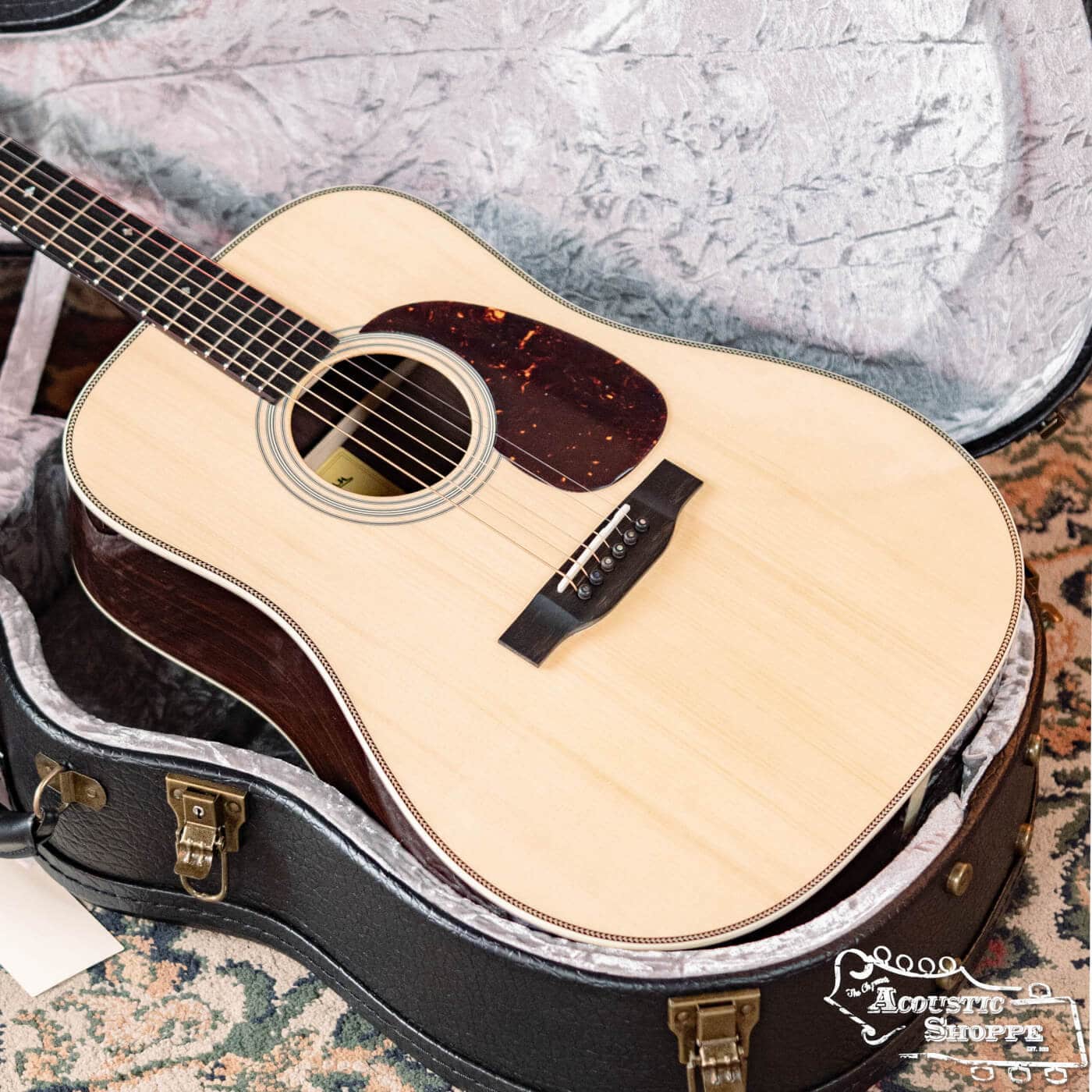
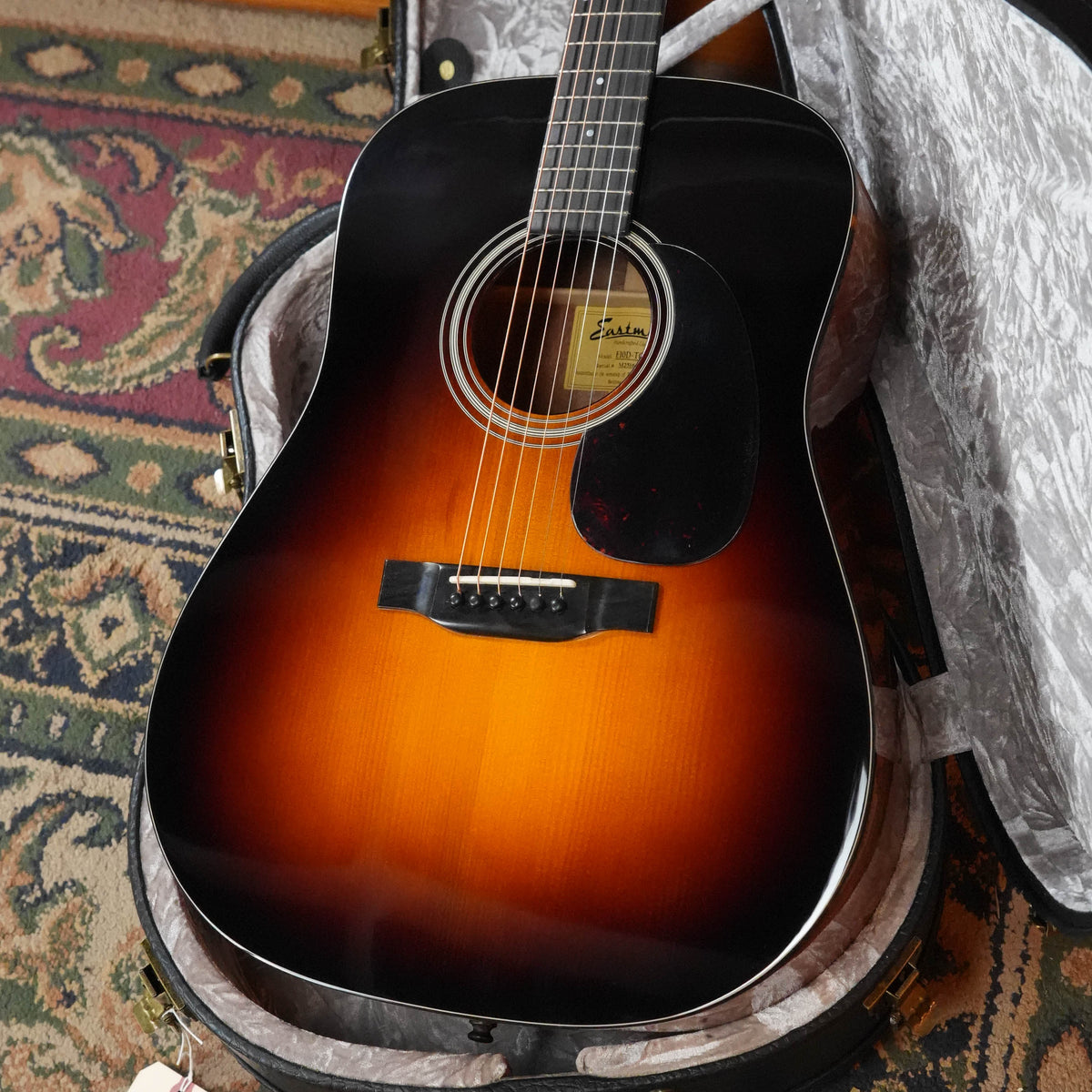
The Eastman E10D is a solid mahogany dreadnought with a solid Adirondack (red) spruce top, and for years it was the best-selling guitar in the Eastman lineup. The current version is the E10D-TC, and the TC means the Adirondack top is thermo-cured, heat-treated so it starts out sounding more like a top that's been played for years. It's part of Eastman's Traditional series, alongside the E8 and E20.
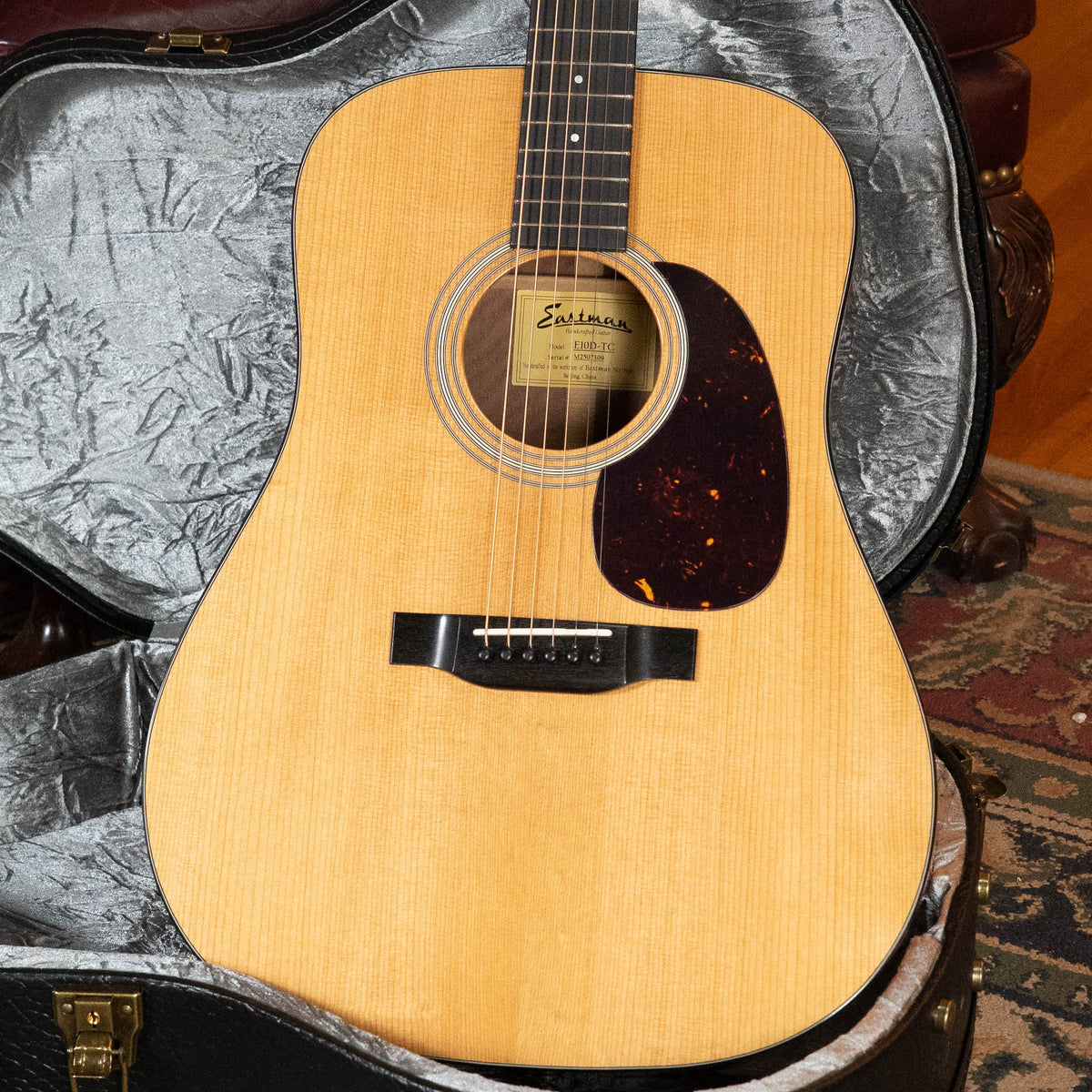
On paper it's built a lot like a pre-war style D-18, which was always its claim to fame, and the current E10D-TC carries:
- Solid thermo-cured Adirondack spruce top: Adirondack has headroom, so the harder you dig in, the more it gives back instead of flattening out.
- Solid mahogany back and sides: a dry, focused low end and a strong midrange, which is where a lead line lives.
- Hand-carved scalloped X bracing: lighter bracing lets the top move under a strong right hand.
- 1-3/4" bone nut and an even C neck: more room between strings for your fretting hand, in a profile that stays comfortable through a long set.
- Ebony fingerboard and bridge, 25.4" scale: the full-scale tension that gives a dreadnought its snap, with a hard, dense ebony board under your fingers.
Most boutique builders charge an upgrade fee just to put an Adirondack top on a dreadnought. When the Eastman E10D first came out it sold for around $1,000, about what that Adirondack upgrade alone costs from a boutique builder, and today the E10D-TC is $1,799. Eastman also buys its Adirondack from the same supply a lot of the big-name builders use, so you're getting the top other makers charge a premium for, already built in.
Jump to: the specs at 2:33 · John's E10D vs the D-18 Golden Era at 5:03 · why mahogany suits flatpickers at 6:14 · the dovetail neck joint at 9:38 · tone samples at 11:19.
Is the Eastman E10D as good as a Martin D-18?
This is the comparison everyone makes, and it's a fair one, because the E10D was built around the same recipe. Jeremy owns a D-18 Golden Era and John plays it a lot. John also owns an E10D, an older oddball he bought about eight years ago that has become one of his favorite guitars, and he prefers it to the Martin:
"I find it to be a louder, punchier guitar. It has more low end, and it does more of what I want." (John, on his E10D next to Jeremy's D-18 Golden Era)
That isn't a knock on the Martin. John's view is that, tone for tone and on playability, the E10D lands right in the D-18's range in a head-to-head: sometimes a little below, sometimes a little above, before you even factor in price. If you want to hear the two played blind, our E10D vs D-18 blind test puts them side by side, and our list of D-18 alternatives runs six mahogany dreadnoughts against each other.
| Dreadnought | Top | Back and sides | Price today |
|---|---|---|---|
| Eastman E6SS-TC (slope shoulder) | Thermo-cured Sitka spruce | Mahogany | $1,379 |
| Eastman E10D-TC | Thermo-cured Adirondack spruce | Mahogany | $1,799 |
| Eastman E20D-TC-SB | Thermo-cured Adirondack spruce | Rosewood | $2,119 |
| Eastman E40D-TC | Thermo-cured AAA Adirondack spruce | Rosewood | $2,999 |
Prices are from our store on the date of this update; the video itself is from 2023, when the E10D sold for less.
Why do flatpickers choose an Eastman E10D over a rosewood dread?
Back in the mid-1980s, hardly anybody wanted a mahogany guitar. The D-28 was the guitar you had to have, and rosewood was the default. That made sense when most dreadnoughts were rhythm guitars, because rosewood has more low-end richness and thickness behind a singer. Today's players are more likely to flatpick leads, fast, and that's where mahogany's brightness and midrange pop come in. The E10D has plenty of low end, but where it stands out is in the mids, right where a lead line needs to sit.
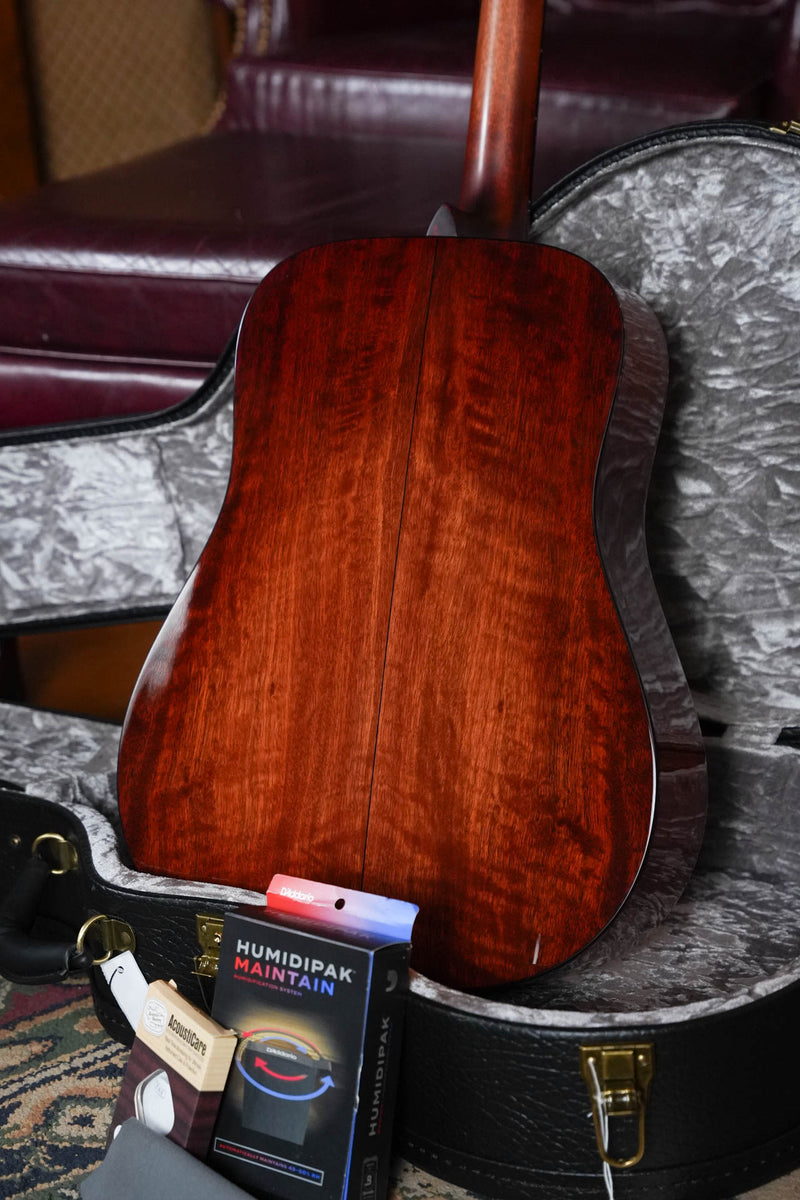
Rosewood tends to sustain longer, so the note you just played is still ringing when you hit the next one, and in a fast run that rolls over and clouds things up. Mahogany is tighter and more precise:
"It's almost like putting a compressor on a guitar in the studio, where it's just getting rid of some of those in-between notes."
There's a jam-session reason too. Higher frequencies are perceived as louder, and a guitar in a bluegrass group tends to get buried under the banjo and fiddle. A little more brightness and midrange pop helps the Eastman E10D stand out in that mix and gives you more oomph when it's your turn. For the longer version of this argument, read our mahogany vs rosewood comparison.
Does the dovetail neck joint matter?
Eastman's Traditional series, including the E10, E8 and E20, keeps a dovetail neck joint, while some of Eastman's more modern designs use a newer neck system developed with Dana Bourgeois. Early on, Eastman sent us a couple of damaged guitars with the backs cut off so we could show people the bracing and the joint, and that dovetail was one of the tightest we've ever seen. It's a skilled job that takes more time, which is why the newer system is easier to repeat consistently. Whether the joint changes what you hear is a separate question, and we've done a whole video on it; for this guitar, think of the dovetail as traditional build quality you get at this price.
Recent E10Ds have picked up a few other changes from the Eastman and Bourgeois tie-in, including thinner bracing and new finishes. Every E10D also gets its final adjustment at Eastman's shop in Pomona before it ships to us.
What's the catch with the Eastman E10D?
There are a few honest ones:
- It isn't a rosewood guitar. If you mostly strum and sing, the rosewood E20D-TC-SB will give you the thicker low end that sits under a voice.
- Boutique dreadnoughts still win on the little things. John will put the E10D up against a $4,000 to $6,000 guitar without feeling disappointed, but he'll also tell you those builders do some small things a bit better.
- It's not a Martin. If the name and resale value matter to you, buy the D-18; that's a real reason, not a weakness in the Eastman.
Who should buy the Eastman E10D?
Buy it if you're a bluegrass flatpicker or lead player who wants Adirondack headroom and mahogany clarity without paying boutique prices. John's advice goes further than that: even if budget isn't your main concern, put the E10D on your shortlist of mahogany dreadnoughts at any price and play one before you decide.
"If you're looking for a mahogany guitar with a red spruce top, you're going to have a hard time beating this." (John)
Look elsewhere if you're a strummer and singer who wants rosewood's low-end thickness (the E20D-TC-SB or the AAA-top E40D-TC), or if your budget tops out closer to $1,400, where the E6SS-TC slope shoulder pairs a thermo-cured Sitka spruce top with mahogany back and sides in a slope-shoulder body. Our E10D vs LD60e vs FG5 scorecard compares it with two other mahogany dreadnoughts in a similar price range.
Buying an Eastman E10D from us
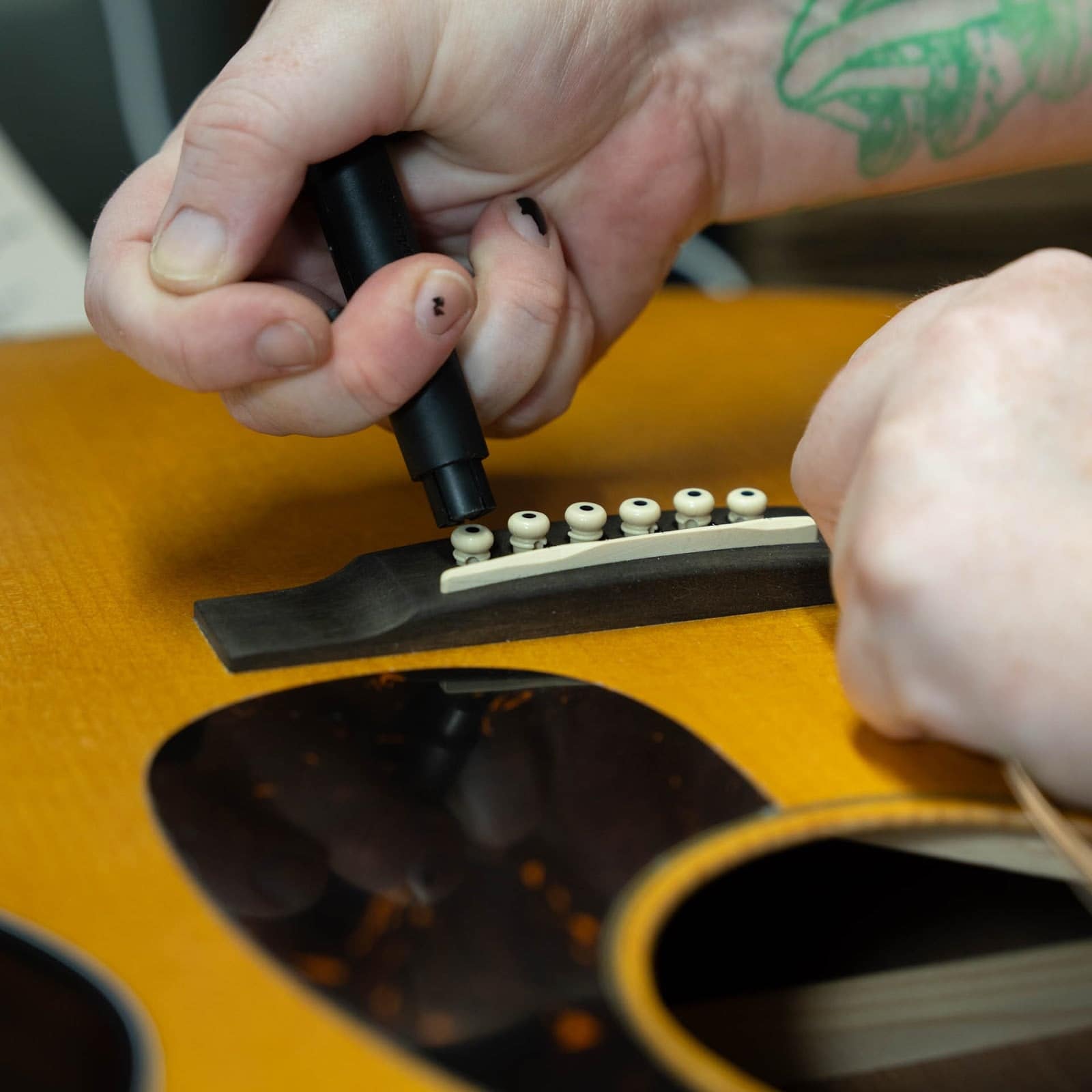
Every guitar we ship gets our 23-Point Professional Inspection before it leaves the building, so it plays the way it should out of the box.
At $1,799, the E10D-TC is covered by our Dread-Not Guarantee: a full year to trade it in for up to 90% of the pre-tax purchase price in credit, less round-trip shipping, plus a 30-day in-home trial. So if your playing changes and you want a rosewood dread next year, the guitar you buy today still counts toward it.
We're the #1 Worldwide Dealer for Eastman guitars and mandolins, and the E10D is one of the models that got us there. Browse every model in our Eastman guitars collection, see every mahogany and rosewood option in our dreadnought guitars, or shop acoustic guitars across every brand we carry. To ask about the E10D-TC we have in the shop right now, contact us, and we'll tell you how it plays.
Related reading
- The best mahogany dreadnoughts under $1,600
- Our Eastman E20D review, the rosewood sibling