
Table of Contents
Most players come to a 12 string guitar the same way. You already own a six-string you love, and then you hear the opening of "Wish You Were Here" or "Hotel California" and realize no amount of strumming on your own guitar is going to make that shimmer. So you start shopping, and you find out quickly that 12 strings run from a few hundred dollars to more than most people pay for their main guitar, and that the cheap ones have a reputation for being hard to play.
That reputation is earned, but it isn't the whole story. A 12 string guitar asks more of its builder than a six-string does, and the difference between a good one and a frustrating one comes down to a few things you can check before you buy. For most players a well-built 12 string under $1,000 is plenty, and the solid-wood jumbos earn their price only if the 12 string is going to be your main voice. Below is what we check, and the four we have in stock right now.
Paired strings give a 12 string guitar its shimmer
A 12 string guitar has six pairs of strings, called courses, and you fret and pick each pair as if it were one string. The trick is in how those pairs are tuned. On the four lower courses, the second string is an octave above the main string, and on the two highest courses you tune the pair to the same note. Here's how a standard 12 string is laid out from low to high:
- Low E course: a regular low E plus a thin E an octave higher
- A course: an A plus an A an octave higher
- D course: a D plus a D an octave higher
- G course: a G plus a G an octave higher, which is the thinnest string on the guitar
- B course: two B strings tuned to the same note
- High E course: two high E strings tuned to the same note
Every note you play is doubled, and that's where the chorus effect comes from. The two strings in each pair never ring in perfect lockstep, so the sound spreads out and keeps moving. That's why a 12 string fills up a song so fast, and why players usually reach for it on rhythm parts and intros, and less often for single-note lead lines.
We reviewed the Eastman AC330E-12 a while back, and the video below covers most of what this post talks about. Jump to 3:00 for why a 12 string is usually your second guitar, 4:21 for what makes one easy or hard to play, 5:13 for string tension, and 6:04 for the tone sample.
Playability matters more on a 12 string guitar
Twelve strings pull on the neck and the top a lot harder than six do, and that extra load is the root of every complaint you've heard about 12 strings. If the nut is cut a little high or the neck isn't built to handle the pull, the guitar fights you on every chord. Here's the short version:
"Twice as many strings means twice as much tension, so it's harder to play usually. It's also more tension on the build of the guitar."When the builder doesn't plan for that load, it can be close to impossible to play, and over time the pull can even bend the neck out of shape.
That's why we care about how a 12 string was built as much as what it's made of. The guitars worth owning are designed as 12 strings from the start, with a neck and bracing meant for the load, and not a six-string body with a 12 string neck stuck on it. The two Taylors and the Guild in our stock list all have a 1-7/8" nut, which gives each pair of strings enough room that your fingers aren't crowding the next course when you fret a chord.
"For a 12 string you really want it to be pretty easy to play. You're doubled up on the strings, so you want it to be easy to play, and you want it to still project a lot."Every guitar we ship goes through our 23-Point Professional Inspection before it leaves the building, and on a 12 string that bench time matters more than usual, because the nut slots, the action and the neck relief all have to be right for twelve strings to feel like six.

Most players don't need to spend over $1,000 on a 12 string guitar
John's take is that most people don't make a 12 string their main guitar, and that should shape the budget:
"Usually you're not going to put your entire guitar budget into your 12 string, but you want a high quality one."We agree with that for most players. If the 12 string comes out for a handful of songs a night, a well-made guitar in the $500 to $1,000 range will cover you, as long as it plays easily. If you're a songwriter who writes on a 12 string, or you play it for whole sets, it's worth moving up to a solid-wood jumbo with a real pickup system, because you'll feel the difference in how the low courses bloom and how the guitar sounds plugged in.
Here's how the four 12 string guitars on our wall compare, using the specs from each listing:
| Guitar | Price | Body | Top | Back and sides | Pickup |
|---|---|---|---|---|---|
| Yamaha FG820-12 | $479.99 | Dreadnought | Solid spruce | Mahogany | None listed |
| Taylor 150ce | $899.00 | Dreadnought cutaway | Solid torrefied spruce | Layered sapele | Expression System 2 |
| Taylor Legacy 855e | $3,499.00 | Jumbo | Solid Sitka spruce | Solid Indian rosewood | LR Baggs Element VTC |
| Guild F-512E | $4,135.99 | Jumbo | Solid Sitka spruce | Arched flamed maple | LR Baggs Anthem |
The 12 string guitars we have in stock
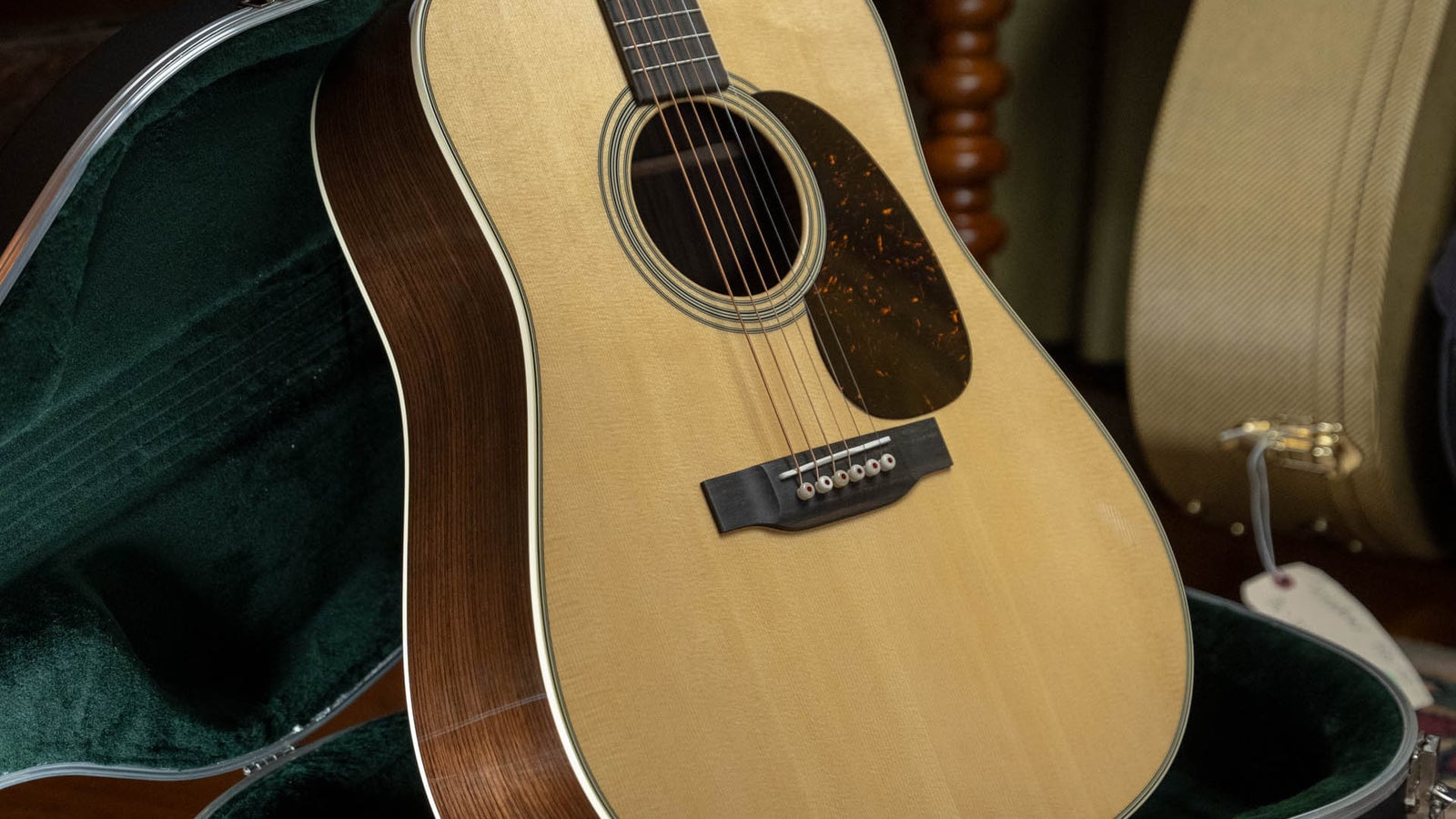
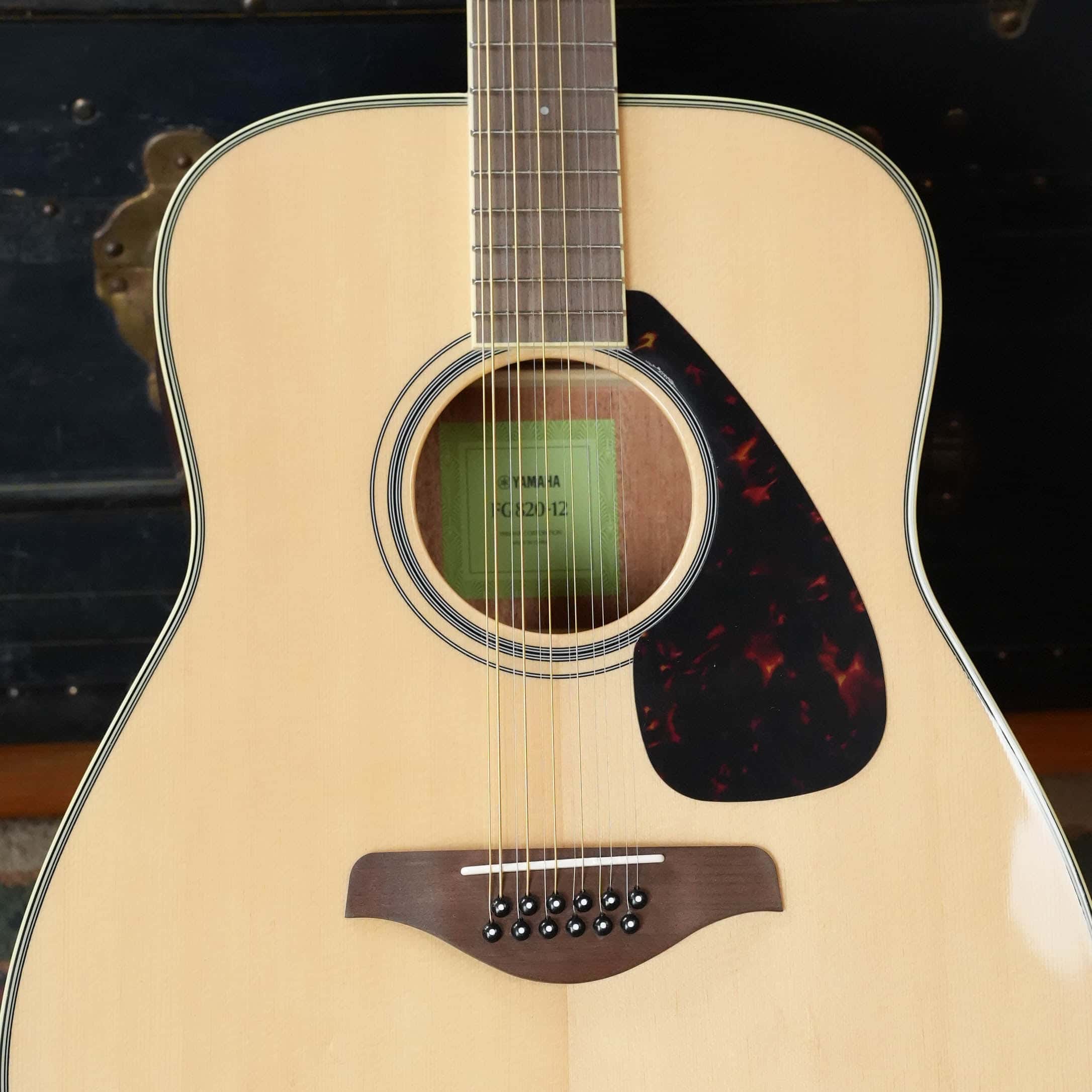
The Yamaha FG820-12 is where we'd point a player who wants a 12 string for a few songs and doesn't want to spend much to get there. It's a traditional dreadnought with a solid spruce top over mahogany, and the spruce top keeps the attack clear while the mahogany adds warmth and keeps the low end from getting loose, so chords stay separated enough to sound musical. At $479.99 it's the least expensive way into a good 12 string guitar on our wall.
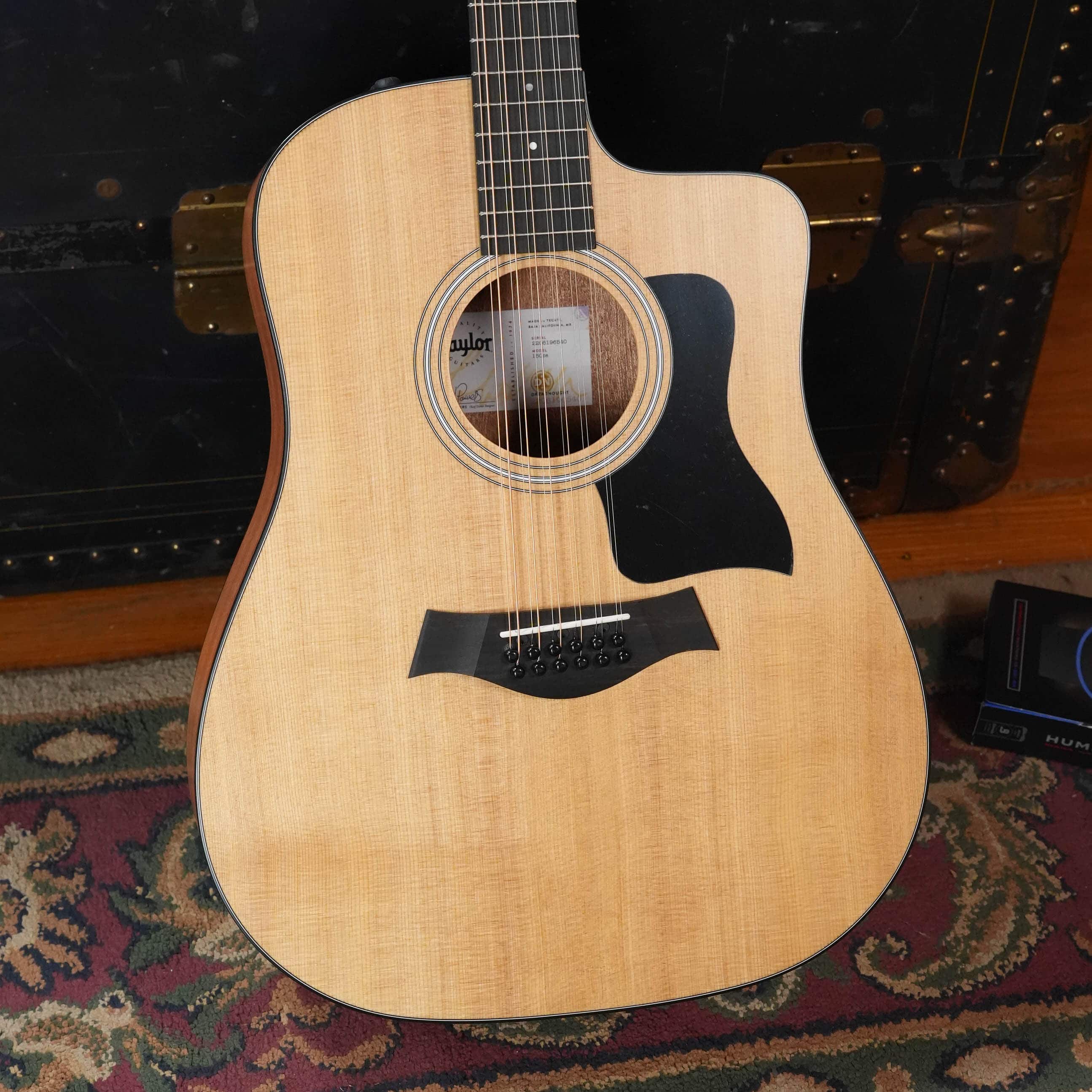
If you play out, the Taylor 150ce is the one we'd look at next. It adds a cutaway and Taylor's Expression System 2 pickup, so it goes straight into a PA, and Taylor heat-treats its spruce top so it responds more like an older, played-in top. The layered sapele back and sides give it a focused midrange close to mahogany, which keeps the shimmer from turning harsh, and it ships in a gig bag.
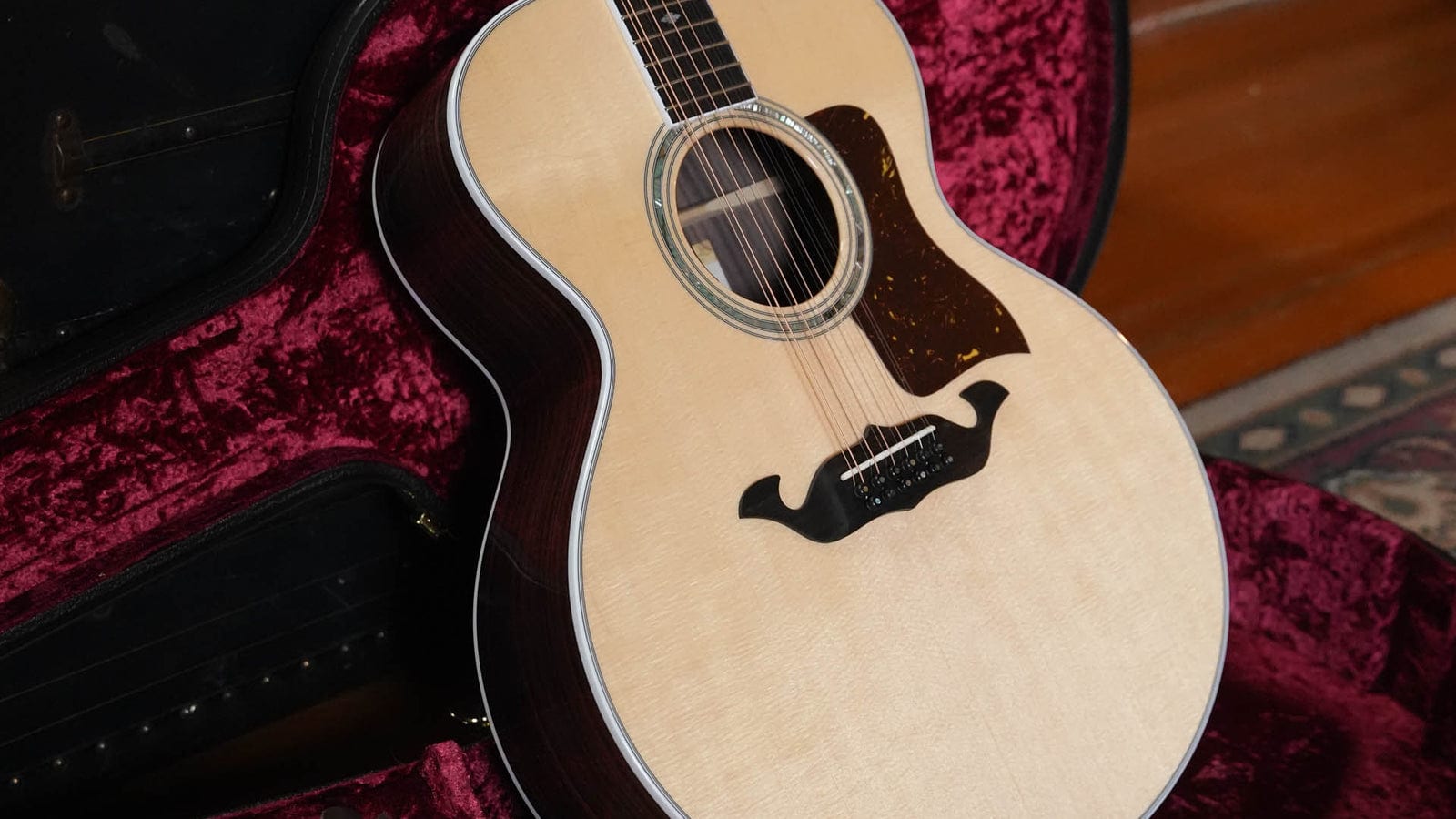
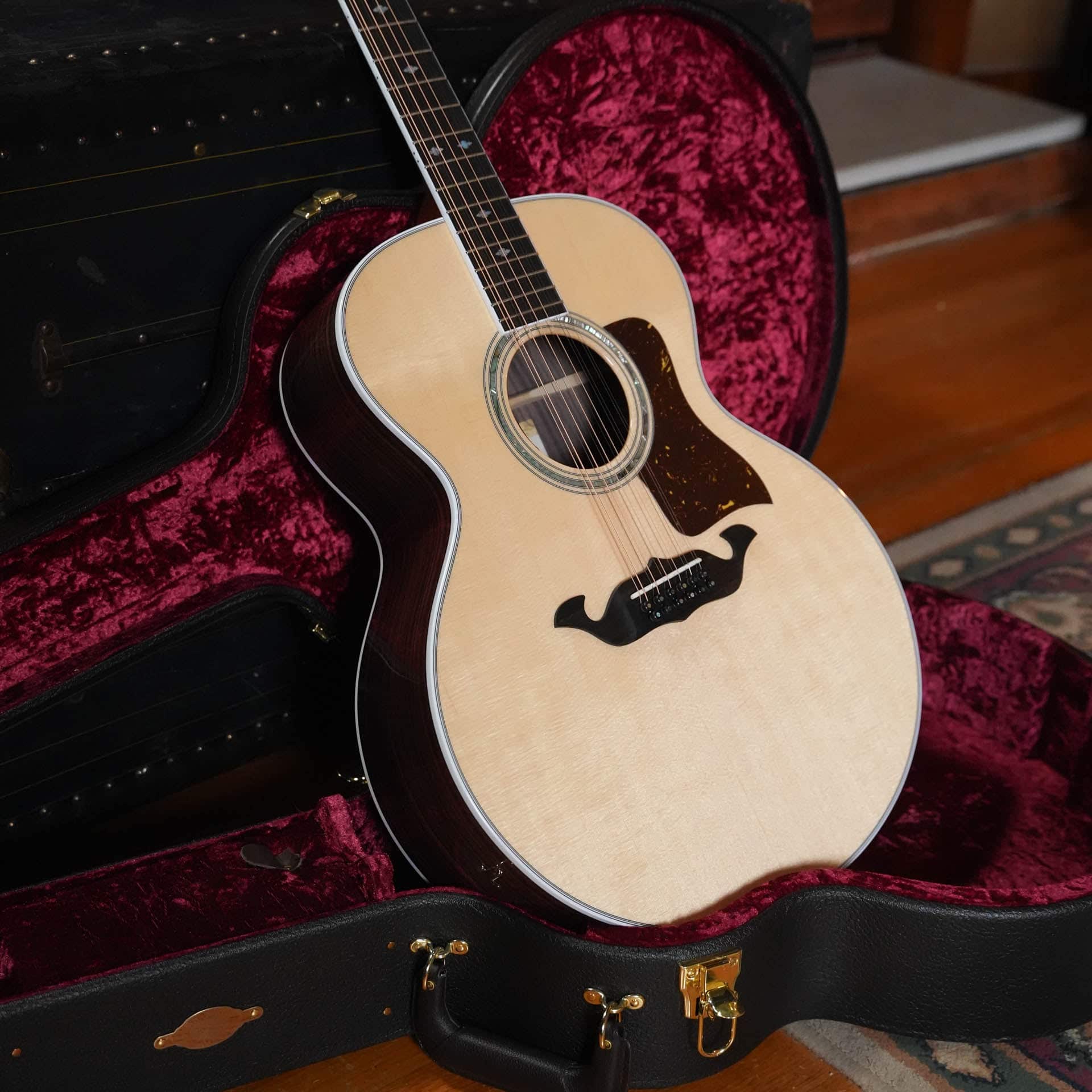
The two jumbos are a different conversation, so take them on their own. Taylor's Legacy 855e brings back the 17-inch jumbo body and traditional X-bracing from Taylor's early 12 strings, with solid Indian rosewood behind a solid Sitka top. That big air chamber gives the octave strings room to bloom, and the rosewood adds a warm, deep low end under the sparkle. It ships in Taylor's Deluxe hardshell case, and the LR Baggs Element VTC pickup means you can take that jumbo sound to a stage.
Guild voices the F-512E bright and balanced, pairing a solid Sitka top and scalloped X-bracing with arched flamed maple, which keeps the strings separated and the low end tight when you dig in. Its LR Baggs Anthem system adds volume, mix and phase controls for playing through a PA. Ours is a Stage Ready unit, which means it's new with a cosmetic mark, in this case some surface scratches on the headstock from tuner installation, shown in the listing photos.
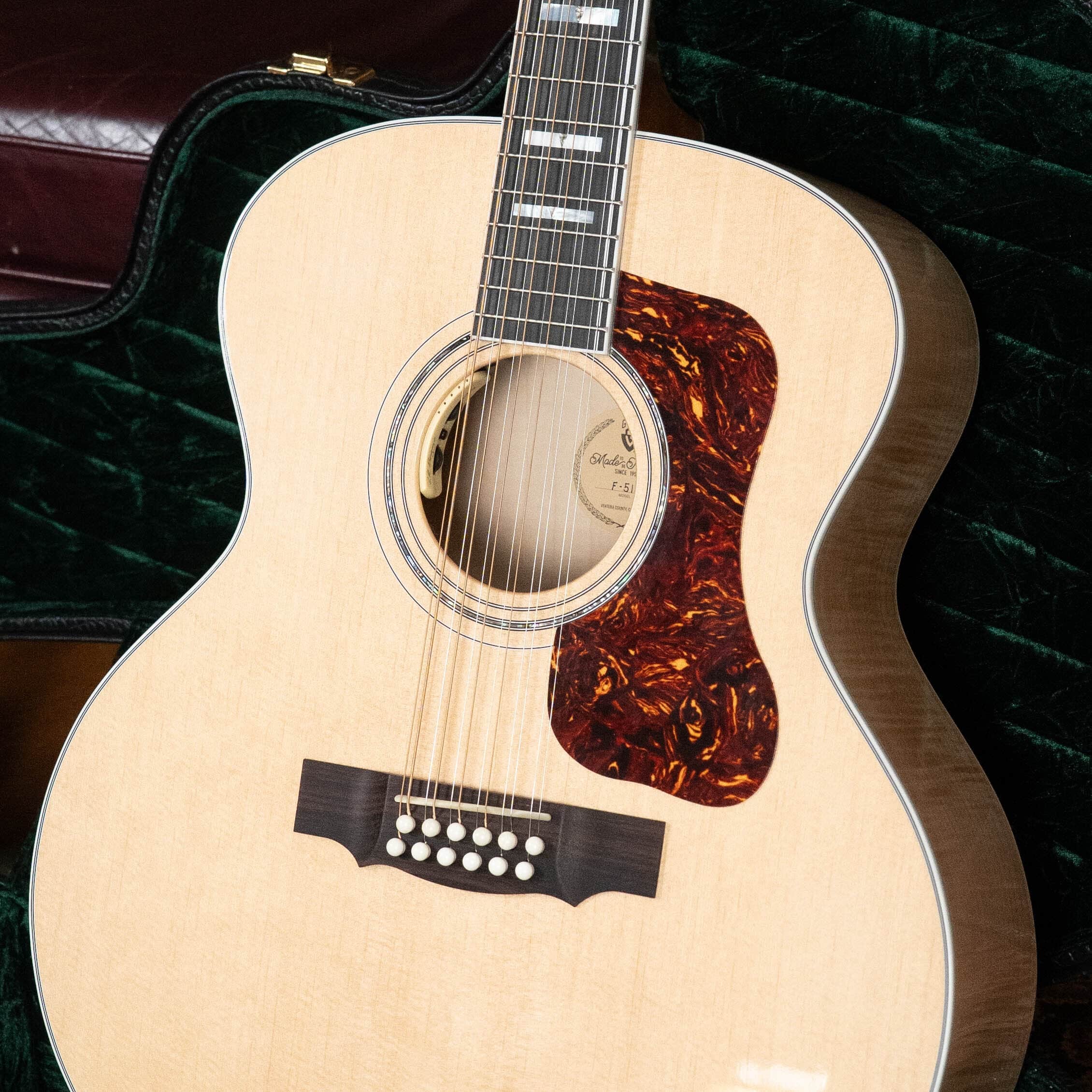
The Eastman AC330E-12 from our review isn't listed on the site as we write this, so you won't find it in the table. You can see everything else in our 12 string guitar collection, and if you want to compare body sizes first, our jumbo guitars and dreadnought guitars are a good place to start.
How to try a 12 string guitar before you buy
In our showroom or at home with a new one out of the box, these checks tell you in a few minutes whether a 12 string is going to be easy to live with or a fight:
- Tune all twelve strings carefully before you judge anything. A 12 string with one octave string slightly off sounds sour, and it's easy to blame the guitar for it.
- Play an F barre chord at the first fret. This is where a high nut shows up first, because the pairs are hardest to press down right next to the nut.
- Move up to the seventh fret and play the same shape. If it gets much harder as you go up the neck, the action is too high for twelve strings.
- Strum hard, then strum soft. A good 12 string keeps the notes separated when you lean into it and still speaks when you play soft.
- If it has a pickup, plug it in. The chorus effect can get harsh through a cheap system, so listen at the volume you play at.
Strings matter here too. The two Taylors and the Guild all ship with light strings, and when it's time to restring you can find sets on our acoustic guitar strings page. Our guide to acoustic guitar strings explains how gauge changes the feel. If you use a capo, make sure it clamps all twelve strings cleanly on a 1-7/8" neck before a gig, or pick one from our guitar capos. For humidity and storage, our acoustic guitar care guide covers what every acoustic needs.
Which 12 string guitar is right for you
If the 12 string is your second guitar and it comes out for a few songs, start with the Yamaha FG820-12, and step up to the Taylor 150ce if you need to plug in. If you write songs on a 12 string guitar or play it for whole sets, the extra money for a solid-wood jumbo shows up every time you play, and the choice between the Taylor Legacy 855e and the Guild F-512E comes down to warm rosewood or bright, tight maple.
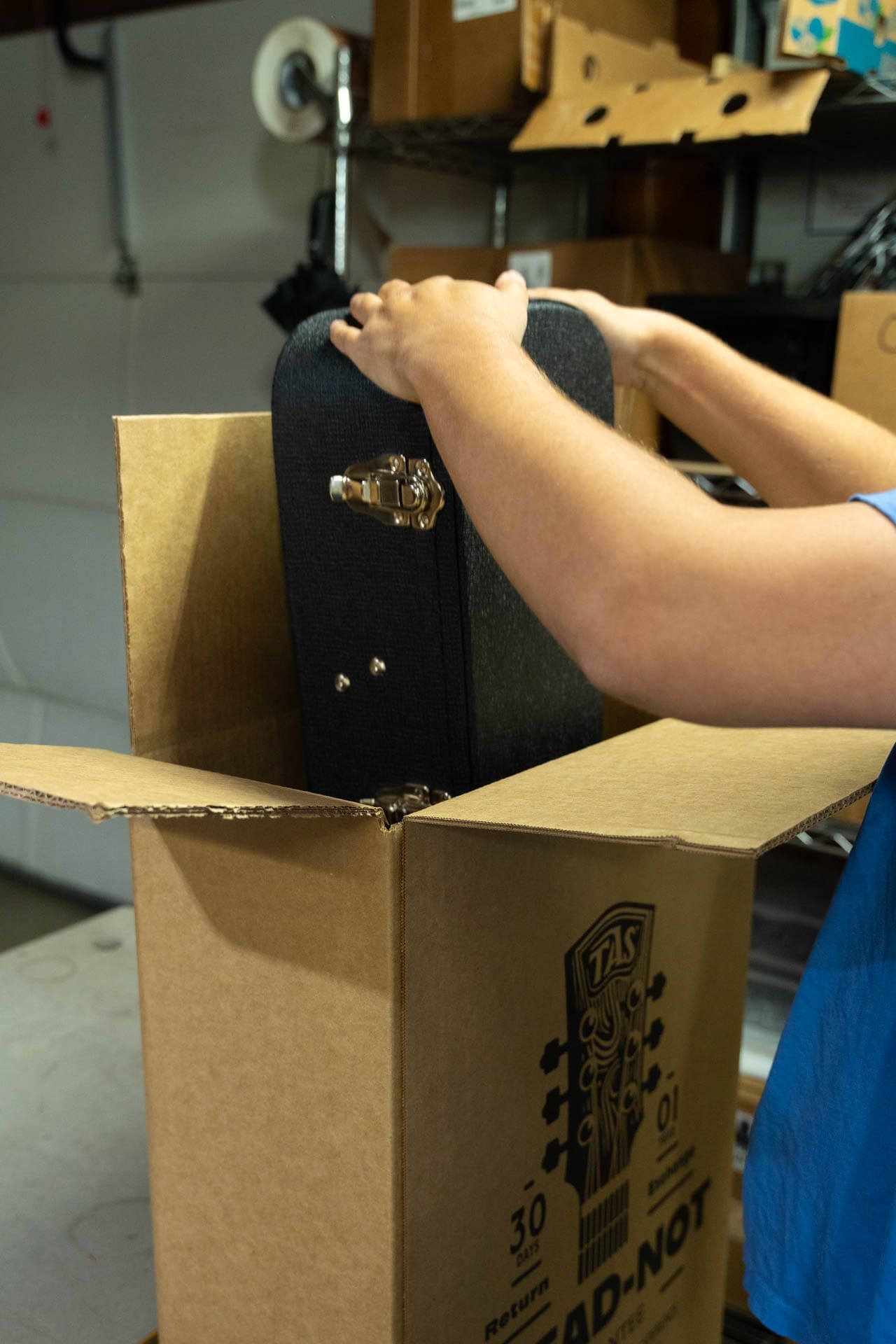
Our Dread-Not Guarantee covers both jumbos and includes a one-year trade-in credit of up to 90% depending on condition, so if you decide later that you'd rather have a six-string, the money you put into the guitar isn't stuck there.
The Acoustic Shoppe is an Authorized Taylor Premier Dealer and Gold Label Advantage Dealer, and you can see everything we have from them on our Taylor guitars page. If you're still deciding between a 12 string and another six-string, you can shop acoustic guitars of every kind in one place.
Related reading
- Dreadnought vs. OM: choosing your guitar shape
- The acoustic pickup systems we trust for live playing
- Our top capos for acoustic guitar