
You've decided to learn mandolin, you've set a budget, and you've narrowed it to two A-styles that look almost the same on paper: the Eastman MD305 and the Kentucky KM-150. Both have carved spruce tops, maple backs and sides, and price tags close enough that the spec sheet won't settle it. If you're weighing the Kentucky KM-150 against the Eastman, the useful question is which one you'll still want to pick up after the first month, when your fingertips hurt and the novelty wears off.
We had both on the bench, went through them point by point, and then played them back to back. They didn't finish close on feel, the Kentucky won on looks, and both of us would buy the Eastman. Below is why, and who should buy the Kentucky instead.
Why a cheap mandolin holds beginners back
As a mandolin instructor, Jeremy struggled for a while to find a starter instrument that wouldn't hold his students back, and most of the cheaper options on the market are ones we still don't recommend. A mandolin is harder to build cheaply than a guitar because of the tension. You're fretting eight strings in four pairs on a short scale, so pressing a chord takes roughly twice the effort of the same shape on fewer strings. The top has to be carved and graduated properly to carry that load, or it sinks over time.
Budget makers usually cut that corner in one of two ways. Some press a laminated top and back into shape, which is rigid and doesn't give much tone. Others carve a solid top but leave it thick so it never comes back on warranty, which protects the maker on warranty but leaves the mandolin sounding dull. A bad setup makes it worse: strings a quarter inch off the fretboard, and a new player can't get a clean note without killing their fingers.
"You're not going to stick with it because it hurts, doesn't sound good, and it's not enjoyable. And it shouldn't be that way."
That's why we set a floor for starter mandolins and don't stock below it. Both of these clear that floor. They're the kind of instrument that carries a player through the first three or four years without needing to be replaced.
Eastman MD305: what you get for the money
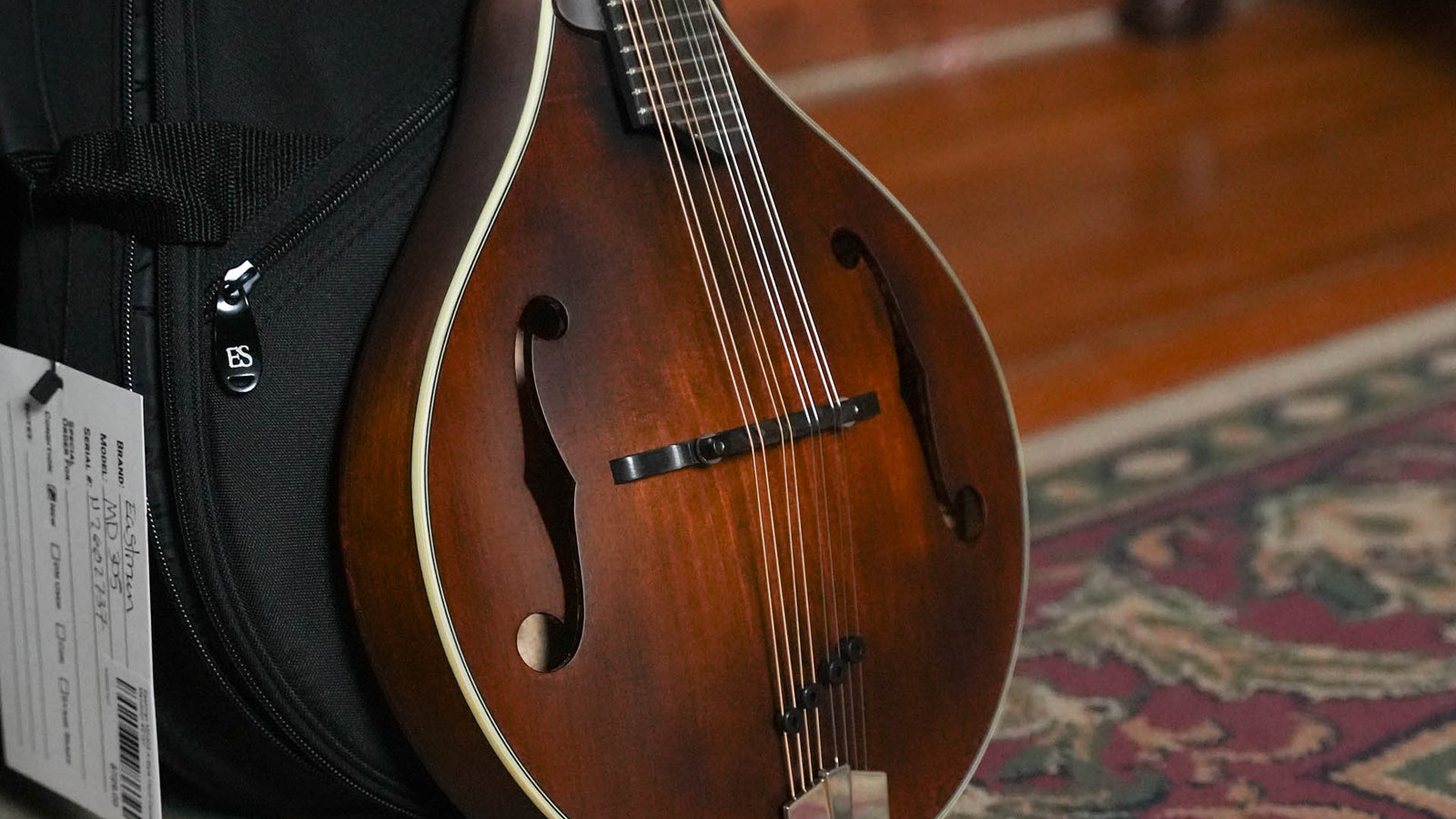
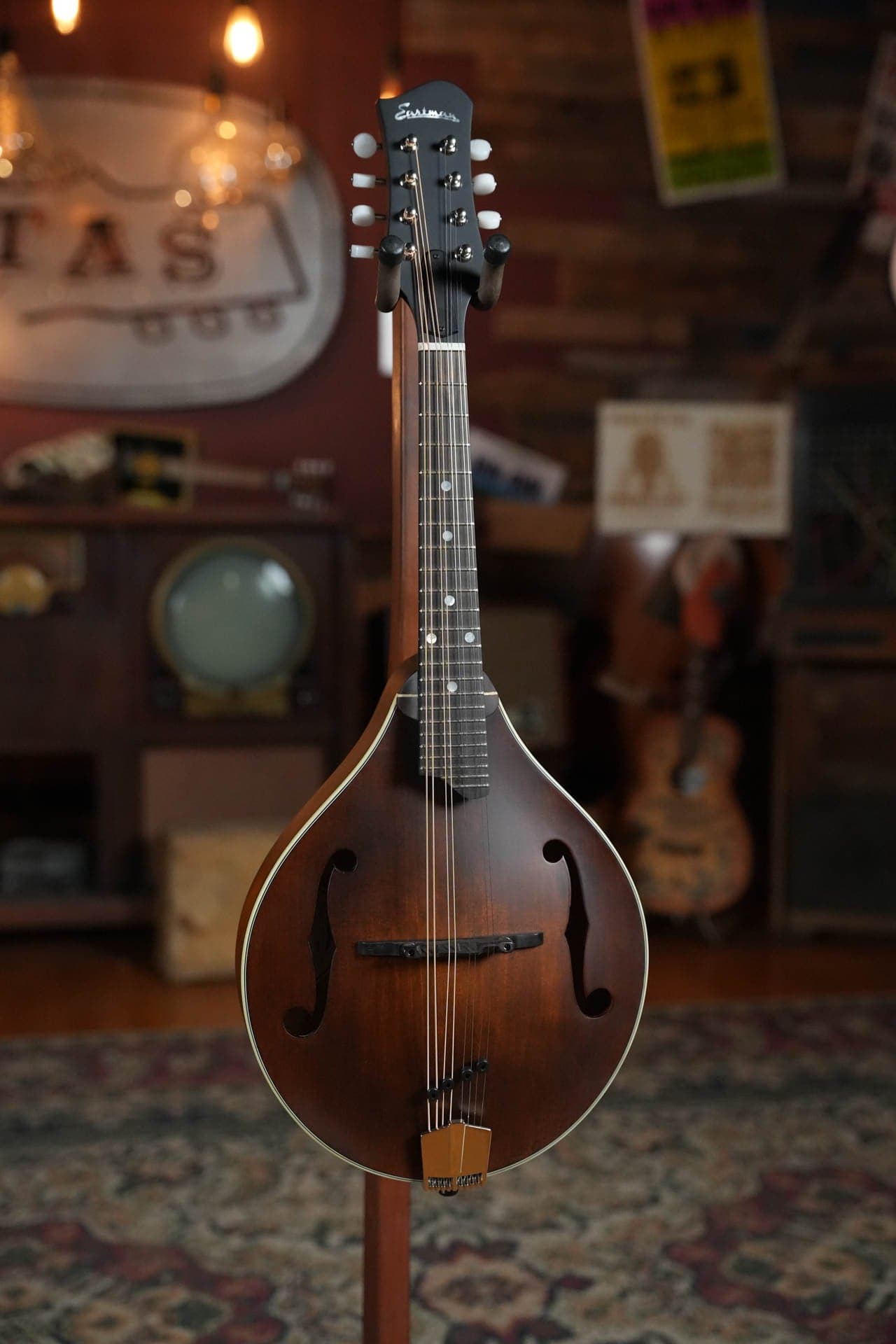
The Eastman MD305 is the mandolin that sold Jeremy on Eastman. It's Eastman's entry A-style, and it's plain on purpose: the top is bound and the fretboard and back aren't, so the money goes into the parts you hear and feel. Every top is hand-carved and hand-voiced, which means each one is braced and graduated a little differently depending on how thick that piece of spruce is.
Here's what's on the unit we have in stock today (from the listing):
- Solid Adirondack spruce top and solid maple back and sides, in a satin finish
- Ebony fretboard with a 12" radius, and larger frets than a typical mandolin's, which make clean notes easier to get
- 13 7/8" scale and a bone nut 1 3/16" wide
- Adjustable compensated ebony bridge, and an Eastman cast aluminum tailpiece
- Adjustable truss rod and a padded gig bag
The binding is better than it looks at first glance. It's grained ivoroid with black and white purfling lines on the top, where you'd expect a single strip of plastic at this price. The cast tailpiece matters too. Stamped tailpieces have thin prongs that break, and the slide-on cover can rattle against the strings, so a cast one is one less thing to fix later.
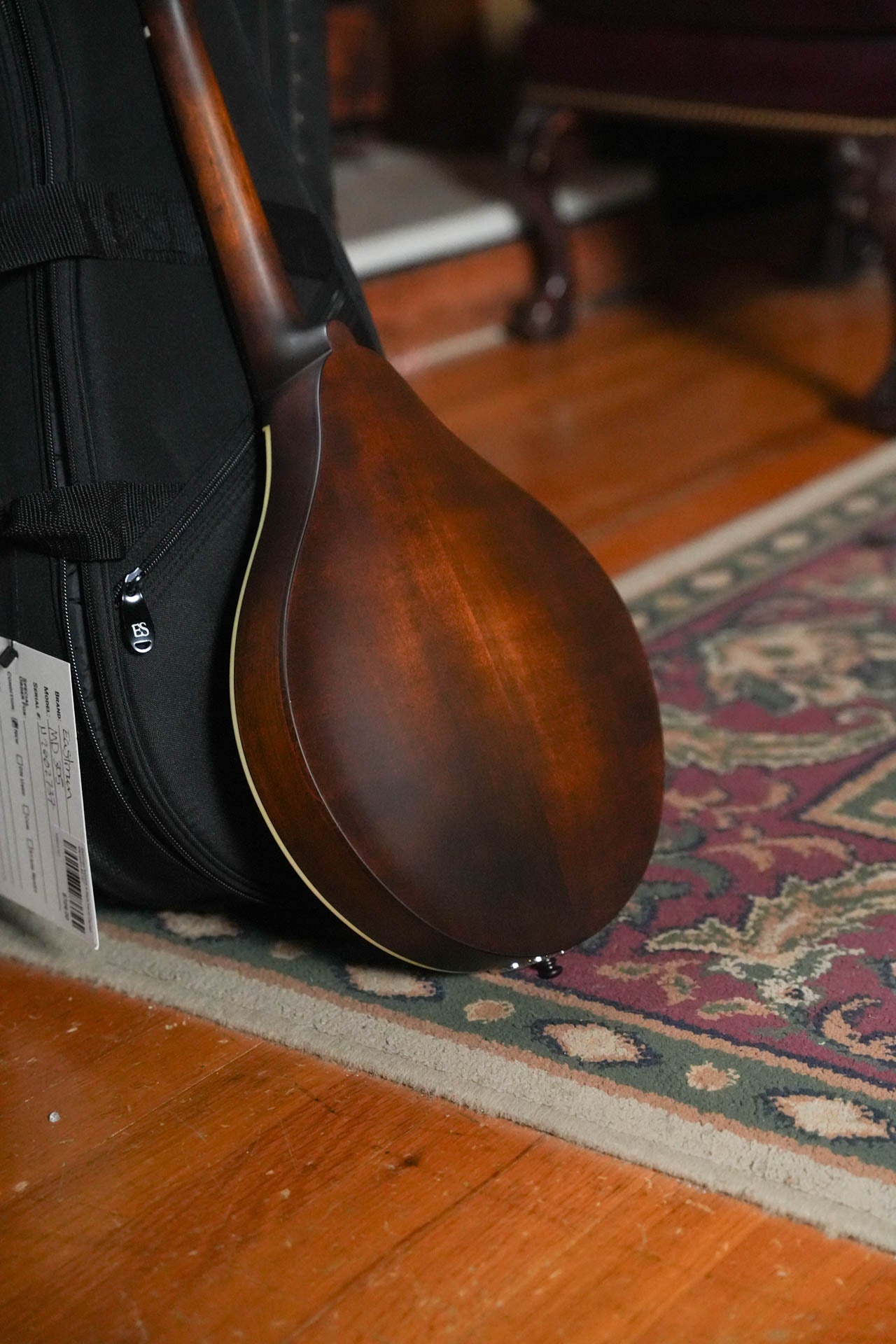
The point we'd make about any mandolin at this level is the bridge. Every carved top is a little different, so the foot of the bridge has to be shaved to match it, with the whole surface touching the top and no gaps. A gap means the string energy isn't getting into the top. On a lot of inexpensive instruments the foot is left arched and the bridge rocks, so it isn't stable and doesn't connect. Fitting one properly by hand takes about an hour of shaving, sanding and checking, and a well-fitted bridge is one of the MD305's big advantages.
Jump to: the bridge fit at 7:39 · the KM-150 rundown at 10:02 · the play-off at 14:51 · our verdicts at 16:08.
Kentucky KM-150: deep tone, gloss finish, a few shortcuts
The Kentucky KM-150 is a starter from a brand that's well respected in the mandolin world, and one of us has owned Kentucky mandolins over the years. Kentucky calls the KM-150 hand-carved. It doesn't claim the hand voicing Eastman does, which is a real difference at this price.
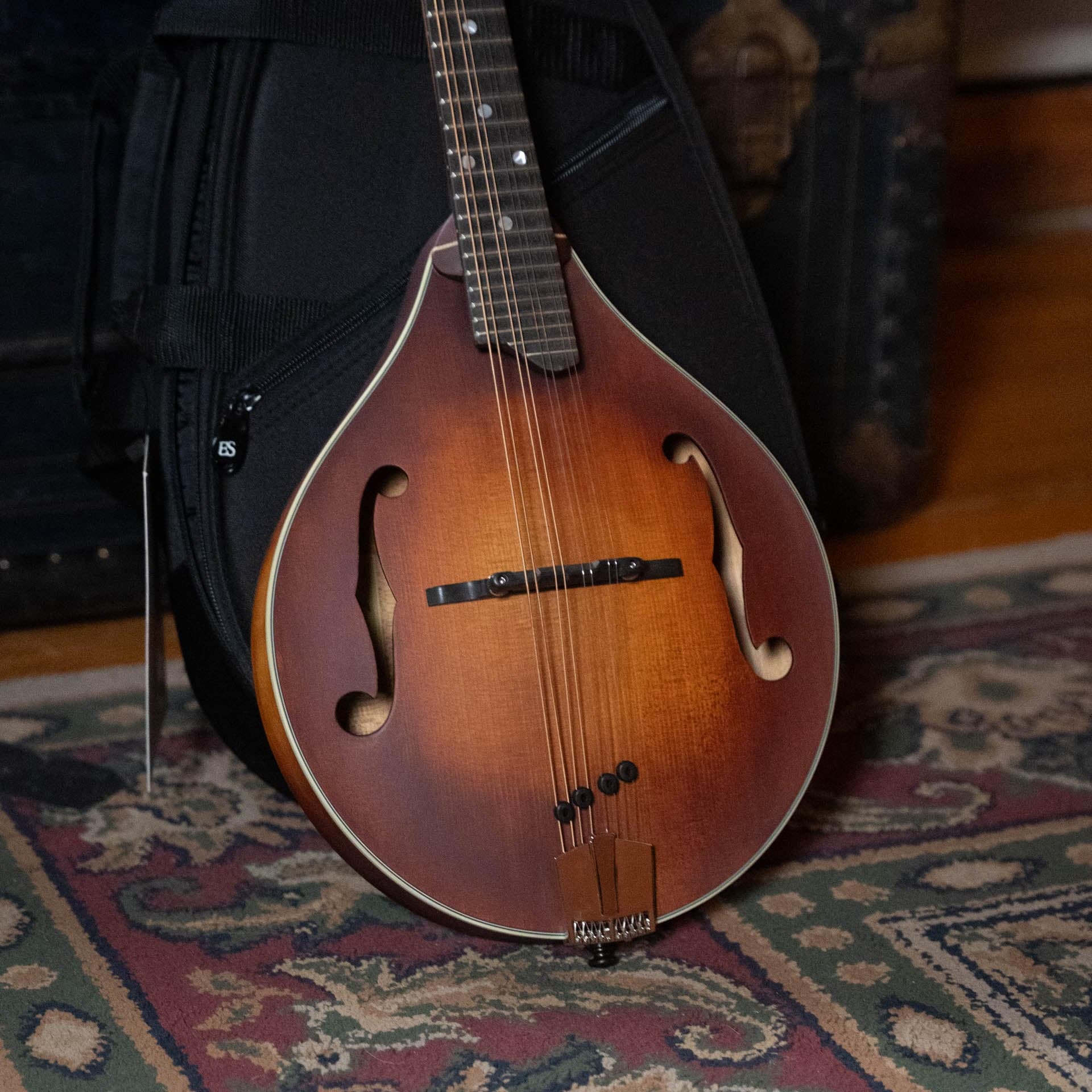
Where it pulls ahead is the finish. The KM-150 we compared has a gloss sunburst finish, chocolate-brown and nicely done for an entry-level mandolin. It's a heavier poly finish than the Eastman's satin, but nowhere near the eighth of an inch of gloss some brands pile on. It's bound on the fretboard, top and back, although it's a single ply of ABS plastic. It has a flat rosewood fretboard with smaller mandolin frets, which matters more than it sounds once you play the two side by side, plus a pressed tailpiece and a pickguard.
Whether the pickguard helps is personal. If you like a finger rest or you're worried about scratching the top, it's a plus. It's the first thing one of us takes off a new mandolin, and there's an argument that it costs volume by covering half an f-hole.
Then there's the bridge. Jeremy's biggest complaint about the KM-150 is the size of its ebony bridge. The foot is huge, a tree trunk of a bridge, and we think it's holding back a lot of the tone. Dense ebony is the right wood, but the foot should be thinner and less bulky. Our guess is that a better bridge would improve the Kentucky KM-150 by 10 percent, maybe 15.
Kentucky KM-150 vs Eastman MD305 side by side
| Feature | Eastman MD305 | Kentucky KM-150 (the unit we compared) |
|---|---|---|
| Top | Solid spruce, hand-carved and hand-voiced | Spruce, hand-carved |
| Finish | Satin | Gloss sunburst |
| Fretboard | Ebony, 12" radius, larger frets | Rosewood, flat, smaller frets |
| Binding | Ivoroid with purfling, top only | Single-ply ABS, fretboard, top and back |
| Tailpiece | Cast | Pressed |
| Pickguard | None | Yes |
The MD305 column is the Shopify listing today. The KM-150 column is the one we had on the bench in 2022, so check Kentucky's current specs before you buy.
How the Kentucky KM-150 and the MD305 sound and play
Playability was the first thing we both noticed. Jeremy found the Eastman a little easier to play, and John found it dramatically easier, even though the KM-150 had lighter strings on it. That's the radius fretboard and the bigger frets doing their job. A radius puts a slight curve across the fretboard, which suits the rounded shape your hand makes, and it's now standard on most high-end mandolins. Whichever you learn on will feel normal, but one of us started on a flat board, moved to a radius, and found it hard to go back.
The tone split was clear. The MD305 sounds more developed, with more definition to each note, and its high end will cut through in a group. The Kentucky has volume and a darker, deeper voice, old-timey and hollow. Jeremy called it a Darth Vader sound. If you want something thick with lots of low end, it's a good choice. It also gets closer to the hollow, oval-hole sound of the mandolin part in "Losing My Religion", which someone asked us to play on a TikTok live.
"If it inspires you to pick it up and pull it out of the case, that's worth a lot right there."
That's the case for the Kentucky's looks. A surprising number of customers go the other way, though, and pass on a sunburst for a plain dark finish like the MD305's.
Which one we'd buy
We both planted our flags on the Eastman MD305. It plays easier, it sounds more defined, the build is a little nicer, and it's hand-voiced. The Kentucky KM-150 is a good mandolin held back by its bridge.
Here's how we'd decide, in order of what matters most to a new player:
- How it plays. If it hurts, you'll quit. The MD305's radius and frets win here.
- How it sounds. Pick the MD305 for definition and cut in a jam, or the KM-150 for a dark, hollow voice.
- How it looks. If the gloss sunburst is what gets you playing every day, that counts.
Going cheaper usually costs more in the end. A student once brought in a budget mandolin and asked us to set it up to play like the Eastman. Cutting a new bridge and going through the whole instrument would have cost more than the difference in price, and it still wouldn't have played as well.
Who should buy which
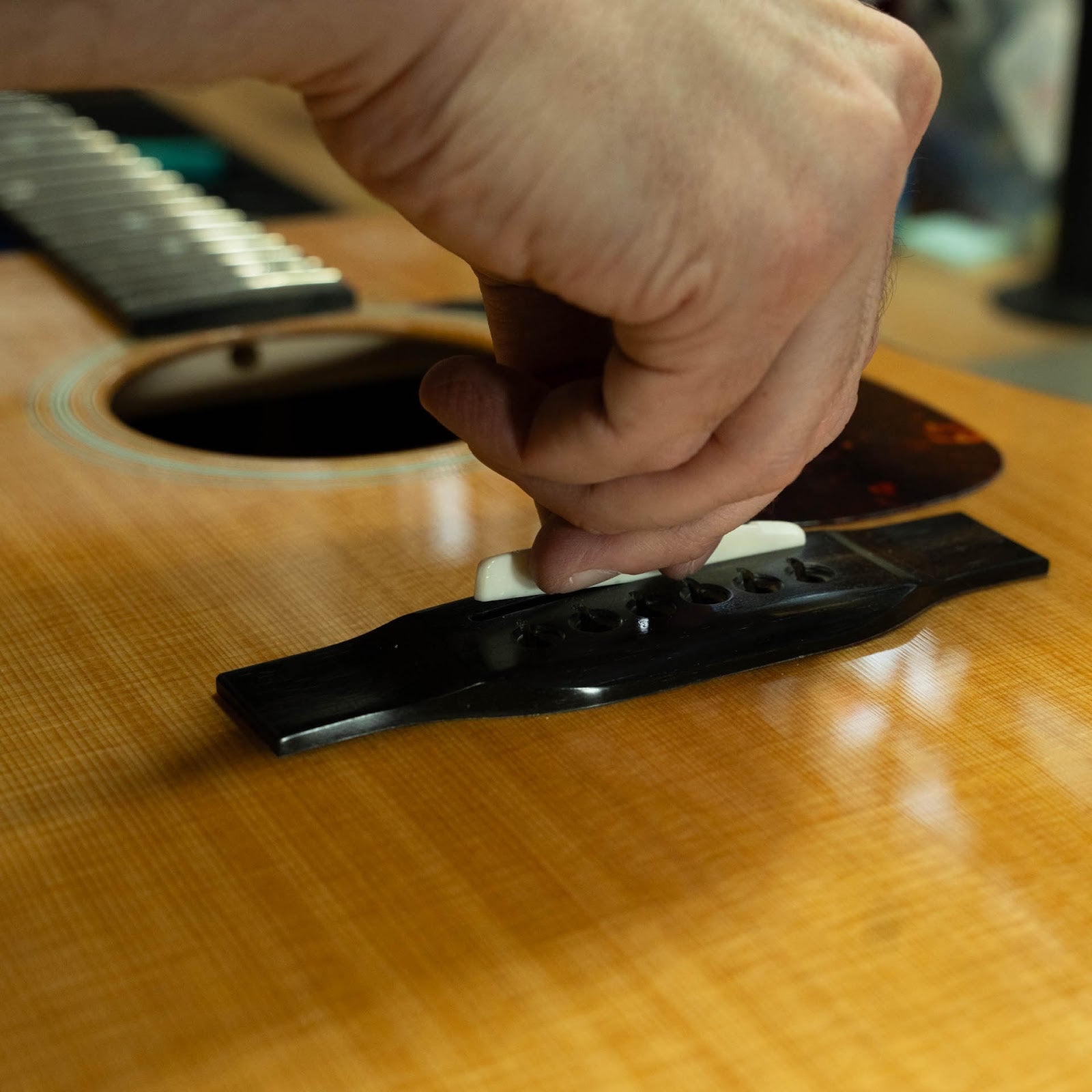
The Eastman MD305 is for the beginner who wants an instrument that's easy to play from day one and good enough to keep for years, and for anyone who'll play in a group and needs notes that cut. It's $729 today. There's also a wide-nut MD305 in amberburst at $829, if you want a sunburst look or more room between the string pairs, and a left-handed MD305L at $739.
The Kentucky KM-150 suits the player who wants a dark, thick, old-time tone and loves a gloss sunburst. We don't have one in stock right now, so if that sound is what you're after, call us and we'll talk through what we do have. If you can stretch past the MD305, our PCH M104 vs Eastman MD305 comparison covers the next step up, and if you're still choosing a body style, read our A-style vs F-style mandolin comparison.
Related reading
- Mandolin chords for beginners: 6 shapes to learn first
- How to tune a mandolin
- Eastman MD315 vs MD515
Find your first mandolin at The Acoustic Shoppe
Whichever one you lean toward, start with how the mandolin plays. Every mandolin we ship gets our 23-Point Professional Inspection first, so it plays right the day it reaches your hands. Browse every Eastman mandolin we have in stock, MD305s included, or every A-style mandolin on the floor.
We're the #1 worldwide dealer for Eastman guitars and mandolins, so if you want help choosing between the satin and amberburst, standard and wide nut, or this and something else entirely, ask us.