



Table of Contents
- At The Acoustic Shoppe, we believe every guitarist eventually faces the same "unplugged" dilemma:
- What Is the "Gold Standard" for Acoustic Tone?
- Why Are Transducer Pickups the "Next Best Thing" to a Mic?
- When Should You Choose a Piezo (Under-Saddle) Pickup?
- What are The Acoustic Shoppe Staff Picks for Live Performance?
- Can a "Blender" System Give You the Best of Both Worlds?
- Why Should You Use an Outboard Preamp?
- Frequently Asked Questions about Acoustic Guitar Pickups
- Ready to Experience the Difference?
- Acoustic Shoppe FAQ
At The Acoustic Shoppe, we believe every guitarist eventually faces the same "unplugged" dilemma:
How do you take the complex, wooden resonance of your favorite acoustic and make it loud enough for a crowd without it sounding like a plastic toy? Finding the right acoustic guitar pickup is about more than just volume; it is about finding the right compromise between natural tone and the practical realities of the stage. Whether you are playing a hushed listening room or fronting a loud bluegrass band, understanding the hierarchy of pickup technology is the first step to stage-ready tone.
What Is the "Gold Standard" for Acoustic Tone?
Before we dive into the electronics, we have to start with a hard truth: nothing will ever sound as good as a high-quality condenser microphone placed in front of a great guitar. A true microphone captures the "air" and the three-dimensional movement of the soundboard. However, for most performing musicians, standing perfectly still in front of a mic stand isn't realistic. That is where the quest for the best acoustic guitar pickup begins. Our goal at the shop is to get you as close to that "mic'd" sound as possible while giving you the freedom to move and the power to be heard. Shop Our Pickup collection.
 Why Are Transducer Pickups the "Next Best Thing" to a Mic?
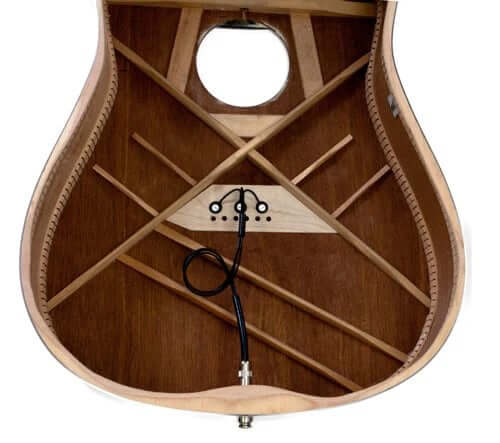
If you want to keep the soul of your instrument intact, we almost always point players toward bridge plate transducers like the K&K Pure Mini or the L.R. Baggs HiFi. Unlike systems that sit under the saddle and only "hear" string tension, these sensors attach directly to the bridge plate inside your guitar.
The Benefit: They "listen" to the wood of the guitar, providing a warm, woody, and organic response.
The Trade-off: Because they are sensitive to the vibration of the top, they are more prone to feedback than a piezo in high-volume settings.
For the singer-songwriter or the solo performer, a transducer is often the best acoustic guitar pickup because it preserves the percussive nuances of your playing style. [Link to a related blog post: 'The Best Guitars for Fingerstyle Players']
When Should You Choose a Piezo (Under-Saddle) Pickup?
If you are playing large venues or loud stages with a full band (drums, electric guitars, or a loud banjo), you need a "tank." This is where the Piezo or Under-Saddle Transducer (UST) shines. Because these sit directly under the saddle, they are incredibly efficient at rejecting feedback. They don't "hear" the stage volume; they only hear the strings. The downside is the infamous "piezo quack"—a sharp, synthetic attack that can feel disconnected from the guitar's natural woodiness. However, for pure reliability in a 5-piece band, the UST remains a staple of the industry.
L.R. Baggs Element VTC
What are The Acoustic Shoppe Staff Picks for Live Performance?
The best way to choose a system is to see what the pros use. Our crew at the shop has tested every combination imaginable. Here is a breakdown of their personal "go-to" setups for the stage:
| Staff Member | Pickup Choice | Preamp / DI Choice | Why They Love It |
| Corey | K&K Pure Mini | L.R. Baggs Venue DI | Low maintenance, raw/natural output with minimal setup. |
| John | K&K Trinity | ToneDexter | The Trinity adds an internal mic, and ToneDexter restores the "studio mic" feel. |
| Trent | L.R. Baggs Anthem | L.R. Baggs Venue DI | The Anthem is the industry-standard blender for consistent pro tone. |
| Jonas | L.R. Baggs HiFi Duet | L.R. Baggs Venue DI | The newest tech from Baggs, combining transducers with a mic. |
| Austin | L.R. Baggs HiFi Duet | Fishman Aura Spectrum DI | Using Aura images with the HiFi sensors creates incredible realism. |
| Sean | K&K pure mini | Fishman Aura Spectrum DI | Combines the woody K&K signal with high-end mic imaging. |
| Thomas (Luthier) | K&K (w/ Vol) or HiFi Duet | L.R. Baggs Align EQ | Focuses on high-fidelity signal and surgical EQ control. |
Can a "Blender" System Give You the Best of Both Worlds?
For the professional who refuses to compromise, we often recommend "Multi-Source" or Blender systems like the L.R. Baggs Anthem or the HiFi Duet mentioned by Jonas and Austin above. These systems combine a pickup with an internal microphone.
The Logic: You use the pickup to provide the foundational "thump" and volume, and then you dial in just enough of the internal mic to add "air."
The Risk: You are introducing a live microphone into your signal chain, which requires careful monitor placement. When dialed in correctly, these are world-class solutions. [Link to a relevant product: L.R. Baggs Anthem System]
 Why Should You Use an Outboard Preamp?
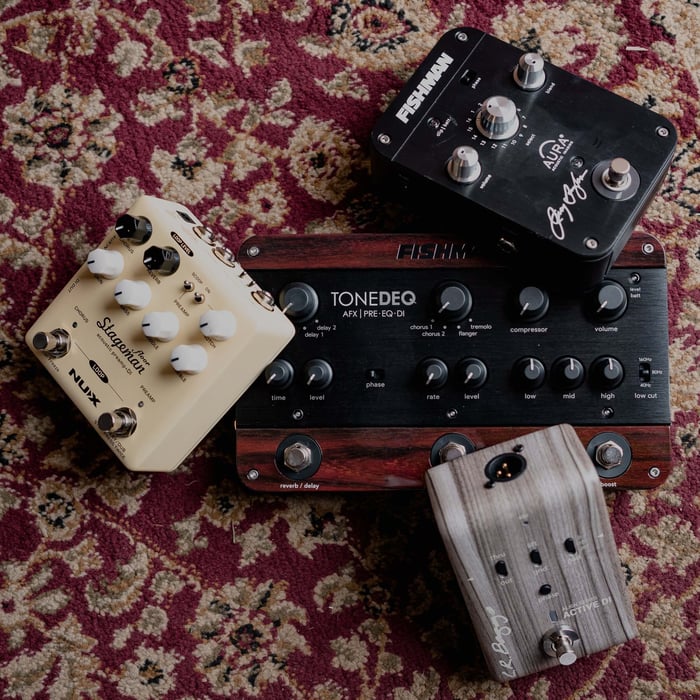
As you can see from our staff picks, the acoustic guitar pickup is only half the battle. Using an outboard preamp or "Mic Modeler" like the ToneDexter or Fishman Aura can substantially impact your tone. These devices allow you to "map" the sound of a studio microphone onto your pickup's signal. This effectively "fixes" the piezo quack and makes your plugged-in sound like a studio recording. Plus, you get essential stage tools like a built-in tuner and a solo boost.
K&K Trinity Pro Mini
Frequently Asked Questions about Acoustic Guitar Pickups
Do I need to drill a hole in my guitar to install a pickup?
Most professional systems require enlarging the endpin hole to accommodate the output jack. This is a standard procedure and does not hurt the value of the guitar when done by a pro. However, if you want zero modifications, a clip-in soundhole pickup is your best bet. [Link to our Service and Repair page]
Why does my acoustic guitar sound "thin" when I plug it in?
This is usually a result of an impedance mismatch or a lack of a preamp. Acoustic pickups produce a high-impedance signal that needs to be buffered. Using a dedicated acoustic preamp or a high-quality DI box will bring back the fullness and bass response of your instrument.
L.R. Baggs
Ready to Experience the Difference?
Your guitar was meant to be heard. Whether you need the organic warmth of a K&K or the stage-proven power of an L.R. Baggs Anthem, we are here to help you find the perfect match. Ready to experience the acoustic guitar pickup difference for yourself? Explore our full collection of instruments and electronics today and find the one that will inspire your music for years to come.
Shop our Acoustic Pickup Collection Now
Shop our Pedal Collection Now
Acoustic Shoppe FAQ
Do I need to drill a hole in my guitar to install a pickup?
Most professional systems require enlarging the endpin hole to accommodate the output jack. This is a standard procedure and does not hurt the value of the guitar when done by a pro. However, if you want zero modifications, a clip-in soundhole pickup is your best bet.
Why does my acoustic guitar sound "thin" when I plug it in?
This is usually a result of an impedance mismatch or a lack of a preamp. Acoustic pickups produce a high-impedance signal that needs to be buffered. Using a dedicated acoustic preamp or a high-quality DI box will bring back the fullness and bass response of your instrument.
What is the difference between an active and passive pickup?
An active acoustic guitar pickup has a built-in preamp and requires a battery (usually 9V). A passive pickup, like the K&K Pure Mini, has no internal power and relies on an external preamp to boost the signal to a usable level.
Can I install a bridge plate transducer on any guitar?
Generally, yes, as long as there is enough room on the bridge plate inside. However, some guitars with very large bridge pins or specialized bracing might require a different solution.
How do I stop my guitar from feeding back on stage?
The best way to stop feedback is to use a feedback buster (a rubber soundhole cover), use a notch filter on your preamp, or switch to a more feedback-resistant piezo or magnetic pickup.
Does a pickup affect the unplugged sound of my guitar?
Most modern bridge plate transducers are so light that they have no audible effect on the acoustic tone. Some under-saddle piezos can slightly change the string-to-top contact, but for most players, the difference is negligible.
Is the L.R. Baggs Anthem better than the K&K Pure Mini?
It depends on your needs! The Anthem is a "blender" system with a mic for maximum realism, while the K&K is a "passive" transducer for a simple, woody tone. The Anthem is more versatile for loud stages; the K&K is more "natural" for quiet settings.
What is "Impulse Response" (IR) technology?
IR technology, like that found in the L.R. Baggs Voiceprint, or ToneDexter, creates a digital "fingerprint" of your guitar recorded with a mic. It then applies that fingerprint to your pickup signal to make it sound mic'd.
Are soundhole pickups only for beginners?
Not at all! Many professionals use high-end magnetic soundhole pickups because they handle effects pedals well and are virtually immune to feedback.
How often do I need to change the battery in my pickup?
Most active systems provide about 100-200 hours of playing time. A good rule of thumb is to change it every 6 months or whenever you notice your tone becoming distorted or "fuzzy."