
Table of Contents
- Can a Gold Tone banjo really sound like a Gibson?
- Gold Tone OB-12: a top tension built with Greg Rich
- The Twanger: J.D. Crowe's Banger as an import
- The OB-Béla: Gold Tone's modern pro banjo
- Which Gold Tone banjo fits your playing?
- The honest drawbacks
- What you get when you buy a Gold Tone banjo from us
- Who should buy a Gold Tone banjo
If you love the sound of a prewar Gibson Mastertone, you already know the problem. Gibson isn't building the RB-3 or the RB-75 right now, and a real prewar banjo or a boutique top tension runs anywhere from $10,000 to $100,000. The import banjos that cost less usually get most of the way there, then miss the details that made you want one. So the question every bluegrass player asks about a Gold Tone banjo is the same: is it the real sound, or only the look?
Three Gold Tone banjo models answer that question in different ways: the new OB-12 top tension, the OB-3 "Twanger" and the OB-Béla My Bluegrass Heart. They don't chase the same player, and that's the most useful thing to know before you pick one. The short answer: Greg Rich worked on the OB-12, and Tate Greer, a Rich-era Gibson guy, calls it "an absolute powerhouse." The Twanger and the OB-Béla each fit a specific kind of picker.
Can a Gold Tone banjo really sound like a Gibson?
Traditional banjo players are fussy, and they have reason to be. A little more head tension or a different bridge changes the whole voice of a banjo, so a copy that's close on paper can still sound wrong. For years that's where the affordable intermediate banjos landed, Gold Tone included: good parts, the right look, and a sound that never quite got there.
Two things changed. First, Gibson let the Mastertone name lapse and Gold Tone picked it up, so it's on the fingerboard of a Twanger or an OB-12. Second, and more important for the sound, Gold Tone brought in Greg Rich, the builder behind the Rich-era Gibson banjos. Tate, who calls himself "exclusively a Rich-era Gibson guy," says he'd take one of those over some prewars he's played. When Greg went through the OB-12, he worked on the small details that make it more like the original top tensions.
Jump to: what a top tension changes at 2:14 · who the OB-12 is for at 4:10 · the honest critique at 5:25.
Gold Tone OB-12: a top tension built with Greg Rich
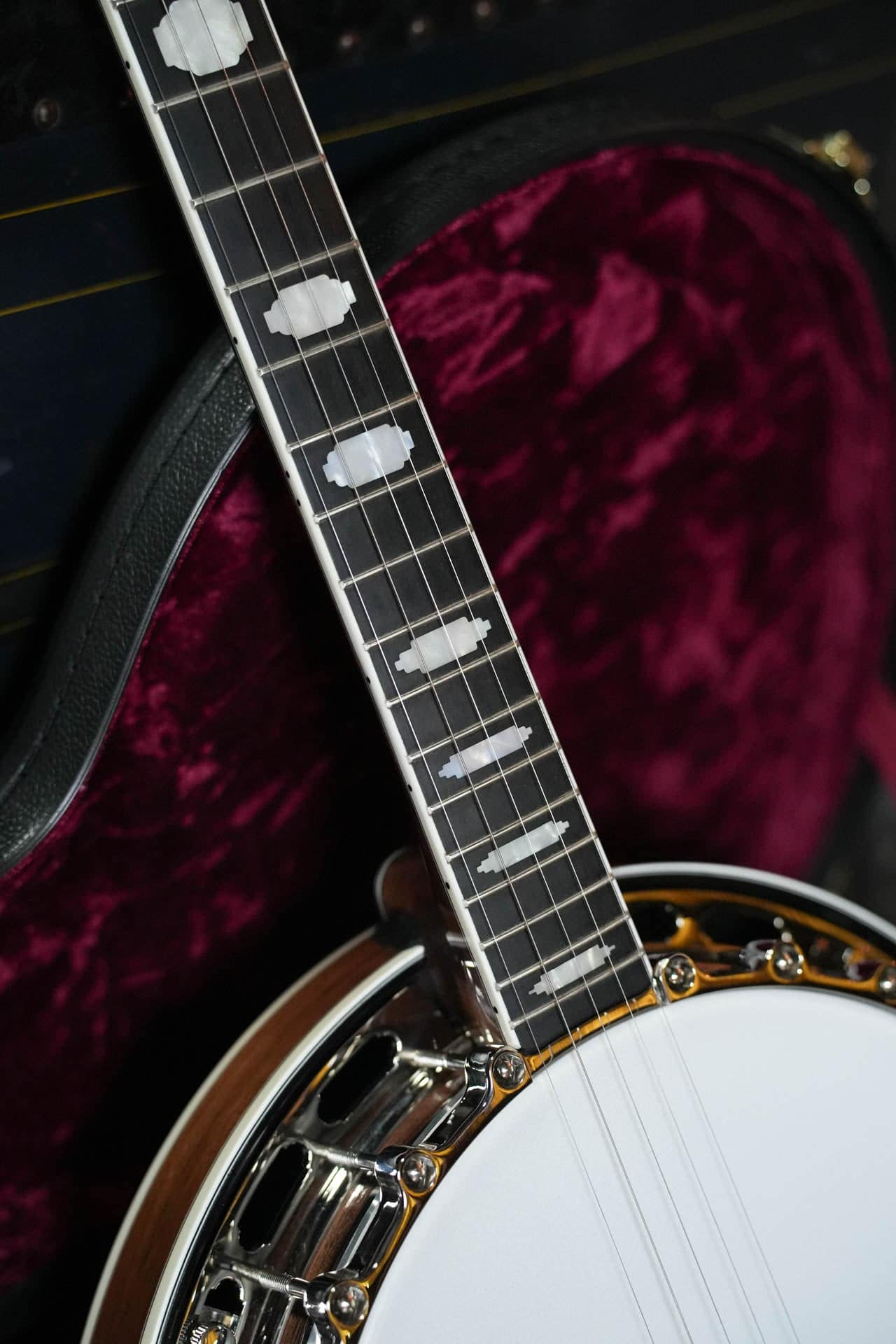
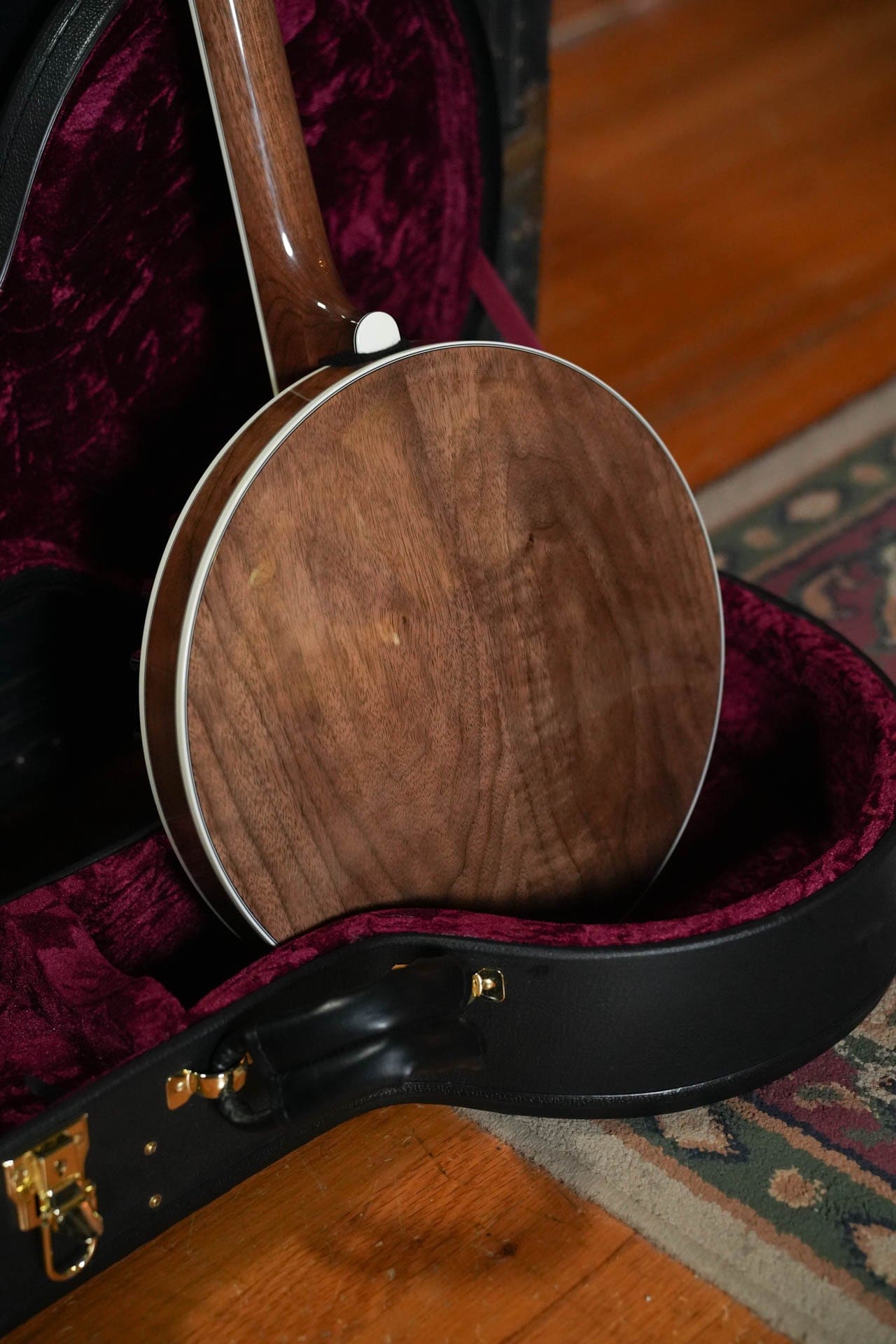
The OB-12 is Gold Tone's recreation of the late-1930s Mastertone top tension. On a top tension, the tension hoop is adjusted from the top of the pot, so you dial in head tension in a few seconds instead of flipping the banjo over and reaching for a wrench. That matters more than it sounds, because you'll actually do it.
"A little more tension or a little less can change your entire tone, and this puts it right here where you can do it easily." (Tate Greer)
Top tensions have a reputation for a warmer, softer voice. Tate doesn't buy it, and he points to Sammy Shelor's early records with Lonesome River Band, played on a top tension and "cutting through the air just fine." Tate gets a lot of great tones out of the OB-12, and in his words it's gutsy, loud and poppy, and "within a budget, but it's not a budget banjo." Real prewar top tensions are hard to find, so a production banjo this close to one is worth a hard look if that's the sound you want.
Here's what's in it, from our listings for the two in stock, including OB-12 #8307:
- A walnut neck and a carved walnut resonator. Walnut sits between mahogany and maple in tone, so you get some warmth without losing the clarity a flathead ring is known for.
- A Pre-War Formula brass flathead tone ring on an 11" 3-ply maple rim, which is where the weight, the volume and the cut come from.
- 24 brackets on the top tension hoop, with a custom armrest shaped to cover the tension bolts so your forearm doesn't sit on them.
- Gotoh planetary tuners and a Prucha Presto tailpiece, with a hard case included.
The Twanger: J.D. Crowe's Banger as an import
The OB-3 "Twanger" started when our friends Robbie Boone and Banjo Bandy, then at Banjo Ben's store, worked with Gold Tone on a banjo closer to J.D. Crowe's "Banger," the RB-75 he played through his years with Jimmy Martin. It started as a shop exclusive with a limited run of serial numbers, then became an official model, which means anyone can now buy a Mastertone-style RB-75 voice with a case for a fraction of a vintage one.
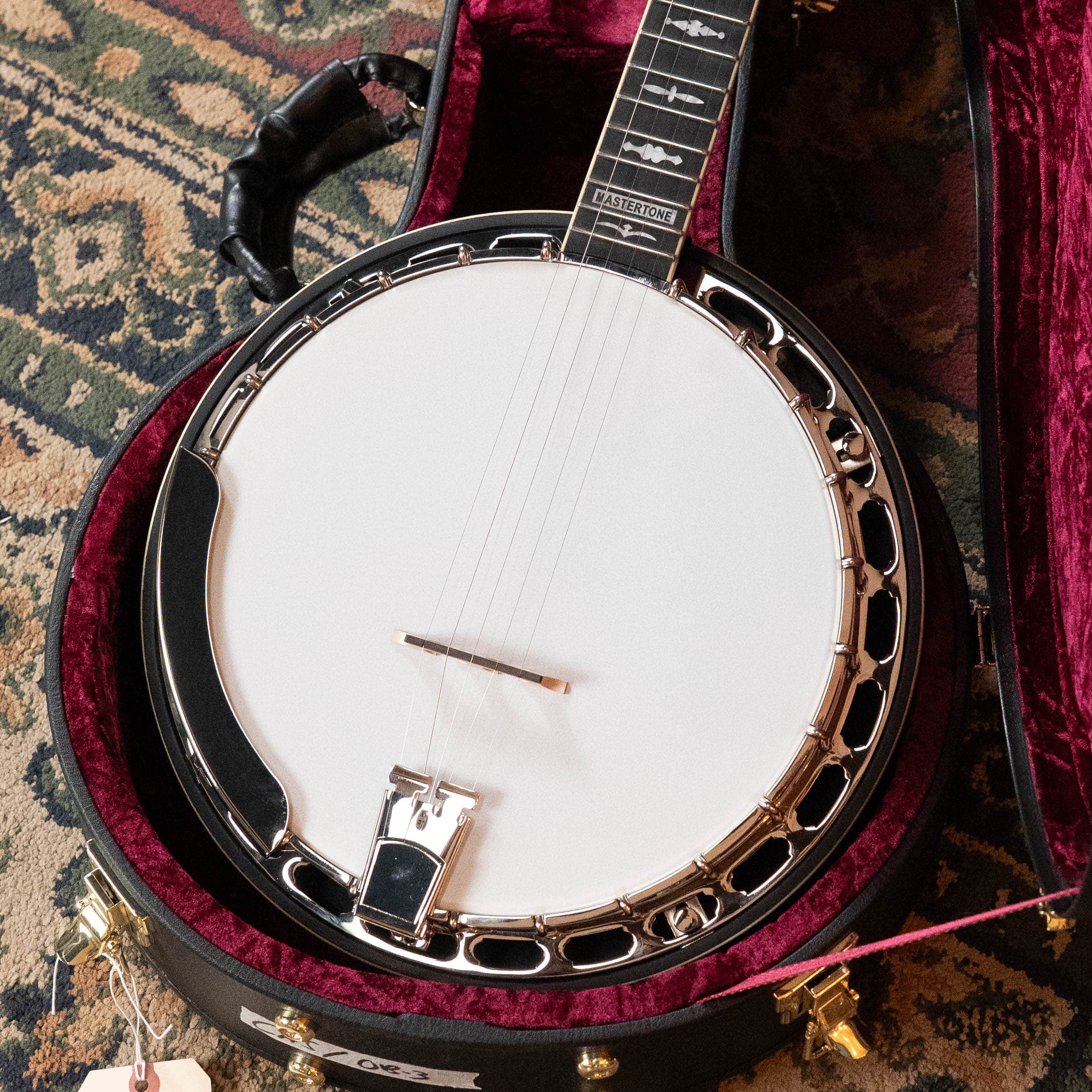
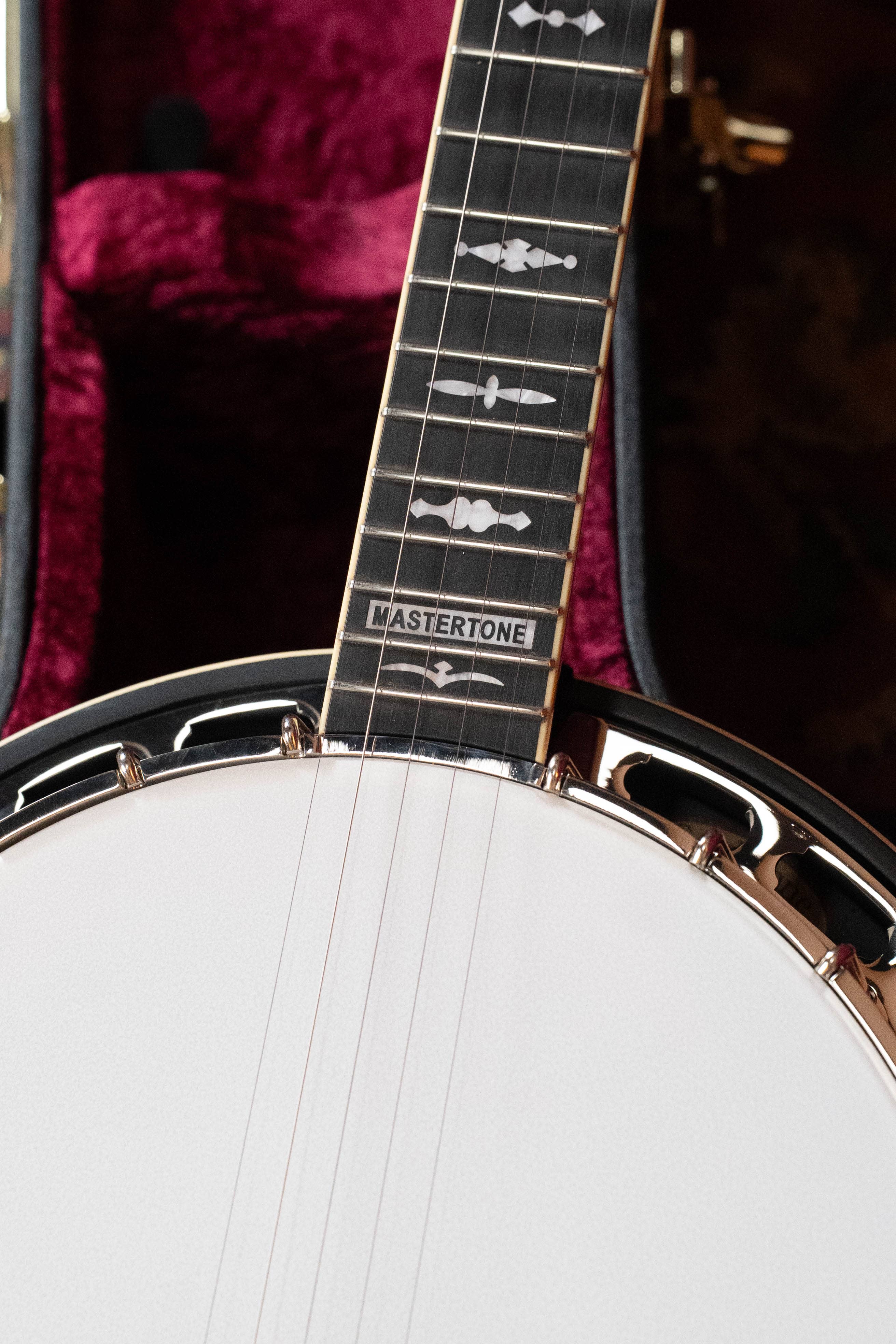
The specs follow the RB-75 closely, with a couple of changes. The neck and resonator are mahogany, the tone ring is a no-hole brass flat top on a 3-ply maple rim, and it comes with a Snuffy Smith bridge and a Presto-style tailpiece. The fingerboard is ebony where the original was rosewood, and the pearloid leaves-and-bows inlays keep the RB-75 look. Our listing credits the Snuffy Smith bridge, the Presto-style tailpiece and the notched hoop with its quick response and strong note separation. Out of the box it's "barking up that same Gibson deal," with a good bite, a little on the bright side, and more roundness up top than we expected. That was Gold Tone's factory setup, and a small change in head tension moves it a long way.
Professional banjo player Aaron McDaris sees it as an upgrade banjo: "your intermediate player that's looking to upgrade, this would be a very good purchase." The catch is the neck. The width feels good, but the depth and shape are thicker than a Gibson's, especially around the first few frets. That's common at this price, since import builders tend to add bulk to keep a thin banjo neck from breaking. If your hand is used to a slim prewar neck, play one before you buy.
Here's how we scored it with Aaron, out of five:
| Twanger (out of 5) | Score | Why |
|---|---|---|
| Tone | 3.5 | A little bright as it shipped; setup gets it closer |
| Setup and playability | 3.5–4 | Well set up, and easy to set to anyone's taste |
| Build quality | 4 | Put together well; the neck is the only knock |
| Looks | 4 | Not much more you could ask of an RB-75 style |
| Value | 4–4.5 | A full Mastertone-style banjo, set up, with a case |
It compares most directly with the Recording King Elite 75 and Elite 76 and the Gold Star J.D. Crowe model, which has a satin finish where the Twanger is full gloss. We like the Snuffy Smith bridge and the closer look to Crowe's Banger. If the brass ring vs bell bronze question is on your mind, our rolled vs cast tone ring guide explains what each one does to the sound.
The OB-Béla: Gold Tone's modern pro banjo
The OB-Béla is the Gold Tone banjo that started what we call its elite era. It's a reproduction of the banjo Béla Fleck toured with for his My Bluegrass Heart album, and the neck is the showpiece: a copy of Béla's own neck, built by John Monteleone, wider than usual, with a radiused fingerboard and jumbo frets. This version has traditional inlays instead of the red hearts on the original signature model, and we liked the traditional layout better.
It's very responsive, with lots of sustain, and Aaron calls it darker than most Gold Tone banjo models. The action is easy all the way up the neck. To us it's "extremely warm, yet it has some bite to it," and Aaron and we both gave it five stars for value, because we didn't know of anything else at its price for a player who wants a modern-style pro banjo.
The catch is the same thing that makes it special. If you've played a Gibson or a Deering for years, the wide neck, the radius and the jumbo frets take getting used to, and Aaron noticed the width right away. The tall 7/8" bridge felt unusual to us too, though it didn't bother Aaron. It's the banjo for a player who wants something different in their stable, not a copy of what they already own. We don't have one listed right now, so ask us about ordering one.
Which Gold Tone banjo fits your playing?
Here's every Gold Tone banjo in this guide, with prices and stock from our site in October 2026. The Twanger was $1,799 when we reviewed it in 2023, so prices have moved.
| Model | Tone ring | Neck | Price today | Best for |
|---|---|---|---|---|
| OB-12 top tension | Brass flathead | Walnut | $3,499.99 (2 in stock) | The prewar top tension sound |
| OB-3 Twanger | No-hole brass flat top | Mahogany | $2,099.99 (1 in stock) | An RB-75 sound for an upgrading player |
| OB-Grandee | Bell brass flat top, 20-hole | Curly maple | $3,199.99 (1 in stock) | Fancy appointments, gold hardware |
| OB-Béla | No-hole | Wide, radiused | Ask us | A modern-style pro player |
To narrow it down, go through these in order:
- Decide what sound you're chasing. A prewar top tension voice points to the OB-12. Crowe's RB-75 points to the Twanger. A modern, darker voice with sustain points to the OB-Béla.
- Play the neck before anything else. The Twanger's neck is chunkier than a Gibson's, and the OB-Béla's is wider. If you've played one banjo for years, this is where you'll notice the difference.
- Check the weight. The OB-12 is a heavy banjo, so if your shoulder is already at its limit with a tone-ring banjo, hold one first.
- Make sure you want a resonator. Every Gold Tone banjo here is a resonator banjo set up for three-finger bluegrass. If you're headed toward clawhammer, browse our open-back banjos instead.
The honest drawbacks
None of these banjos is perfect, and the trade-offs are worth knowing before you buy:
- The OB-12 is heavy. Tate calls it "literally a tank." Coming from another tone-ring banjo you won't notice a huge jump, but if your shoulder is already at its limit, that could be an issue.
- The OB-12 is plain. The brown finish and block inlays are classic, and there's not a lot of fancy art on it. If you want frills, look at the OB-Grandee.
- The Twanger's neck is thick in depth and shape, more than a Gibson player expects.
- The OB-Béla's wide neck and tall bridge take adjustment if you come from a Gibson or Deering, and its neck has a satin finish where we'd rather have gloss.
What you get when you buy a Gold Tone banjo from us
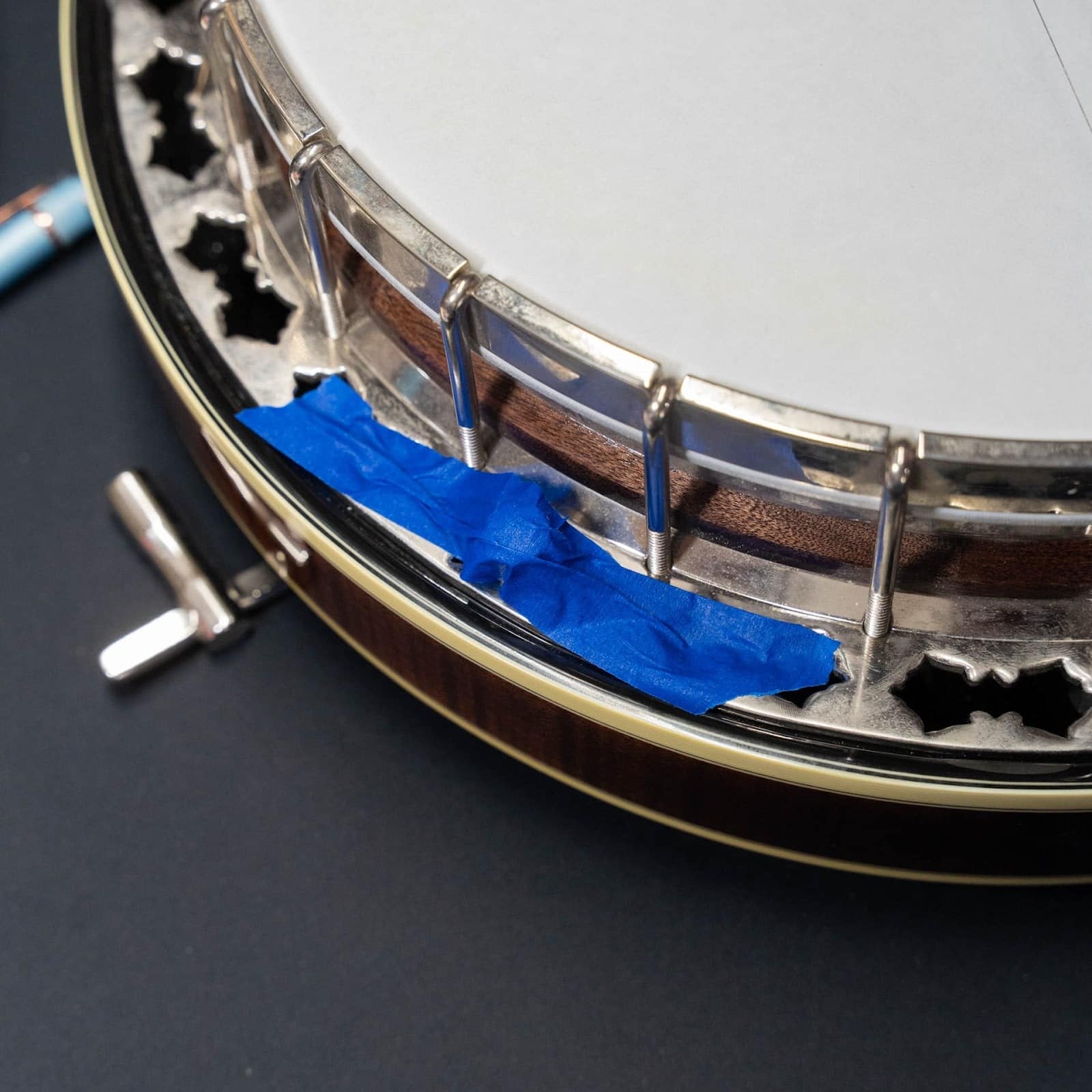
Every Gold Tone banjo we ship goes through our 23-Point Professional Inspection, so it doesn't reach you with only the factory setup. Since head tension changes a banjo's voice this much, that bench time is worth having.
Every banjo in this guide is over $1,000, so each one comes with the Dread-Not Guarantee: a full year to trade it in for up to 90% of the pre-tax purchase price in credit, less round-trip shipping, plus a 30-day in-home trial. If the neck doesn't suit your hand after a few weeks of playing, that's what the trial is for.
Related reading
- Gold Tone Super Cremona review: a varnish mandolin without the five-figure price
- Deering Goodtime banjo: which one to buy
- Scott Avett banjo review: Deering Truth vs Vega Avett Star
Who should buy a Gold Tone banjo
Buy the OB-12 if you're a Gibson lover who wants the art deco top tension sound and doesn't have five or six figures for a vintage original. Buy the Twanger if you're an intermediate bluegrass player ready to upgrade and you want J.D. Crowe's RB-75 sound without hunting one down. Look at the OB-Béla if you already play well and want a modern, warmer voice that's different from what you own. If you're shopping for a first banjo, our resonator banjos include lighter, less expensive places to start. Browse every Gold Tone banjo we have in our Gold Tone banjo collection, see the rest of the wall in all banjos, or get in touch and we'll help you pick.