
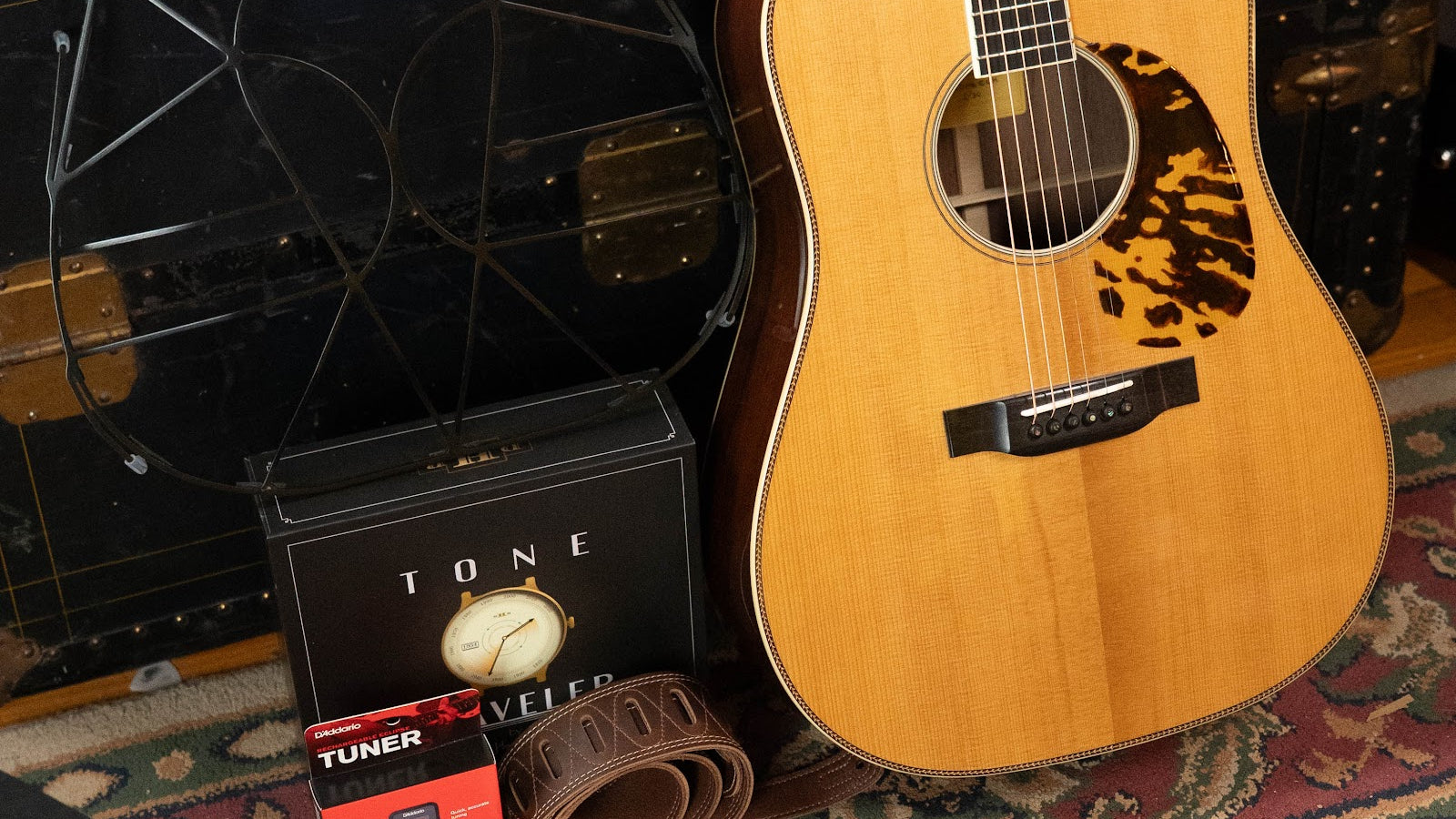
You've found the guitar, and now you're standing in front of the accessory wall with a little money left over and a lot of choices. Most advice about guitar accessories says to start cheap and upgrade later. We'd argue the opposite on at least one of them: the $200 capo can turn out to be the cheap one, because it's the one you still own in 25 years.
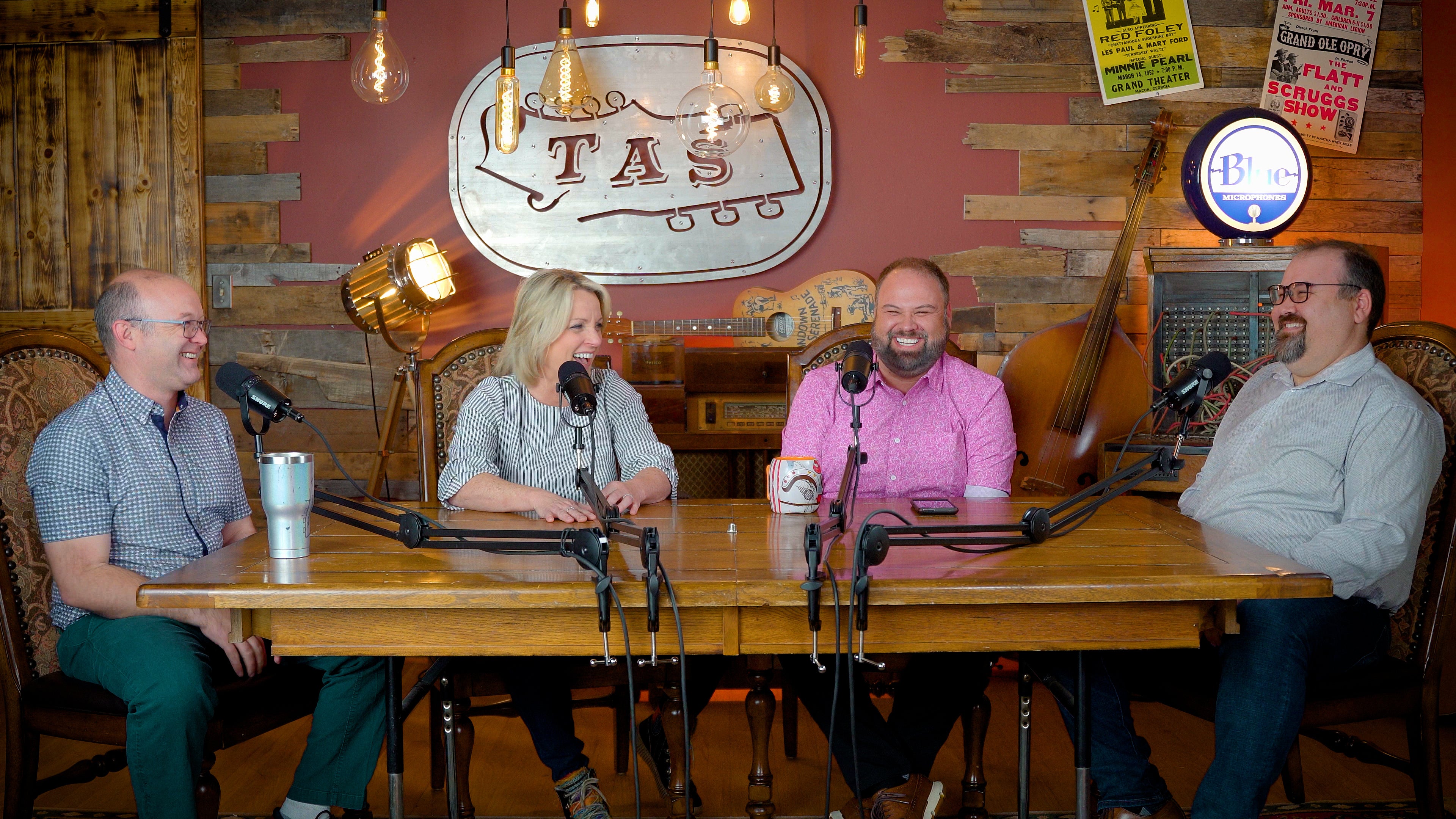
We spent an afternoon with our friend Marcel, who teaches guitar at Lessons with Marcel and spent years playing around 200 dates a year, comparing the guitar accessories we each reach for every day. We covered picks, capos, strings, tuners and the two tone tools we use on guitars in the shop. We agreed on more than we expected, and where we didn't, the reason usually came down to how each of us plays.
The short answer: the guitar accessories we'd buy again
Here's where we landed, with the top pick in each category and the budget pick we'd hand a friend. Prices are from our store today.
| Category | Our top pick | The budget pick | Why it earns a spot |
|---|---|---|---|
| Pick | ToneSlabs or BlueChip | Dunlop Primetone ($9.99, 3 pack) | A clear attack without the upkeep of tortoiseshell |
| Capo | Elliott | Paige ($45) | A cradle-style capo sits right on the fret and stays out of your hand's way |
| Strings | GHS Americana ($10.99) or D'Addario XS ($19.99) | D'Addario EJ17 ($9.99) | Tone, life and price pull in different directions |
| Tuner | Peterson StroboClip HDC ($79.99) | D'Addario Eclipse ($17.99) | You can't sound good out of tune |
| Tone tools | Tone Traveler ($289) | Tone-Gard D-Gard ($139.99) | More volume and a more open sound from the guitar you already own |
Which guitar pick is worth the money?
Picks are the cheapest guitar accessories on the wall and the ones flatpickers argue about most. For a lot of us, tortoiseshell set the standard. Our heroes played it, and plenty of us played it for years, but it chips when you dig in, it wears scratchy, and it needs constant reshaping and buffing. Every few years another company says its pick sounds as good as shell.
"I never ever agreed with that. I just never bought that hype."
The closest thing for a long time was the BlueChip. It doesn't have quite the same attack on the front of the note as shell, but it's close to maintenance-free, and Marcel's line on it is that you can play one forever and it won't change shape. That trade was worth it for us.
Today both of us play a ToneSlabs pick. Marcel describes the attack as almost a faint click, which sounds like a complaint until you hear how clear it makes each note. We've played ours for about six months and haven't had to reshape it, though the playing edges do start to get a little scratchy and need a buff now and then. It needs some upkeep, but nowhere near what shell needed, and so far there's been no chipping. Played against a piece of real tortoiseshell of the same shape and size, the ToneSlab came very close. Gauge is personal: Marcel plays a 1.5, and we play a 1.3 with rounded corners, including the turquoise color ToneSlabs made as a TAS exclusive. Our BlueChip vs ToneSlabs blind test goes deeper on the two.
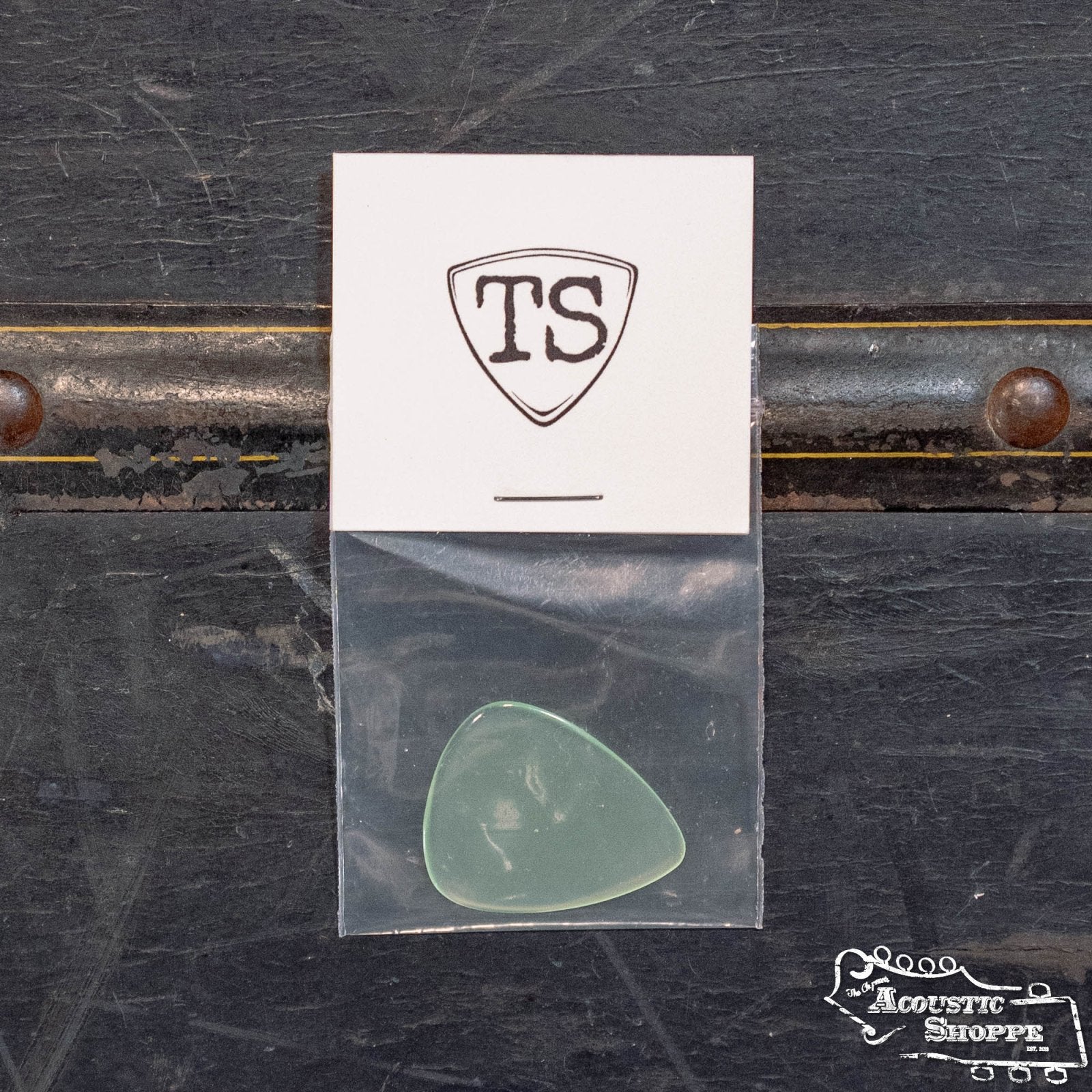
On a budget, Marcel's answer was quick: the Primetone, which he calls the fake BlueChip. We agree, and we like it best without the grip. It wears faster than a BlueChip, but it gets a lot of that sound for about ten dollars. Wegen picks are another step in between, and if you're buying a pick that costs less than a dollar, a Delrin around 1.2 mm is what we played for years. Our guitar pick guide covers what thickness, material and shape do to your tone, and every pick we carry is in our guitar picks collection.
Jump to: capos at 9:22, strings at 15:03, tuners at 20:02, the Tone Traveler at 22:00, and the Tone-Gard at 26:57.
Is a $200 capo worth it?
We've played Elliott capos for a lot of years, and we know it's a debate. It's handbuilt in stainless steel and cradle style, so it's small and gets out of the way when you're up the neck. You can reach around it, play over it and get it right up on the fret, where a bulkier trigger-style capo has a lot more mass in the way. It's fully adjustable, and it parks behind the nut when you're not using it, which means you lose fewer capos.
"If I have a $25, $30 capo… I guarantee you over time I will lose five or six of those."
That's the value argument, and it's why the capo is the one place in guitar accessories where spending more can cost you less. We also hear a tone difference ourselves, and our first Elliott is more than 25 years old and still works the way it did the day it was bought. If you play Tony Rice-style guitar, Elliott also builds the McKinney, a reproduction of the capo Rice used. Our Elliott capos post has more on the line.
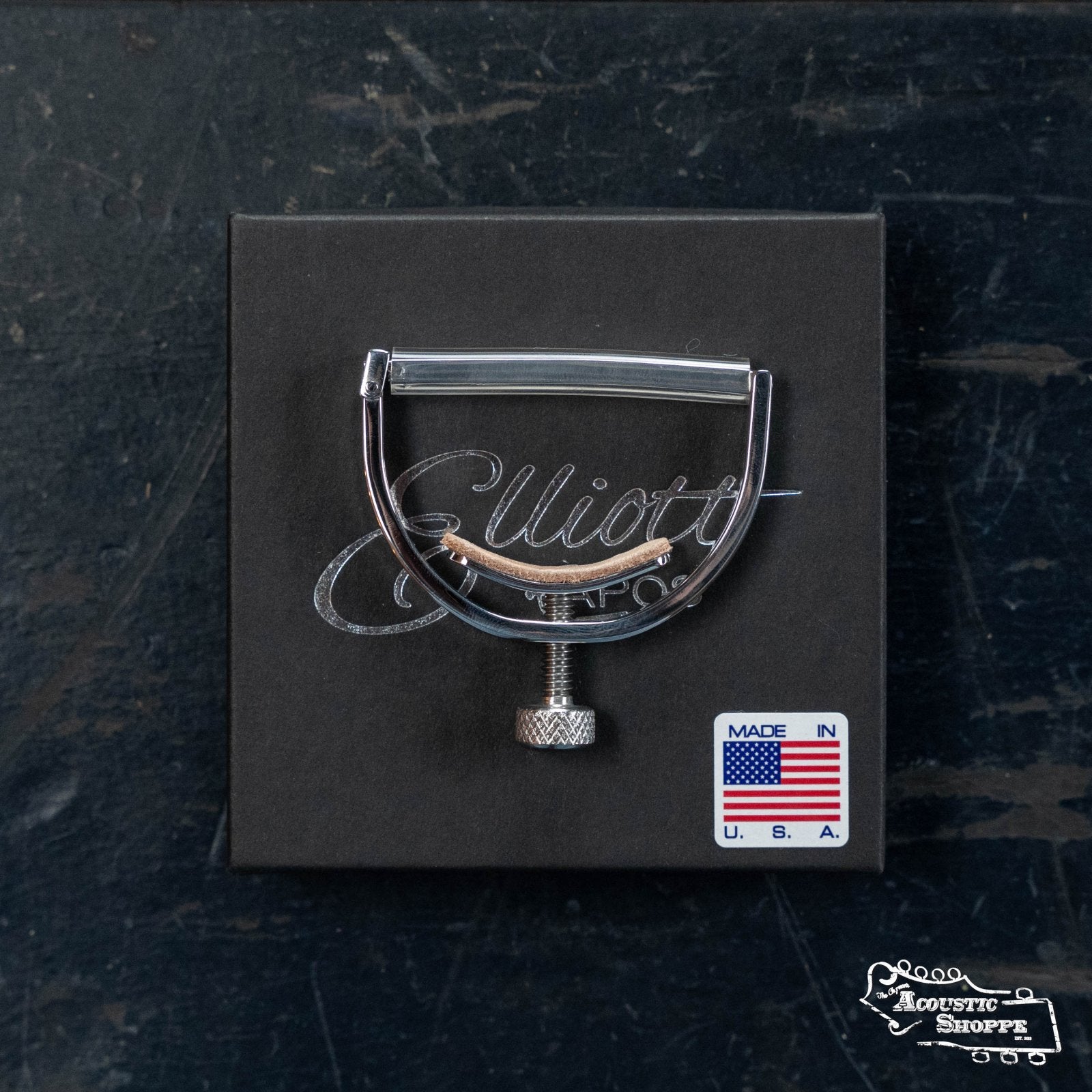
For the same cradle-style benefits at less money, the Paige 6-string capo is our recommendation. Marcel has been playing a Cats Eye, whose triangular cradle centers itself on the neck as you tighten it, and before that a chunky brass Ultimate capo he'd had for decades. One thing we both warn against is buying an old capo for vintage charm. The spring-loaded ones with a cork pad leave an oval mark in the back of the neck once the cork wears through, and Marcel puts it plainly:
"The vintage capo market [is] not as attractive as the vintage guitar market. Do not recommend."
Everything in stock is in our guitar capo collection.
Which acoustic guitar strings do we use?
Strings are the guitar accessories you'll buy most often, so how often you change them should decide which ones you buy. Marcel buys D'Addario EJ17s in bulk. When he was playing 200 dates a year he was changing strings every two or three shows, so there was no point paying more for a set he'd pull off by the weekend, and the habit stuck. Plenty of bluegrass players we know do the same thing.
Our tone set is the GHS Americana medium, which used to be sold as the Signature Bronze. Its plain strings have a plated core, which warms the high E and B a hair and takes off some of the metallic edge, and the two middle strings are slightly heavier than a D'Addario set, which we can feel in the picking hand. The difference isn't dramatic, but it's an edge.
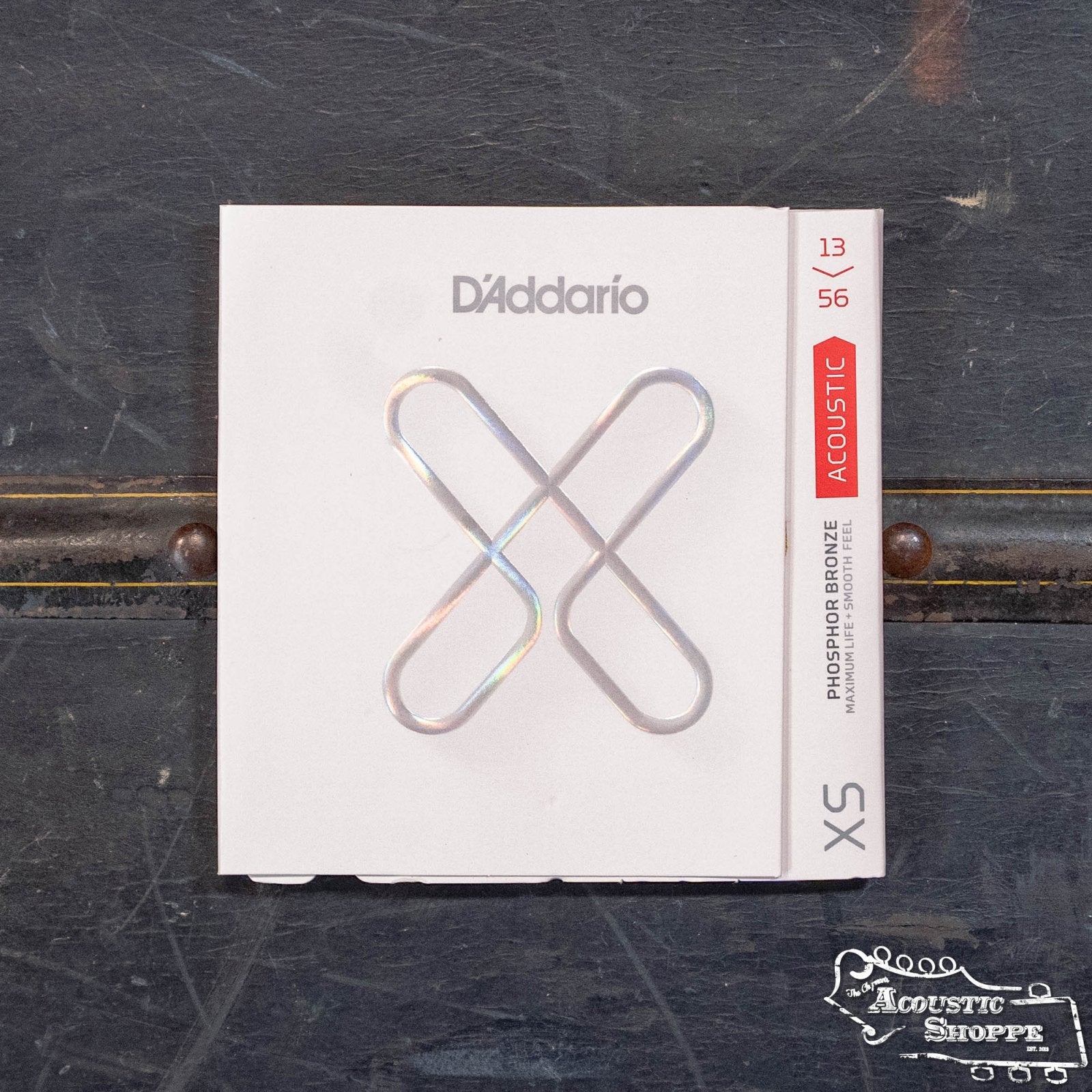
Neither of us was ever a coated-string player. Marcel still remembers older coatings peeling off in webs on his fingers. The D'Addario XS changed that for us: it sounds very close to an EJ17, and it lasts a great deal longer. It goes on every guitar that gets played every two or three weeks or less, so the guitar's one night out in two months doesn't start with a string change. Our acoustic guitar strings guide puts four sets through a blind test.
Do you need a strobe tuner?
A tuner is the least exciting of these guitar accessories and the one you'll use every time you play. Our ultimate tuner is a Peterson strobe, as a clip-on or a stage box. At first we didn't think one electronic tuner could be that different from another. After using it every day and getting a guitar as close to pitch as possible, nothing else matches it for us. The current version is the Peterson StroboClip HDC.
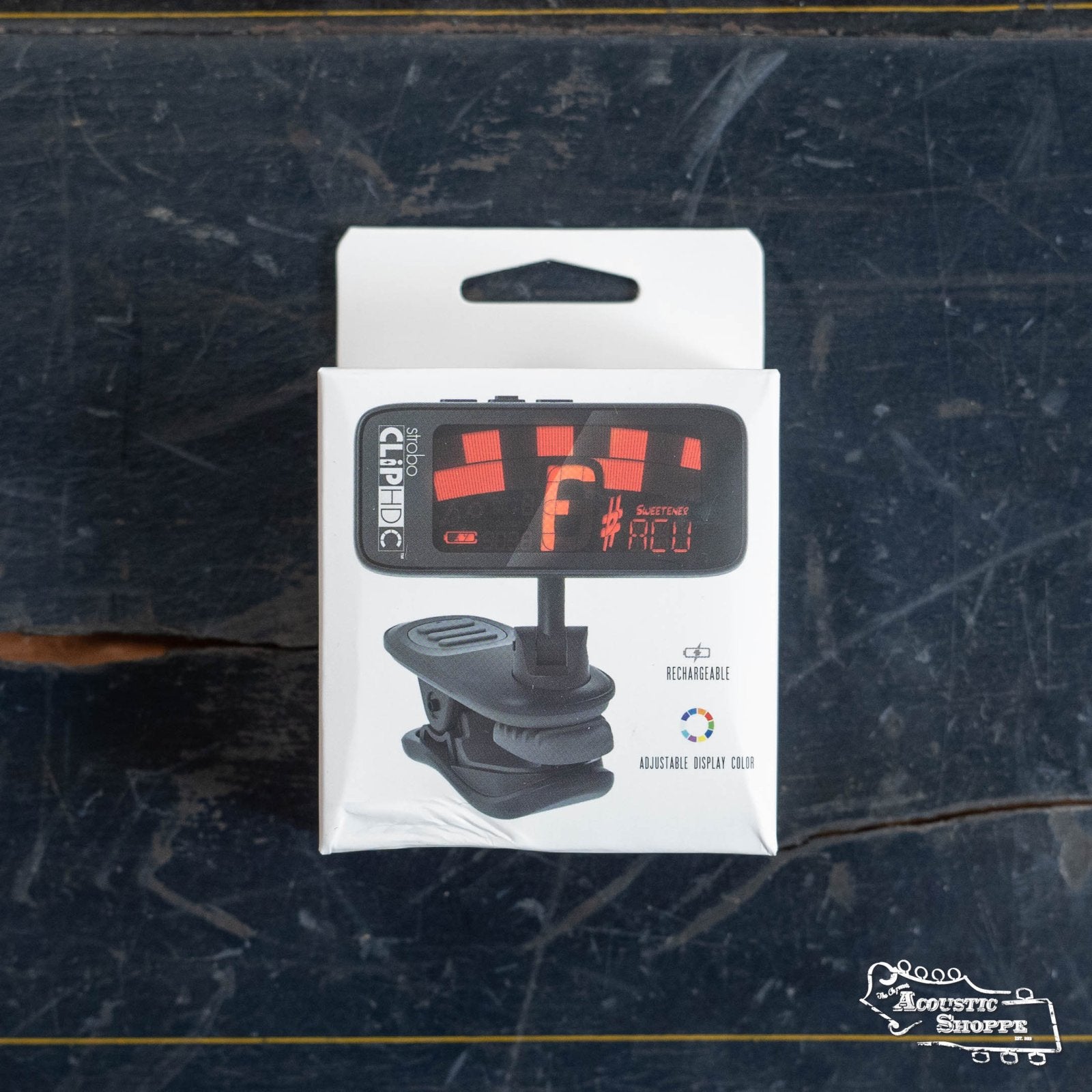
Marcel agrees on the strobe, but his broke, so these days he plays a Snark, the most generic tuner there is, and it's rechargeable now. For a budget clip-on, our favorite is the D'Addario Eclipse: a basic tuner with a big display. Clip-ons of every kind are in our tuner collection.
Two guitar accessories that make a guitar louder
The Dr. Herringbone Tone Traveler plays an instrument's own notes and overtones into it from a tablet, with presets for guitar, mandolin, banjo and the violin family, plus a page where you choose the notes yourself, which helps if you play in an alternate tuning. Older play-in tricks, like a guitar leaned against a subwoofer, push the guitar at frequencies it was never built for. This one is targeted at the instrument, and we use it in the shop on guitars that are close but could be better, left on for a weekend. It makes a difference.
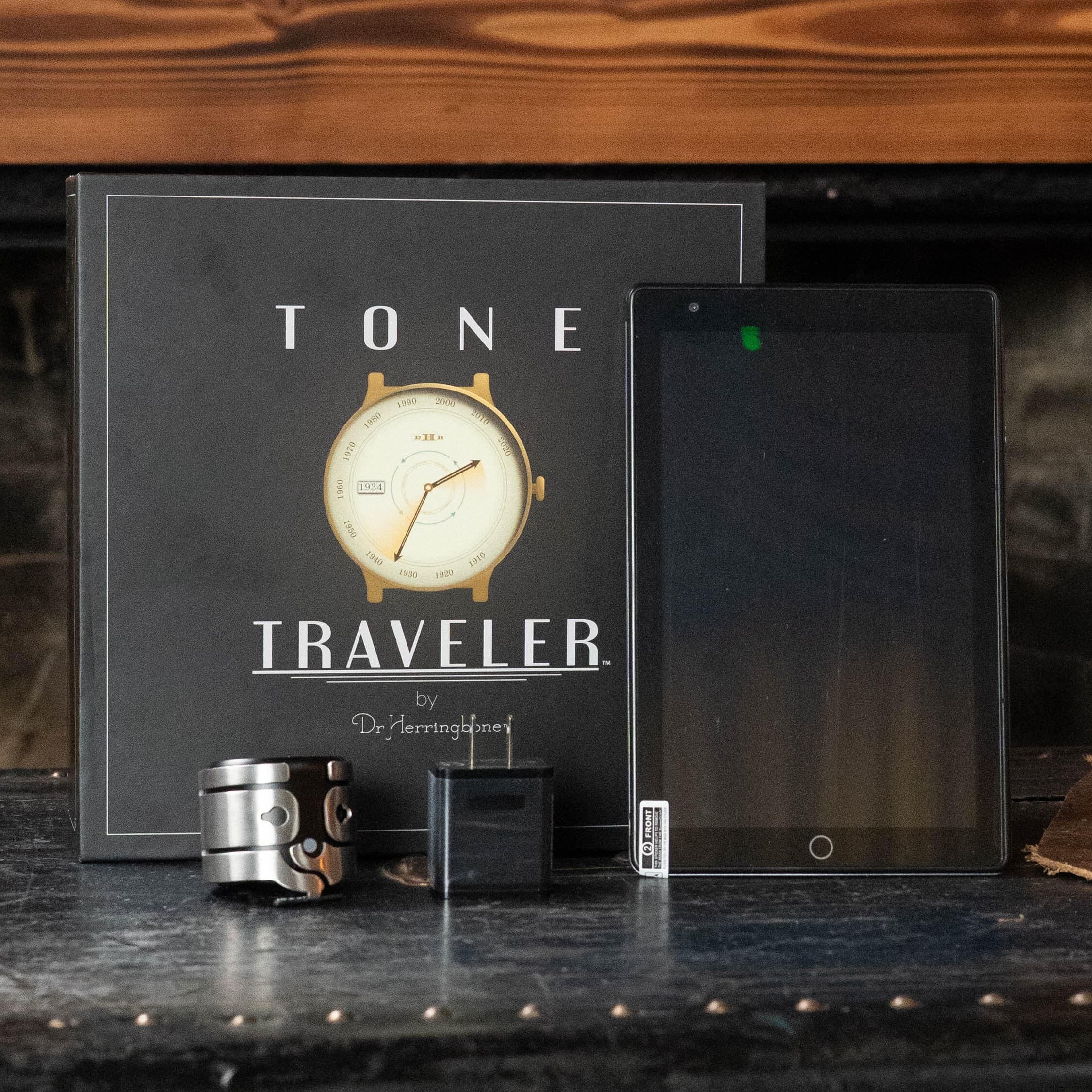
Marcel's catch is a real one: it's loud. You can't work in the same room with it running, and he says he can describe the headache in detail. He ran one on a guitar for about eight hours and recorded the whole time, and the volume rose a lot as it went, with the sound moving from boomy and muddy to clear and bright.
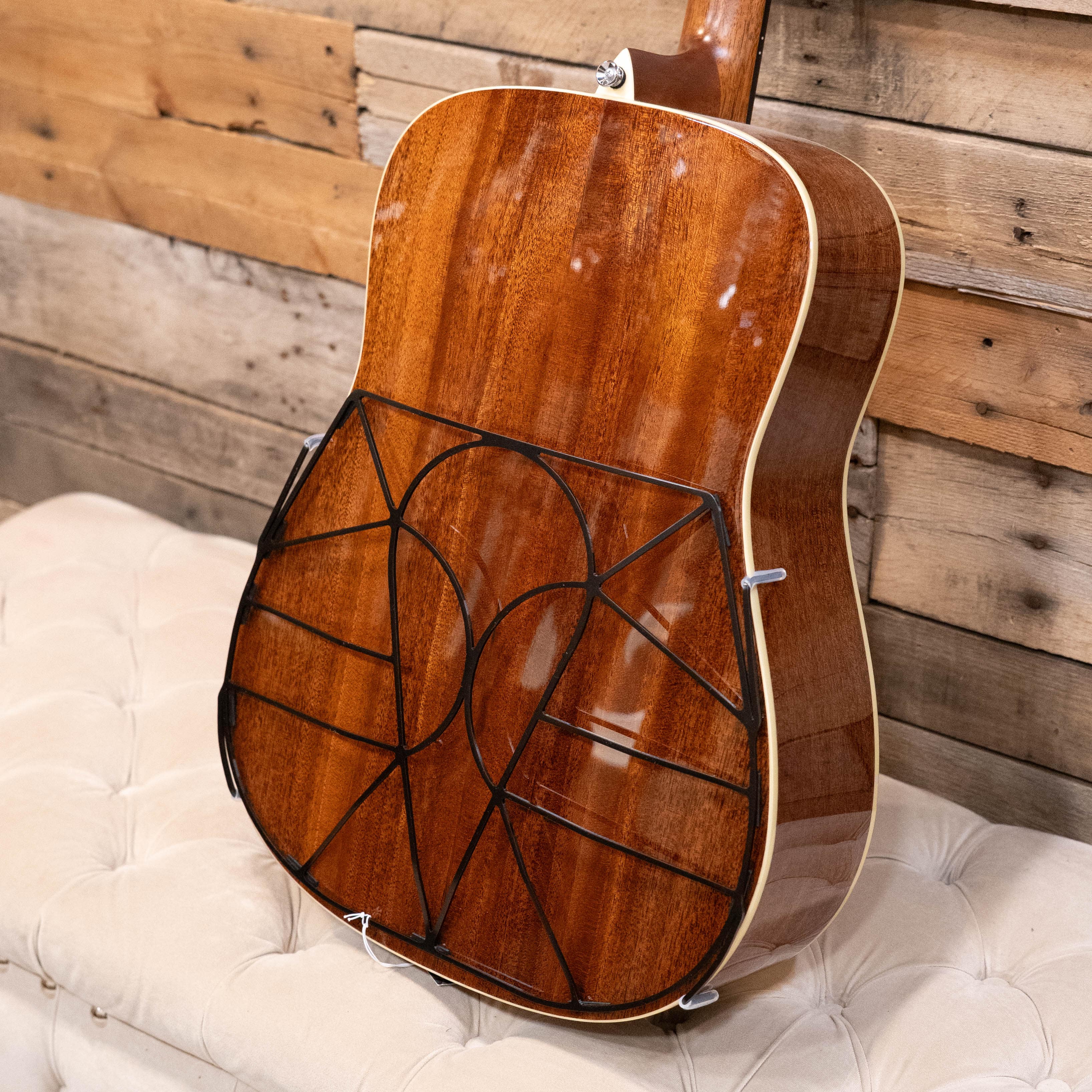
The other guitar accessory is the Tone-Gard D-Gard. Most mandolin players already run one. On a guitar it holds the back away from your body so the back can move, and you can hear what it does before you buy one:
- Hold your guitar tight against your body and play a few chords.
- Hold it so the back sits a couple of inches away from you and play the same chords.
- Listen for the jump in volume and the extra low end and richness.
In a jam, where a guitar gets buried easily, it's a no-brainer for us, and it helps a newer guitar that doesn't have a vintage guitar's presence yet. One honest note: on tour with in-ear monitors, we put one on a 1940 D-18 and the band asked us to take it off because it was so much louder in their ears. It's made for dreadnoughts, and when we tried it on an OM it didn't quite fit. Our Tone-Gard post covers the mandolin and banjo models.
What about a case and a strap?
These two guitar accessories didn't come up in the conversation because nobody argues about needing them. Match the case to the guitar: a well-made gig bag is fine for an entry-level guitar that doesn't get knocked around, and a hardshell case is the call on the road or for an instrument you'd hate to see dinged. For a strap, comfort beats looks. Both are in our case collection and our strap collection.
Related reading
- Tony Rice guitar guide: six Clarence White-style dreadnoughts compared
- Banjo accessories for beginners: Jim Pankey's 10-item case kit
Who should buy which guitar accessories
If you're gigging a lot, buy strings in bulk, a capo you won't leave on a stage, and a tuner you trust in a loud room. If your guitar lives on a stand between jams, coated XS strings and a Tone-Gard will do more for you than anything else on the wall. If you have a guitar that's almost there, a weekend on the Tone Traveler is worth trying before you go looking for a different guitar.
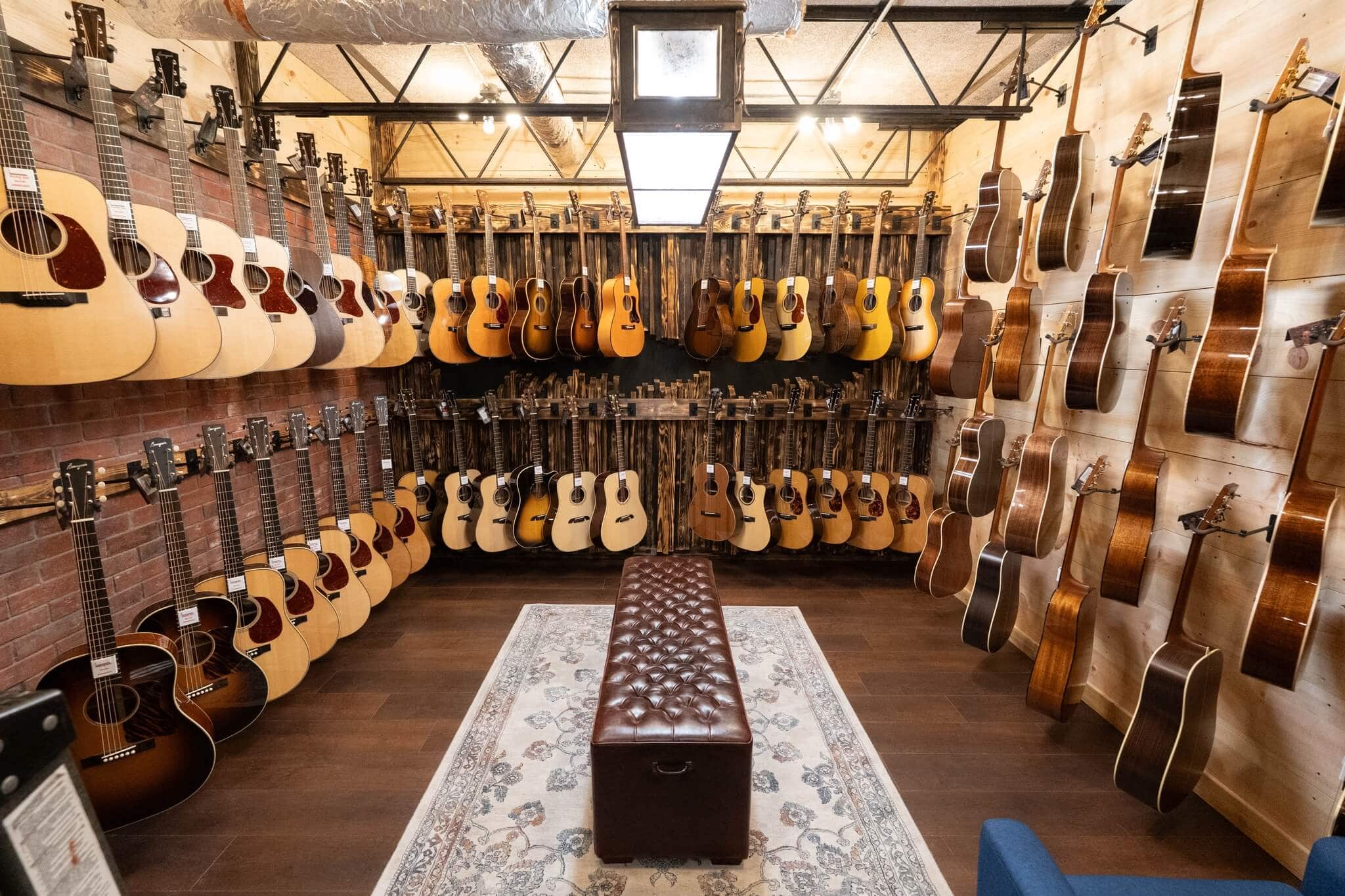
And if you're shopping for the guitar too, every one we sell goes through our 23-Point Professional Inspection before it leaves the shop. Browse our acoustic guitars, or start with the whole guitar accessories collection.