
Table of Contents
- Which Martin D-28 models are there?
- Hear all five D-28 models back to back
- Why no two Martin D-28 models sound alike
- D-28 Satin and Street Legend: the open-sounding way in
- The standard D-28: the sound on the records
- HD-28: what the next $200 buys
- D-28 Authentic: the pre-war build, and the neck that decides it
- Where to stop on the D-28 ladder
- Buying any of the Martin D-28 models from us
"I want a D-28." We hear it all the time, and our first question back is always the same: which one? The Martin D-28 models run from a satin-finish version up to a hide-glue Authentic that cost more than twice as much as the standard guitar when we last had them all in the shop, and on a spec sheet most of them look nearly identical.
The catch is that the D-28 in your head probably isn't the one on the wall. It's whatever D-28 was on the records you grew up with, and Martin has changed the guitar a lot since the 1930s. So we lined up five Martin D-28 models in one room, the Satin, the Street Legend, the standard D-28, the HD-28 and the D-28 Authentic, and worked out who each one is for. They split into four different sounds, and the extra money buys a different era more than a better guitar.
Which Martin D-28 models are there?
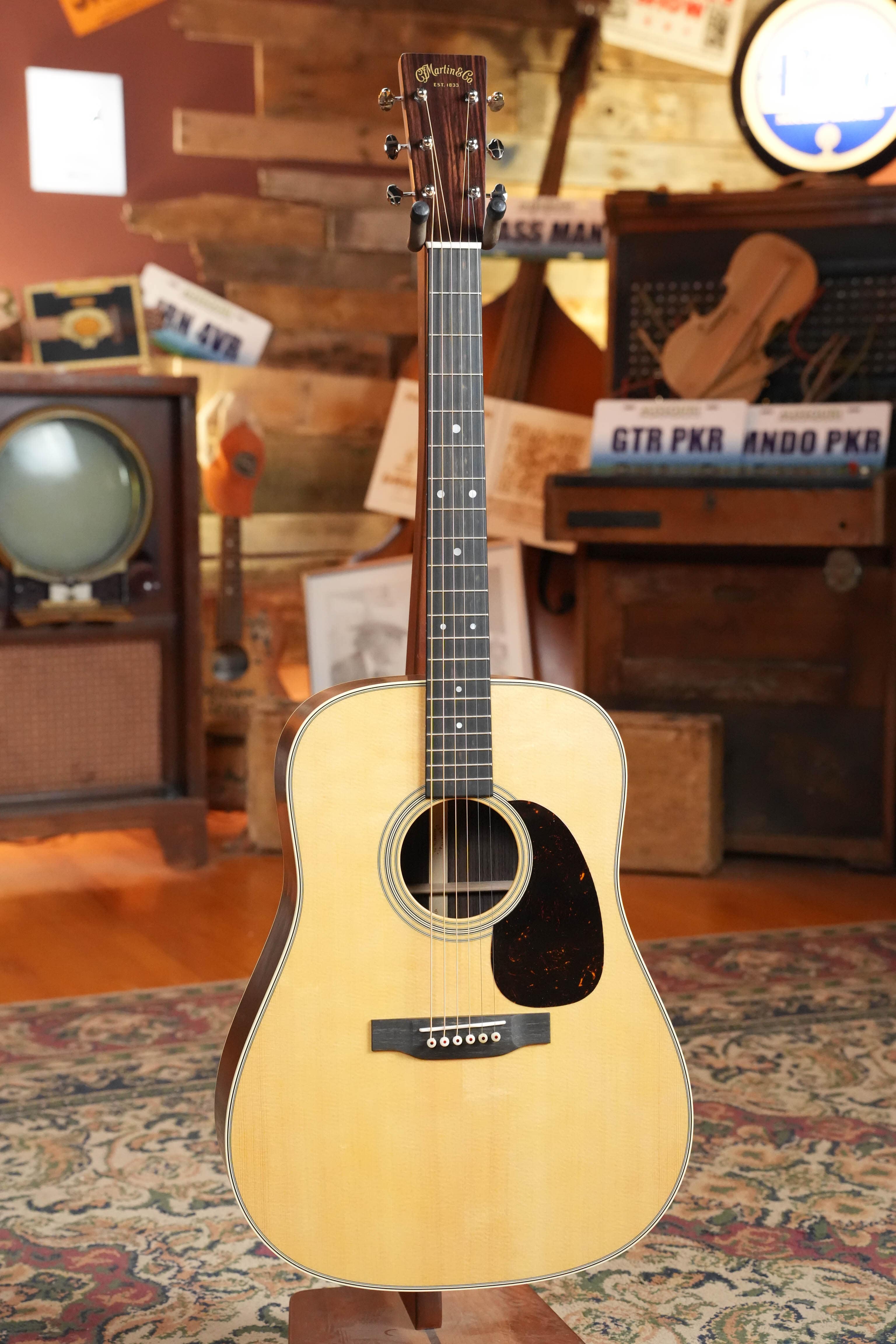
Four of the five Martin D-28 models share their woods: a Sitka spruce top with East Indian rosewood back and sides, a mahogany neck, an ebony fingerboard and bridge, a bone nut and saddle, a 1 3/4" nut and a 25.4" scale. That wider nut gives your fretting hand a little more room between the strings, which you notice on a G run. The Authentic is the odd one out, with an Adirondack spruce top and Guatemalan rosewood back and sides on the 2024 guitar we had. Here's the ladder, with today's prices where we have the guitar listed:
| Model | Price today | What sets it apart |
|---|---|---|
| D-28 Satin | $3,099.99 (sold out) | Satin finish on the body, the most open-sounding of the group |
| D-28 Street Legend | Ask us | Same guitar as the Satin with an aged-look finish on the top |
| D-28 (gloss) | $3,499.99 | Gloss nitro, multi-stripe trim, the post-war D-28 sound |
| HD-28 | $3,699.99 | Herringbone trim, scalloped bracing, the fullest low end |
| D-28 Authentic | Ask us | Pre-war build: hide glue, T-bar neck, vintage gloss, Adirondack braces |
Hear all five D-28 models back to back
Jump to the spec rundown at 0:50, who each guitar is for at 7:22, the drawbacks at 10:10, and the blind play-through at 14:50, where one song moves across all five guitars. You may find that the ugly one is your favorite. The prices you'll hear are from late 2024, so shop by the table above.
Why no two Martin D-28 models sound alike
"Everybody has this picture of what they believe a D-28 sounds like, and it's based on the eras of the music they were listening to."There's a pre-war D-28 sound, a post-war one, and distinct '50s, '60s and '70s sounds, then a more standardized guitar from the '80s into the early 2000s. Most of that change came from the bracing. The earliest D-28s had forward-shifted, scalloped Adirondack braces. Martin moved the braces back around 1939, the scalloping went away in the '40s, the herringbone trim went away around 1946, and by the '70s the guitars were about as heavily built as Martin ever made them. Brazilian rosewood gave way to East Indian rosewood in the late '60s. Our post on the most influential guitars in Martin history covers that bigger story.
Then the Reimagined guitars of 2018 pushed the bracing forward again. In our view that puts today's Martin D-28 models closer to the pre-war sound than new Martins have probably ever been. That's why the model name alone tells you so little. You're really choosing an era.
D-28 Satin and Street Legend: the open-sounding way in
The first step on the ladder is two guitars that sound the same. The Satin and the Street Legend share the same build, and the only difference is cosmetic: the Street Legend adds a pigmented spray over the top to make a new guitar look like an old one.
The satin finish is what gives these two their sound. Satin holds the top back less, so these are the most open-sounding Martin D-28 models in the group, and they fill a room. That openness costs some focus, the same trade-off we hear in satin instruments across the board. If you mostly play on your own and want rosewood D-28 tone for less money, start here.
The honest catch is that the Satin doesn't sound like any of the vintage D-28s. It's its own thing, with less of the focused character you know from records. And the Street Legend's look splits people: some players love it and some can't stand a new guitar dressed up as an old one. It buys you nothing in sound, so only pay for it if you like it.
The standard D-28: the sound on the records
If your idea of a D-28 comes from the '50s through the '90s, the gloss D-28 is the closest match. It has a tighter low end than the HD-28 and isn't quite as full, but the sound is so distinctive that anyone who knows acoustic guitars can name it. That isn't a flaw: plenty of players prefer a more defined, tight low end.
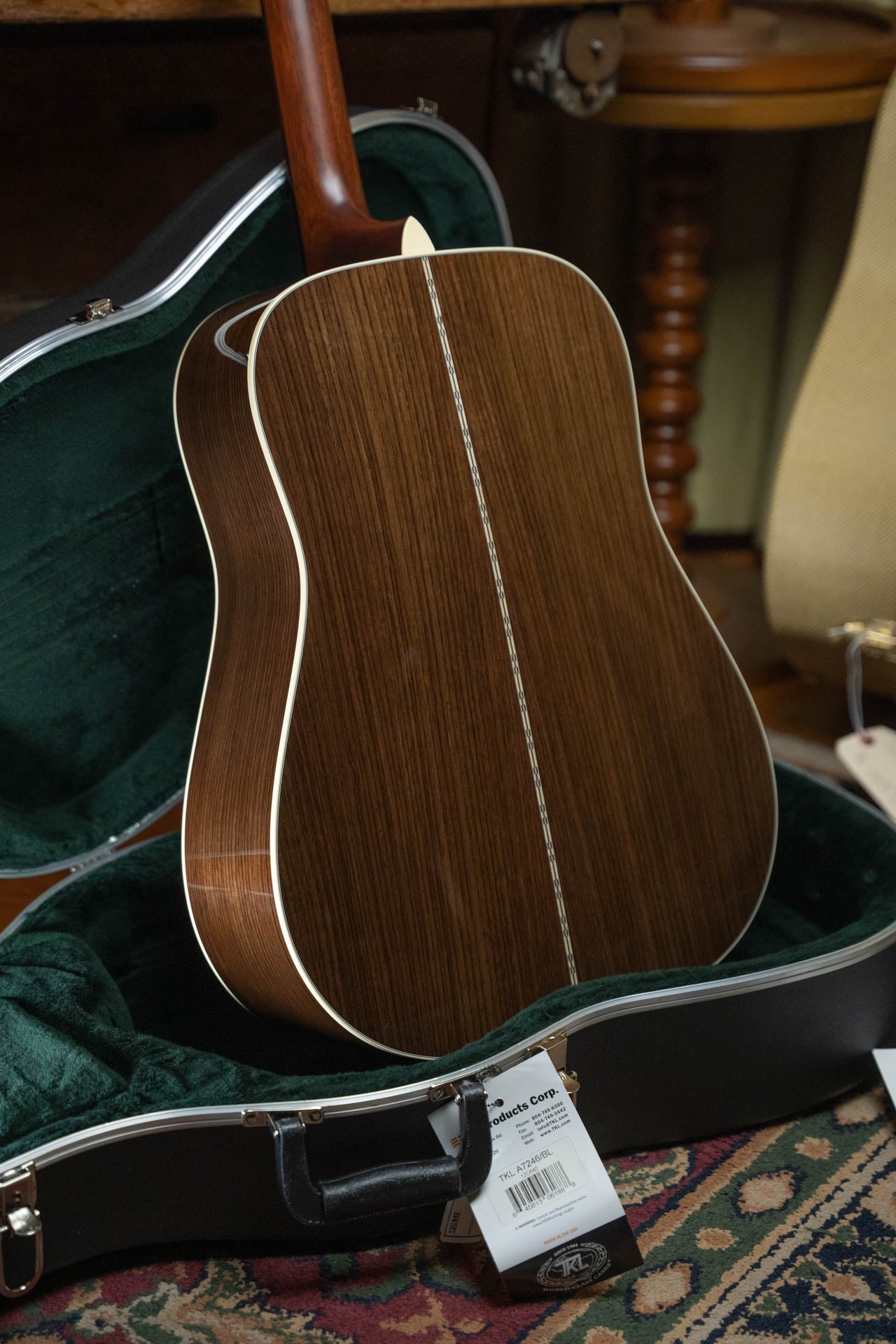
One spec has moved since our 2024 rundown. Back then the Satin, Street Legend and standard D-28 had non-scalloped braces, and that was the main reason the HD-28 sounded bigger. Martin's current spec, as our listings show it for the D-28 Gloss #0231 at $3,499.99 and the D-28 Satin, calls for forward-shifted GE-scalloped bracing, the same brace shape listed for the HD-28. Play the current guitars side by side before you assume the 2024 gap still holds. Every one we have is on our Martin D-28 page.
The D-28 is still the yardstick. When we compare a dreadnought from another builder, the D-28 is what we compare it to:
"We compare other instruments to the D-28. It's a D-28. This is classic Martin guitar."HD-28: what the next $200 buys
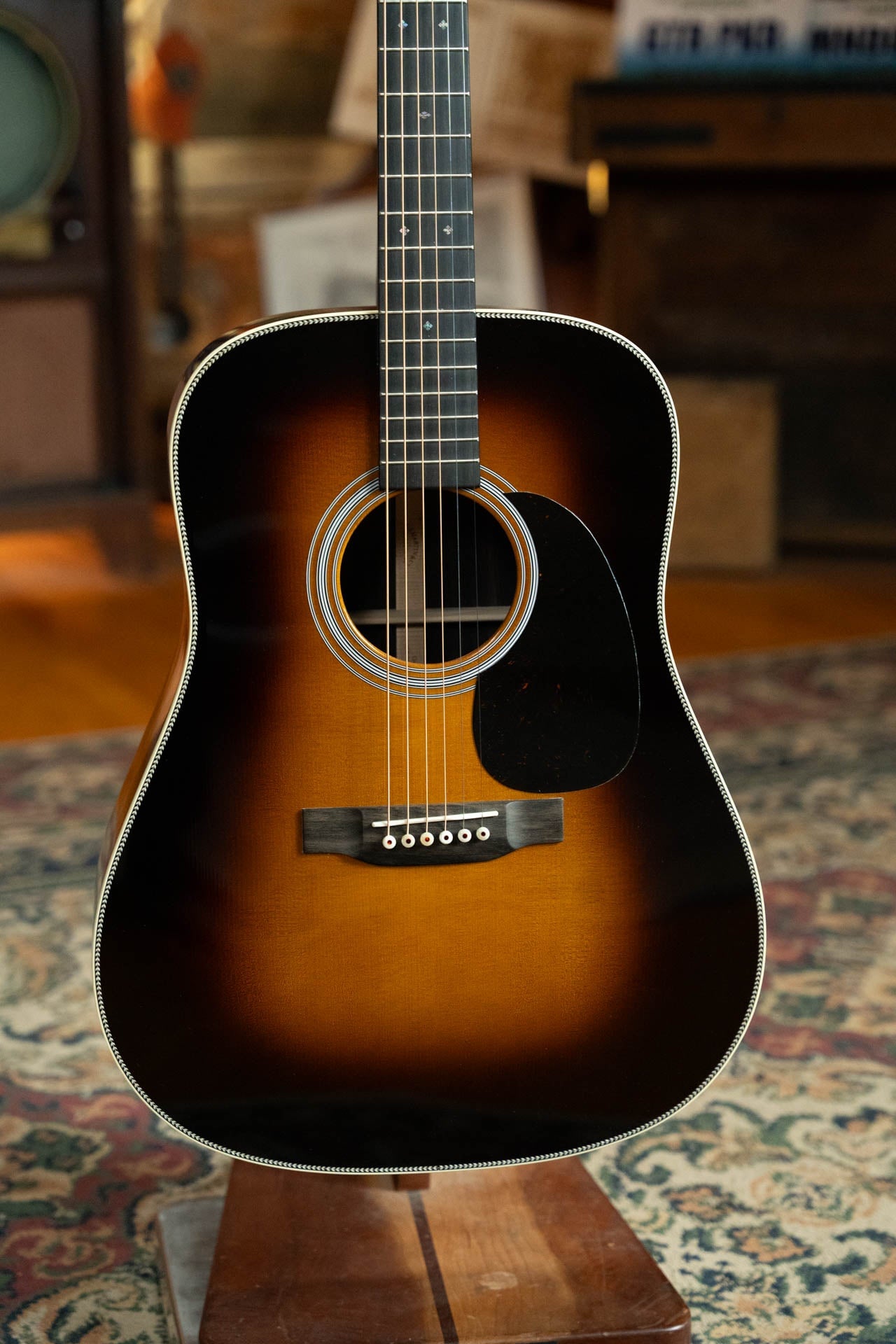
At today's prices the HD-28 is $200 more than the gloss D-28. Martin brought the herringbone trim and scalloped braces back as the HD-28 in the late '70s, and it was the first step back toward the pre-war sound. It has a much fuller bass, a thicker overall tone and more volume, with a rounder sound all the way across. We call it the pro bluegrass guitar:
"That one to me tends to be your pro bluegrass, in-your-face kind of standard guitar."If you flatpick in a band or strum hard and want the guitar to carry, this is the step most players should take. We have an HD-28 Gloss #5397 at $3,699.99, a second HD-28 #7930 at the same price, and an HD-28 1935 Sunburst #5446 at $3,899.99. For the whole two-guitar argument, scores included, read our D-28 vs HD-28 comparison.
D-28 Authentic: the pre-war build, and the neck that decides it
The top of the ladder is a different kind of guitar. The Authentic is Martin's best reproduction of a pre-war D-28, built in a separate area of the factory with different methods: hide glue, a non-adjustable T-bar in the neck, Adirondack braces and a vintage gloss on the body and neck. Martin rebuilt it the way the originals were built, rather than guessing which detail made the sound. It's very pricey, and still far less than a real pre-war guitar, which makes it the clearest way for a younger player who wants that uncompromised sound to get it new. We think of it as Martin's boutique-level guitar.
Tone-wise, one of us really likes the Authentic. The deal breaker is the neck. It's the most different neck profile of the group: easy down low, and beefier the higher you go.
"If you are not comfortable with vintage-style guitars, you will not love that neck."It isn't built for speed, and a capo high up the neck can be a struggle. The T-bar is the other question. Every acoustic will eventually need neck work, and an adjustable rod usually wants a tweak with each big season change. A T-bar moves less than an adjustable rod, so the guitar stays put, but when it does need correcting, the fix is fretboard work at a refret rather than a turn of a wrench. The Aged version of the Authentic, with wear marks worked into it by hand, is a different guitar again, and we've seen enough of them to believe the aging changes the tone. Our D-18 vs D-28 comparison takes up whether the aged Authentic is worth it.
Where to stop on the D-28 ladder
With Martin D-28 models, pick the era first and the price second:
- You want rosewood D-28 tone for the least money and mostly play alone: the Satin. Only buy the Street Legend if you love the look.
- You want the D-28 from the records of the '50s through the '90s: the standard gloss D-28.
- You play bluegrass or need a guitar that carries in a band: the HD-28.
- You want a new pre-war guitar and the vintage neck suits your hand: the Authentic.
Two more D-28 models sit outside our five. The D-28 Modern Deluxe #6278 at $4,599.99 is in stock now, and our Billy Strings D-28 overview covers the signature model. If you're still deciding between Martin's model families, start with our Martin guitar series guide.
Buying any of the Martin D-28 models from us
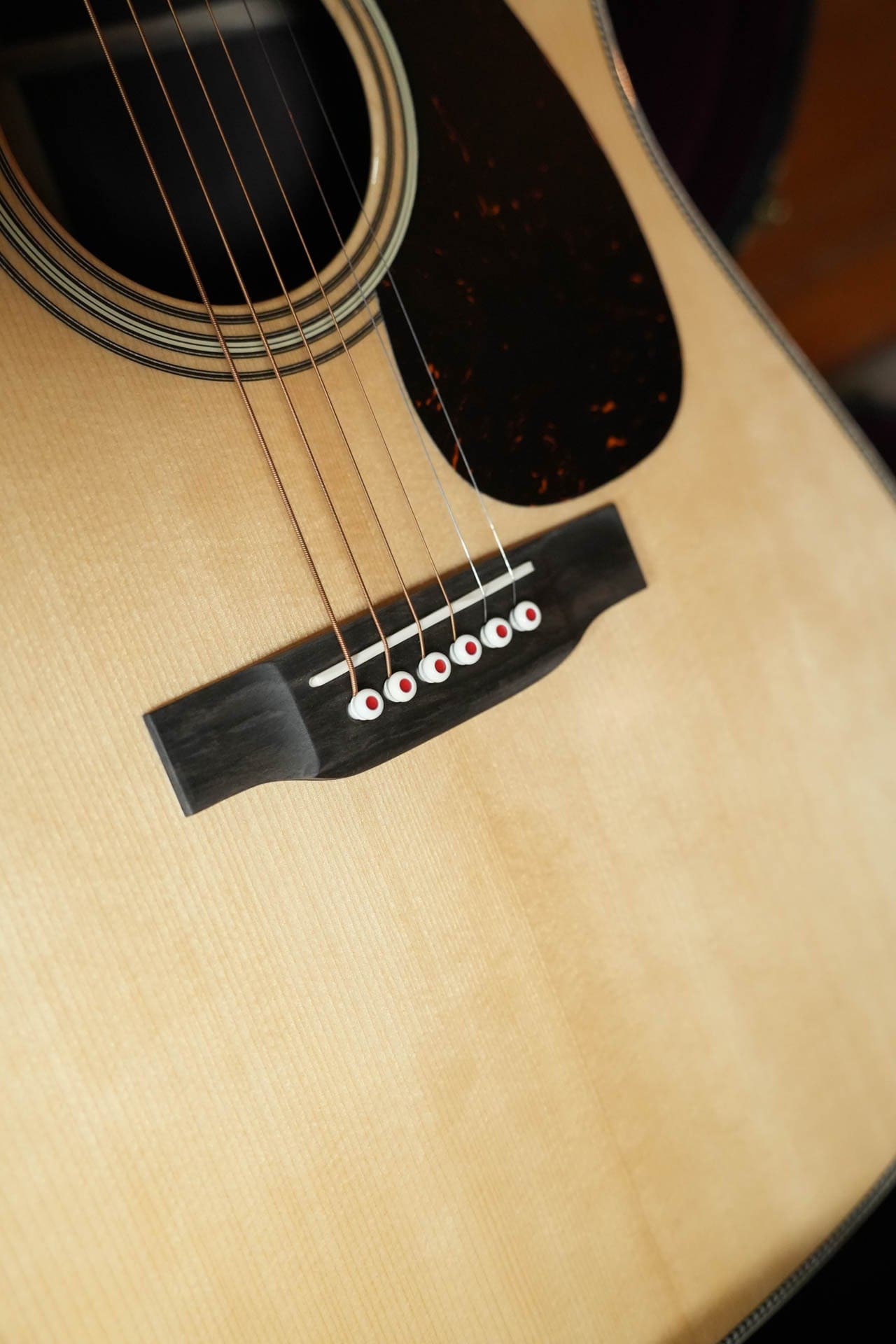
Every guitar we ship goes through our 23-Point Professional Inspection first, so our own bench checks the guitar before it reaches you.
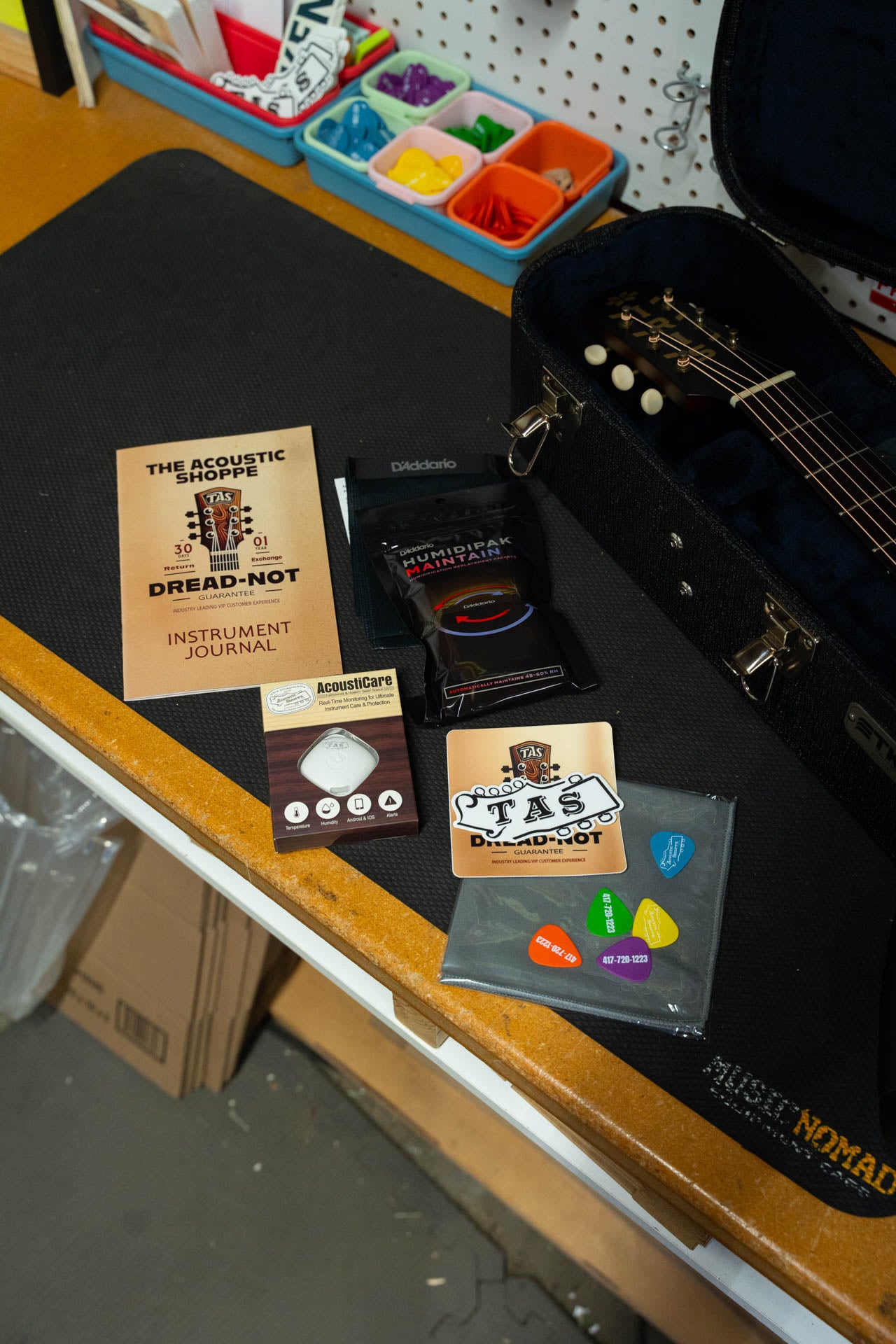
Every D-28 here is well over $1,000, so each one comes with the Dread-Not Guarantee: a full year to trade it in for up to 90% of the pre-tax purchase price in credit, less round-trip shipping, plus a 30-day in-home trial. If you pick the Satin and find a year later that you wanted the HD-28's low end, that credit is how you move up the ladder.
Not set on a Martin? See every dreadnought we stock, all of our Martins, or every acoustic guitar in stock. For a Street Legend or an Authentic, ask us about ordering one.
Related reading
- Brazilian vs Indian rosewood: can you hear it blind?
- Mahogany vs rosewood: which guitar wood is better?
- Inside the Martin guitar factory
If you only remember one thing about Martin D-28 models, make it this: decide which decade's D-28 you're hearing in your head, then buy the one built that way. For most bluegrass players that's the HD-28. For the records of the '60s and '70s it's the standard D-28, and for a pre-war sound with a neck to match, it's the Authentic.